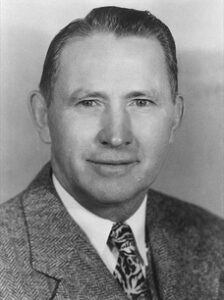
Forrest Clare “Phog” Allen
(November 18, 1885 – September 16, 1974)
Phog Allen lettered in college baseball and basketball, the latter under James Naismith, the inventor of the game.
He was an American basketball coach and physician. Known as the “Father of Basketball Coaching,”
Coach Allen served as the head basketball couch at Baker University (1905–1908), the University of Kansas (1907–1909, 1919–1956), Haskell Institute—now Haskell Indian Nations University (1908–1909), and Warrensburg Teachers College—now the University of Central Missouri (1912–1919), compiling a career college basketball head coaching record of 746–264. In his 39 seasons at the helm of the Kansas Jayhawks men’s basketball program, his teams won 24 conference championships and three national titles.
The basketball arena at Kansas is called Allen fieldhouse, named as a tribute to his coaching.
The Helms Athletic Foundation retroactively recognized Allen’s 1921–22 and 1922–23 Kansas teams as national champions. Allen’s 1951–52 squad won the 1952 NCAA tournament and his Jayhawks were runners-up in the NCAA Tournament in 1940 and 1953. His 590 wins are the second most of any coach in the history of the storied Kansas basketball program.
Allen attended the University of Kansas, having already acquired the nickname “Phog” for the distinctive foghorn voice he had as a baseball umpire. At KU, Allen was a member of Phi Kappa Psi fraternity.
Allen served as the head football coach at Warrensburg Teachers College from 1912 to 1917 and at Kansas for one season in 1920, amassing a career college football head coaching record of 34–19–3. He also coached baseball at Kansas for two seasons, in 1941 and 1942, tallying a mark of 6–17–1, and was the university’s athletic director from 1919 to 1937.
Allen was inducted into the Naismith Memorial Basketball Hall of Fame with the inaugural class of 1959. he home basketball arena the University of Kansas, Allen Fieldhouse, was named in his honor when it opened in 1955. His final season at Kansas was the first full season the Jayhawks played at Allen Fieldhouse.
Early life
Allen was born in the town of Jamesport, Missouri. His father, William Allen, was among the 30 people who originally incorporated Jameson, Missouri in 1879 and the doctor who delivered Allen lived in James. However, he had strong ties to Jamesport where he was town clerk, collector, and constable. His family later moved to Independence, Missouri.
James Naismith, the man who created basketball, coached Allen from 1905 to 1907 at the University of Kansas in Lawrence. Allen spent his last two years on school (1907–09) as the team’s coach. Naismith inspired Phog Allen to pursue a medical degree as well. After two years of coaching, Allen took a three-year break to complete his degree at Kansas City’s Central College of Osteopathy (now Kansas City University College of Osteopathic Medicine). After graduating from medical school, Allen integrated numerous concepts of healthy eating, efficient exercise regimens, and proper body alignment into his coaching. A section on sports medicine was included in his book, My Basket-Ball Bible. Among the many elite athletes he treated at his downtown office at 13 E. 8th St. was Mickey Mantle
In order to grasp the roots of basketball and how they have grown into the players and the game in the year 2026, one must understand who coached Phog and who Phog coached during his lifetime.
The roots of his coaching grew deep and they are alive and active today. You must see how he spread the game Doctor Naismith invented.
…. … … he began classes at the University of Kansas in 1904, where he lettered three years in basketball under James Naismith’s coaching, and two years in baseball.
Unlike his time as a coach, the Jayhawks struggled on the court. In his three seasons as a player, the team only had one winning season. He was a player for the team for the Jayhawks’ first games in their rivalries against Kansas State and Missouri. In 1905 he also played for the Kansas City
Athletic Club
- Nat Holman (“Mr. Basketball”): Regarded as the best all-around player, known for his elite shooting, passing, and floor leadership with the Original Celtics.
- Bennie Borgmann: One of the greatest scorers of his generation,, capturing numerous scoring titles in various leagues.
- Dutch Dehnert: A standout with the Original Celtics, recognized for pioneering the pivot play and exceptional defensive skills.
- Joe Lapchick: Renowned as one of the best centers of the era and a key member of the dominant Celtics team.
- Paul Endacott: A star at the University of Kansas, named Helms Foundation Player of the Year in 1923.
- Chuck “Tarzan” Cooper: A dominant center in the 1920s professional circuit.
- Harry “The Horse” Leonard: Known as a top defensive specialist and scorer.
- Vern Corbin: A standout college player for Cal, earning All-America honors in 1928.
Until the 1930 ‘s film/video/ the game of basketball wasn’t available. Sound recordings were limited. Below is believed to be the first complete basketball game on film.
Prior to 1930, everything we know was passed on by personal voice of those that lived it, audio recordings, limited short visual video/film clips,
We also have the writings. Unfortunately, the death of the aging generation of early basketball has eliminated the word of mouth.
But by the 1940′ we start to see a decent amount of film on teaching and of the actual games
Below we get into a little thought the thirty’s … …
There were a limited number of surviving films/videos of the game of basketball from 1982 beyond the 20’s. The video with female playes is believed to be the earliest surviving footage in 1909. Notice rims with nets.
We have mostly only photographs to see what the game of basketball looked like. until 1940.
There are quite a few surviving audio clips about basketball during the early 20th century. They are difficult to obtain.
The earliest known film/video of a complete basketball game is from a doubleheader at Madison Square Garden in 1939. See this film footage of the first profession game being recorded on film below.
Between 1939 – 45 , during the World War II period, there were a many teams and leagues that continued to play. However, most were semi-pro positions and regional-ocal in nature.
Many young men who would be in their prime basketball years, were off fighting in a World War overseas.
1939 – 45
- Bobby McDermott: A standout guard in the NBL, he was arguably the most famous and dominant player in the first half of the 1940s, winning multiple MVP awards.
- Joe Fulks: A prolific scorer for the Philadelphia Warriors, he was the top scorer in the BAA (precursor to the NBA) during the late 40s.
The First NBA Championship
While the NBA as the world knows it today did not come into fruition until the 1949-50 season, its first official season is considered to be the 1946-47 season. That year marked the formation and inaugural season of the Basketball Association of America (BAA), which merged with the National Basketball League (NBL) in the 1949-50 season to become the NBA as we know it today.
The league, and the game of basketball itself, was at a remarkably different place during its early days than it is today. The 1940s, therefore, saw a version of the game and league almost unrecognizable from today.
However, just because the era was different does not render its legitimacy worthless. The era came before the emergence of superstars, but there were still plenty of elite players during the game’s early days. The following are the five greatest players of the 1940s, the league’s inaugural decade.
1947
The First NBA Championship
The league (NBA) began in the late 1946. The majority of players who played basketball during that decade continued their career into the 1950s.
Around 5,000 unique individuals have played at least one game in the NBA, with recent figures suggesting the number is closer to 5,000 as of late 2024/2025, though exact counts vary slightly depending on the source and cutoff date, with some sources citing over 4,800 or even 5,000+ players.
General Estimate: The consensus is roughly 5,000 players have suited up in the NBA.
Recent Data: As of late 2024, one source noted 4,898 players.
Historical Perspective: Over 5,000 players have played in the NBA throughout its history, with many playing just a few games
.