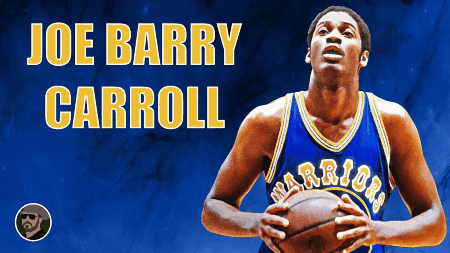
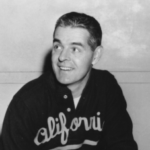
Joe Barry Carroll Reads

Joe Barry Carroll Read Books Before Every Game

1980-81 Number 1 NBA Draft Pick

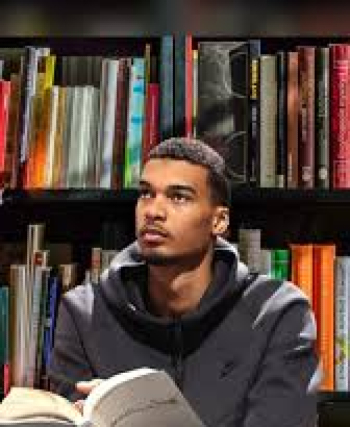
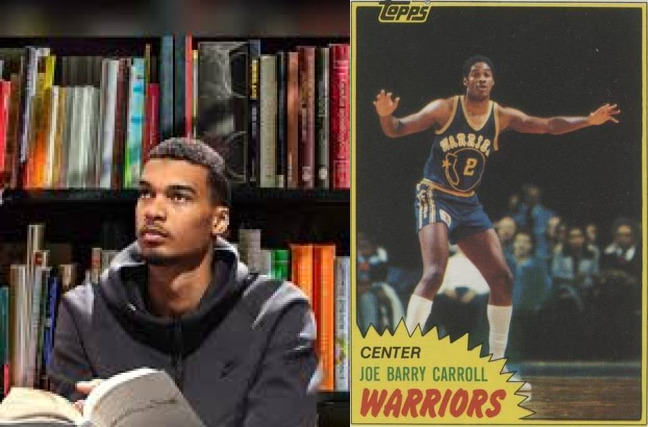
Victor Wembanyama reads books too, …

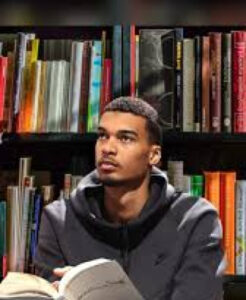
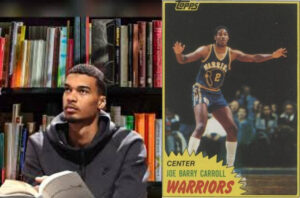
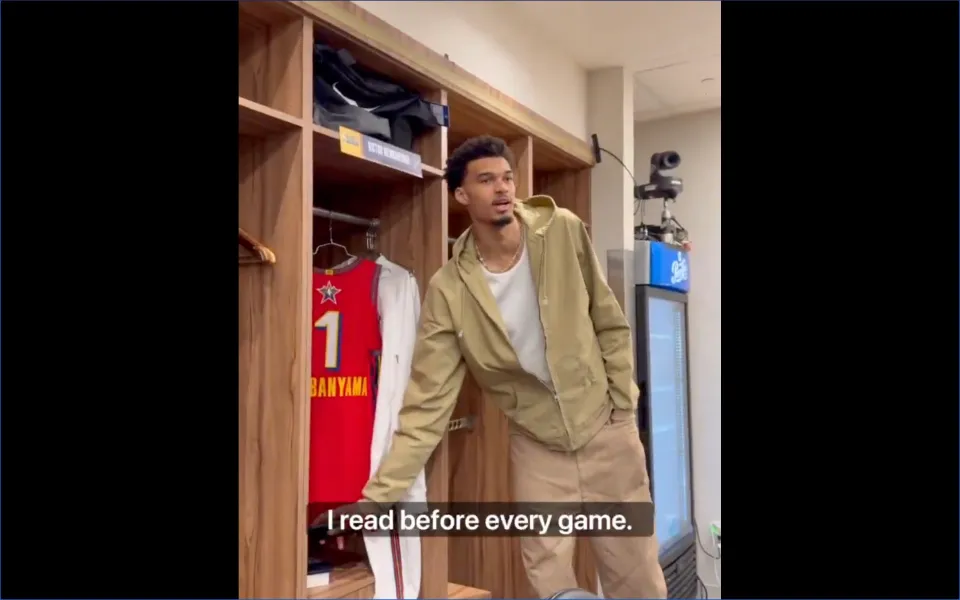
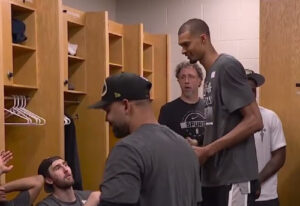
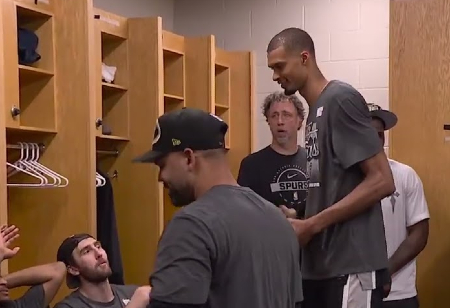
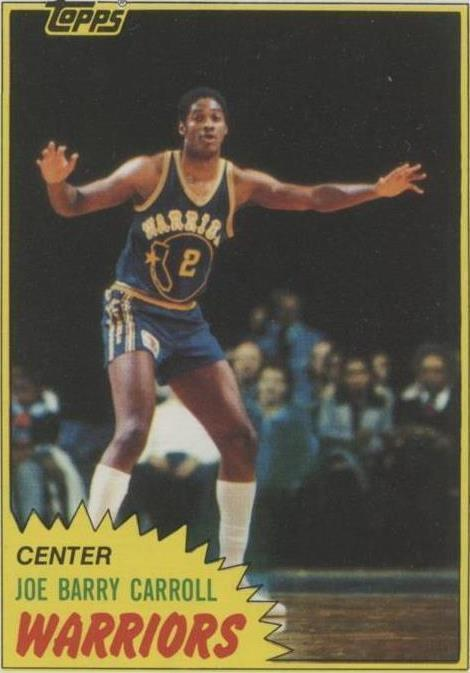
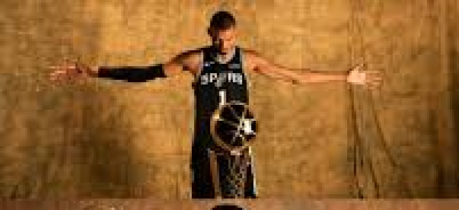
Victor Wembanyama stated that he reads before every game. ( See above photo.  Victor is not the only 7 foot center number one (#1) overall NBA draft pick to read books in the locker room, Joe Barry Carroll, the 1980 number one (#1) overall draft selection of the Golden State Warriors read books furiously throughout all of his career in the locker room and on travel trips.  It is a good habit that will someday pay off.

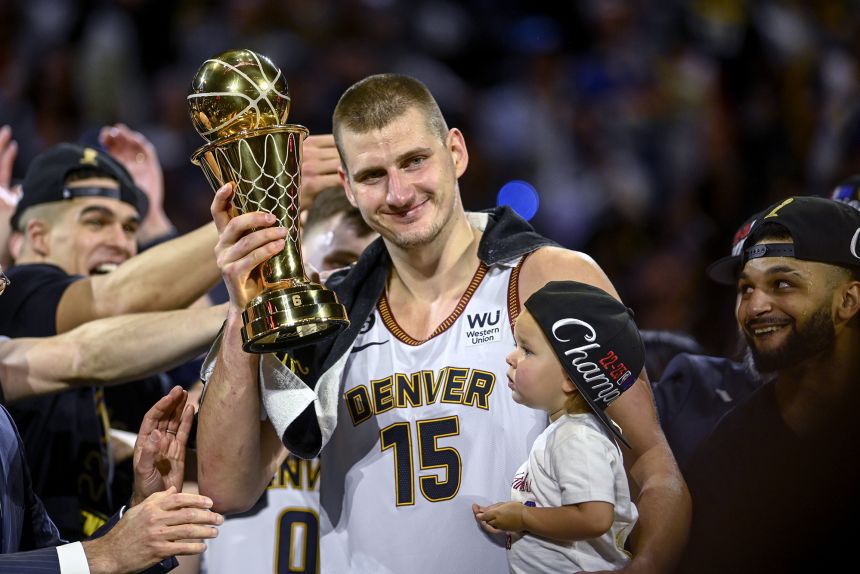
Victor Wembanyama is well-known for his pregame ritual of reading books in the locker room. This habit famously caught the attention of Nikola Jokić, who laughed in disbelief upon discovering that the young superstar read books just before games

Maybe, Nikola Jokic should ask Denver citizen, Joe Barry Carrol to barrow a few of his financial books that help him build tremendous wealth, and be a top financial advisor. 

As the sying goes: “You can buy them books, but some people ‘eat’ the pages”.

Title: The Big Man With His Nose In A Book


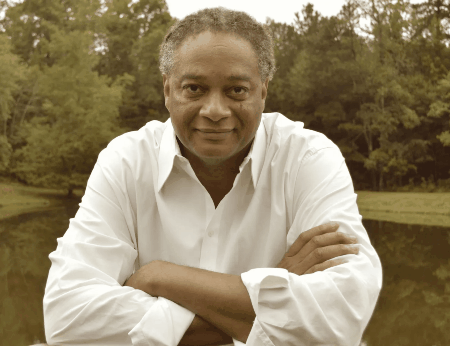
In the summer of 1979 on the campus of Purdue University Joe Barry Carroll ran me over on the basketball court like a freight train at top speed hitting a car.  He and everyone watching were quite shocked that someone would even attempt to take a charge on a 7-footer during a summer pick-up game.  In those days, we were taught,  it was not the size of the man which determined his right to freely drive and dribble the basketball to the basket.  It was my natural reaction to get in front of Joe Barry. 

The real concern of the coaches watching that scrimmage was that Joe Barry, who was already an All-American college center, was set to go as the number one NBA pick after the season.  He was worth a fortune. I, on the other hand, was simply a prospective college-student athlete. 

Joe Barry hadn’t yet cashed in on the basketball player’s monetary value and the only thing that could stop him from a lucrative future as a professional basketball player was injury.  Little did anyone know at that time, nothing was going to stop Joe Barry Carroll from have a financially lucrative future, with or without the game of basketball.

I later learned from his NBA teammates that Joe Barry was not only preparing for a lucrative playing career, he was preparing his mind to excel in the world of investments and finance.

Joe Barry was always reading.  Teammates said he would constantly be reading books, magazines, newspapers and anything about the world of investment and money.  In the locker room and on road trips Joe Barry had his books nearby.  He was always a soft spoken person and an intellectual man who did not often indulge in idle locker room conversations.  He would sit at his locker before games and read until the moment it was time to go to work as a basketball player.  

In those days, life securing player salaries were rare, even for a number one NBA draft pick.  He knew his true long term value was in knowledge.  Nevertheless, he knew his value on the basketball court as well.  He was not going to be under valued or underpaid as a player.

After four years in the NBA, it came time to renegotiate his contract.  The Golden State Warriors were not willing to meet Joe Barry’s well researched and determined financial demands.  So, Joe Barry Carroll went to Milan Italy to play basketball for a year.  After his season in Italy, the Warriors brought him back under contract.  His financial research of his value proved correct.  He spent another six years in the NBA as an elite center. 

Joe Barry Carroll always knew his mind was worth more than his body.  He cashed in on both.  He became wealthy and knowledgeable about the world of money and investment.  He spent his post career quietly building organizations that helped better people and their lives.

Joe Barry & Victor Read Books

Joe Barry Carroll Attends Purdue

After high school, Carroll moved on to play college basketball at Purdue University. Under head coach Fred Schaus, he helped lead the Boilermakers to a 20–8 record. In Carroll’s first national televised appearance, against Indiana, he scored 12 points, had 6 rebounds and 3 blocks in 20 minutes coming off the bench in an 86–76 win. On December 10, 1977, vs. Arizona he recorded the school’s only triple-double with 16 points, 16 rebounds and a single-game school record 11 blocks. He also set a McKale Center single-game arena record that stood until February 2000.[2] He recorded 206 rebounds and averaged 7.4 a game in his first season, the most for a Purdue freshman. Carroll also holds the freshman record for most blocks in a season with 82.

1977–78

Carroll set school records with 105 blocks on the season and averaged 3.9 blocks per game as a sophomore. With senior Walter Jordan, he helped lead the team to a 16–11 record and a fourth-place finish in conference play.

Head coach Fred Schaus stepped down in 1978 and was replaced by Lee Rose. Playing with a slowed down, controlled system compared to Schaus’ fast-pace style, Carroll and senior point guard Jerry Sichting led Purdue to a first place Big Ten tie with an Earvin Johnson-led Michigan State. Not receiving the favor of the two teams to advance to the NCAA Tournament, Carroll led Purdue to the NIT Finals his junior year, losing to in-state rivals, Indiana. He averaged 22.8 points a game on the season and was named First Team All-Big Ten and a Third Team All-America, while leading the Boilers to a 27–8 record. He grabbed a school record 352 rebounds on the season.

1979–80

During his senior year, he led the Boilermakers to an NCAA Final Four appearance, losing to UCLA in the semi-finals. They won the consolation game against Iowa, where Carroll scored a game-high 35 points in his last game as a Boilermaker. Leading Purdue to a 23–10 record on the season, he was named a First Team All-American and a second straight First Team All-Big Ten selection. He played 1,235 minutes on the season, the most by any player in school history.

Joe Barry Carrol – The NBA Number 1 Draft Selection

Golden State Warriors

1980–1981

Carroll was selected by the Golden State Warriors with the first overall pick of the 1980 NBA draft. The Warriors traded Robert Parish and the draft choice used to select Kevin McHale to the Boston Celtics for the first overall pick used to select Carroll.[3] Golden State’s decision to part with two future hall-of-famers, who would both go on to win multiple NBA Finals with Boston, would affect public perception of Carroll throughout his career.[4] He averaged 18.9 points and 9.3 rebounds as a rookie, and also scored a season high of 46 points and led the Warriors with 121 blocks during the season while being named an NBA All-Rookie First Team selection.

1981–1984

Two seasons later, he averaged a career high 24.1 points to go along with 8.7 rebounds. On March 5, 1983, he scored a career-best 52 points against the Utah Jazz.[5]

Carroll’s tenure with the Warriors was tumultuous, and he was criticized for a lack of effort, even being nicknamed “Joe Barely Cares” and “Just Barely Carroll.”[6][7] To the surprise of many, Carroll left the Warriors in 1984 to play in Italy[8] for Simac Milano. With Simac Milano, he won the Italian League Championship, was selected to the All-League team,[9] and won the FIBA Korać Cup.

1985–1987

He returned to the NBA for the 1985–86 season and averaged 21.2 points for two consecutive seasons under head coach George Karl. On February 1, 1987, Carroll scored 43 points and grabbed 24 rebounds in a 150-147 four-overtime victory against the New Jersey Nets.[10] He was later named to the 1987 NBA All-Star Game, where he scored 4 points and had 6 rebounds in 18 minutes. Carroll played in his first playoff game against the Utah Jazz in the 1987 NBA Playoffs. Carroll helped lead the team past the Jazz and to the Western Conference Semifinals, where despite him averaging 20 points, 4.8 rebounds and 1.6 blocks,[11] Golden State lost to the eventual champion Los Angeles Lakers.

Carroll is a top ten career franchise leader in defensive rebounds (3rd), offensive rebounds (4th), points per game (8th), total points (9th) and steals (9th). He scored at least 1,000 points in each of his seasons as a Warrior. He left Golden State as the franchise leader in blocks with 837, which is currently the second most behind Adonal Foyle‘s 1,090 from 1997 to 2007.[citation needed]

Houston Rockets

1987–1988

After his last full season with the Warriors in 1986–87, his production began to decline. In December 1987, he was traded with Sleepy Floyd to the Houston Rockets for Ralph Sampson and Steve Harris to play under head coach Bill Fitch. Carroll averaged just 12.7 points during that season, after averaging 20 or more in the previous four. He helped lead the Rockets to an NBA Playoff appearance, where the team lost to the Dallas Mavericks in the first round.

Later career

1988–1991

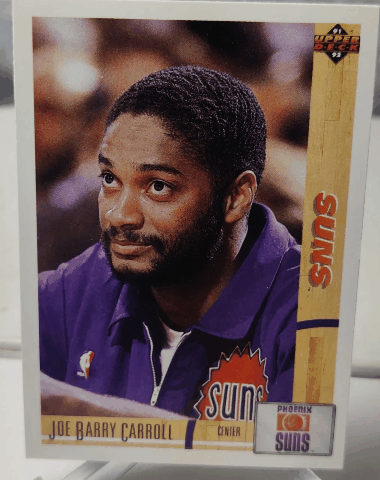
Carroll was traded to the New Jersey Nets for the 1988–89 season alongside Lester Conner for Tony BrownLorenzo RomarTim McCormick and Frank Johnson. In New Jersey, Carroll averaged 14.1 points a game and shot 80 percent from the free throw line. He was traded in the middle of the 1989–90 season to the Denver Nuggets for Michael Cutright on February 21, 1990, where he averaged 10 points a game and appeared in the first round of the 1990 NBA Playoffs, losing to the San Antonio Spurs. Joe Barry Carroll played his last NBA season for the Phoenix Suns. Only playing in 11 games and averaging 3.4 points, he shot a career high .917 from the line.

Career notes

Carroll retired from the NBA in 1991. He ended his career with totals of 12,455 points and 5,404 rebounds, topping 20+ points a game in scoring for 4 seasons. He appeared in 19 playoff games, where he averaged 27 minutes, 5 rebounds and 13.7 points per game.

Over his career, he averaged 17.7 points, 7.7 rebounds, 1.8 assists, 1 steal, 1.6 blocks per game, with a .474 field goal and .747 free throw percentage in 705 games. He averaged 32 minutes of playing time per game.

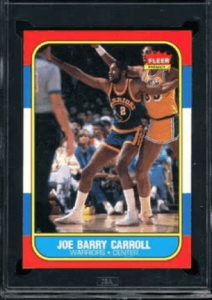
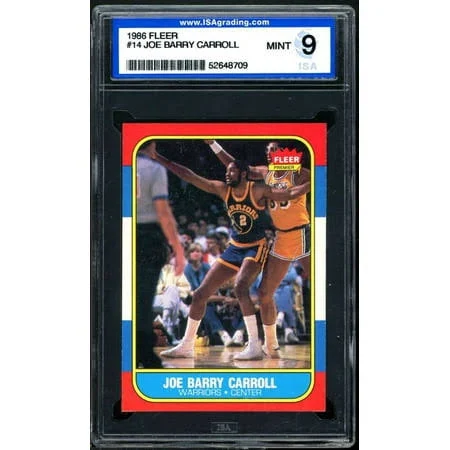
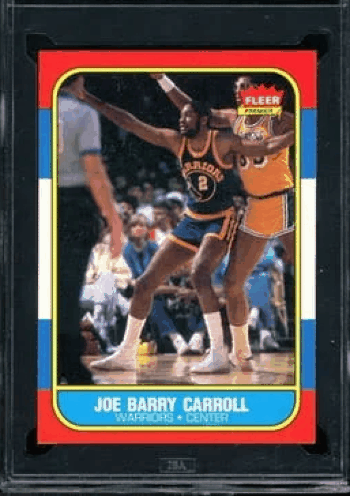
45 years later, 2026, Joe Barry Carroll still hold Sports Memorabilia Value: His rookie cards:

https://fathatcollectibles.com/product/joe-barry-carroll-trading-card-1981-82-topps/

https://fathatcollectibles.com/product/joe-barry-carroll-1986-fleer-trading-card/

 the life and professional trajectory of basketball star Joe Barry Carroll, particularly his time at Purdue University and his career as the 1980 first overall draft pick. The text highlights his unique intellectual habits, such as reading books in the locker room, a ritual he shares with modern star Victor Wembanyama. Despite facing public criticism for his perceived lack of effort, the sources detail Carroll’s statistical dominance and his strategic decision to play in Italy during a contract dispute. Beyond his athletic achievements, the narrative emphasizes his transition into a successful financial advisor and his commitment to lifelong learning. The site also serves as a broader hub for NBA history, featuring memorabilia, legendary player profiles, and speculative future playoff coverage.

How did Joe Barry Carroll’s locker room reading habits shape his career?

Compare Carroll’s journey to Victor Wembanyama and the 2026 NBA landscape.

Tell me about Carroll’s decision to play in Italy and its outcome.

Today • 4:21 PM

How did Joe Barry Carroll’s locker room reading habits shape his career?

Joe Barry Carroll’s habit of reading in the locker room was central to his identity as an “intellectual athlete” and significantly shaped both his professional basketball decisions and his successful post-career life. Rather than engaging in typical locker room banter, Carroll spent his time before games and during road trips “furiously” reading books, magazines, and newspapers focused on investment, finance, and the world of money.

His reading habits shaped his career in the following ways:

  • Financial Independence and Contract Negotiations: Carroll understood that his long-term value lay in knowledge rather than just his physical ability. He used his extensive financial research to determine his own market value. When the Golden State Warriors refused to meet his “well researched and determined financial demands” after four years in the league, Carroll’s financial literacy gave him the confidence to leave the NBA and play in Milan, Italy, for a year. His research was ultimately vindicated when the Warriors eventually brought him back under a new contract.
  • Shaping Public Perception: His intellectual nature and tendency to keep to himself in the locker room contributed to a “tumultuous” tenure with the Warriors. Critics who may not have understood his focus on life outside of basketball labeled him with nicknames like “Joe Barely Cares” and “Just Barely Carroll,” citing a perceived lack of effort.
  • Post-Career Success: Carroll’s dedication to reading was a form of preparation for life after sports. Because he “prepared his mind to excel,” he was able to build tremendous wealth and transition into a career as a top financial advisor. He eventually used the wealth and knowledge he gained to build organizations aimed at helping others.

Ultimately, Carroll believed his mind was worth more than his body, and his locker room reading habit allowed him to successfully “cash in on both”. His legacy as a reading big man is often compared to modern stars like Victor Wembanyama, who also maintains a pregame reading ritual.

What happened during his season playing in Milan, Italy?

How does his reading habit compare to Victor Wembanyama’s?

Tell me more about Carroll’s transition to financial advisor.

How does his reading habit compare to Victor Wembanyama’s?

Joe Barry Carroll and Victor Wembanyama share a striking number of similarities in their reading habits, both being 7-foot centers and number one overall NBA draft picks who utilized the locker room as a space for intellectual growth.

The comparison between the two players highlights several key parallels and distinctions:

  • Shared Ritual and Timing: Both players established a consistent pregame ritual of reading in the locker room. Carroll is described as reading “furiously” throughout his entire career, not only before games but also during travel trips. Similarly, Wembanyama has stated that he makes it a point to read before every game.
  • Atypical Locker Room Behavior: Their habits set them apart from the traditional NBA culture. Carroll was known as a soft-spoken intellectual who avoided “idle locker room conversations” to focus on his books until the moment he had to “go to work” on the court. Wembanyama’s habit is also seen as unique; it famously drew a reaction from Nikola Jokić, who laughed in disbelief when he discovered the young star reading just before tip-off.
  • Focus on Specific Knowledge: While the sources focus on Wembanyama’s habit as a disciplined ritual, they provide specific detail on the content of Carroll’s reading. Carroll used his time to study investments, finance, and the world of money through books, magazines, and newspapers. He viewed his mind as being worth more than his body and used this knowledge to determine his own market value during contract disputes and to eventually become a top financial advisor.
  • The “Pay Off”: The sources suggest that Wembanyama’s reading is a “good habit” that will likely yield benefits in the future, much like it did for Carroll. In Carroll’s case, this intellectual dedication allowed him to build tremendous wealth and transition into a successful post-basketball career building organizations to help others.

Ultimately, while both men used reading to prepare their minds for the game, Carroll’s habit was specifically tailored toward financial literacy and long-term independence, a path the sources suggest modern players like Wembanyama (or even Jokić) could learn from.

What kind of post-career organizations did Carroll build?

How did Carroll’s time playing in Italy affect his legacy?

Why did Nikola Jokić react that way to Wembanyama’s reading?

Tell me more about Carroll’s transition to financial advisor.

Joe Barry Carroll’s transition into his second career was a deliberate process that began long before his retirement from the NBA in 1991. His journey from an elite center to a top financial advisor was rooted in his belief that his intellectual capacity was more valuable than his physical talent.

His transition is characterized by three key elements:

  • Long-term Intellectual Preparation: Throughout his playing career, Carroll was known by teammates for “furiously” reading books, newspapers, and magazines specifically focused on the world of investment and money. He used his time in the locker room and on road trips to prepare his mind to excel in finance, recognizing that player salaries at the time were not always “life securing”.
  • Professional Status in Denver: Following his 11-year NBA career, Carroll successfully applied the knowledge he had gathered. He became a wealthy and highly regarded financial advisor, currently residing and practicing in Denver. His success in this field was so notable that the sources suggest even modern stars like Nikola Jokić could benefit from Carroll’s financial insights and books.
  • Focus on Philanthropy and Impact: Carroll did not just seek personal wealth; he used the success from his financial career to build organizations aimed at bettering people and their lives. He managed this transition “quietly,” maintaining the same soft-spoken and intellectual demeanor he was known for during his time in the league.

By the time he retired, Carroll had “cashed in” on both his body as a professional athlete and his mind as a financial expert, fulfilling his goal of ensuring a lucrative future regardless of the game of basketball.

What kind of organizations did Carroll build to help people?

How did his season in Italy impact his financial path?

What records did Carroll set during his time at Purdue?

What records did Carroll set during his time at Purdue?

During his collegiate career at Purdue University, Joe Barry Carroll established several school and arena records across his four seasons:

Freshman Records

During his first season at Purdue, Carroll set multiple benchmarks for newcomers:

  • Rebounds: He recorded 206 rebounds and averaged 7.4 per game, both of which were the most ever for a Purdue freshman.
  • Blocks: He set the freshman record for the most blocks in a single season with 82.

Sophomore and Single-Game Records

In the 1977–78 season, Carroll continued to dominate defensively:

  • Single-Game Blocks: On December 10, 1977, against Arizona, he set a single-game school record with 11 blocks.
  • Triple-Double: That same game against Arizona (16 points, 16 rebounds, 11 blocks) remains the only triple-double in Purdue school history.
  • Arena Record: His performance in that game also set a McKale Center single-game arena record that stood for over 22 years, until February 2000.
  • Season Blocks: He set a school record with 105 blocks during his sophomore season, averaging 3.9 per game.

Junior and Senior Records

As he transitioned into an All-American center, he set records for both volume and endurance:

  • Season Rebounds: During his junior year, he grabbed a school record 352 rebounds in a single season.
  • Minutes Played: In his senior year (1979–80), Carroll played 1,235 minutes, which was the most by any player in school history at that time.

These accomplishments helped lead the Boilermakers to significant post-season success, including an NIT Finals appearance in his junior year and an NCAA Final Four appearance during his senior year.

Tell me about his triple-double game against Arizona.

How did Purdue perform in the 1980 Final Four?

What other Purdue freshman records did Carroll set?

Was Joe Barry Carroll a seven foot NBA first round number 1 draft selection

Yes, Joe Barry Carroll was a 7-foot center and the number one (#1) overall selection in the first round of the 1980 NBA Draft,,,.

He was selected by the Golden State Warriors, who acquired the top pick from the Boston Celtics in a trade involving Robert Parish and Kevin McHale,. The sources highlight that Carroll, along with modern star Victor Wembanyama, represents a rare group of 7-foot centers who were drafted first overall and were known for their habit of reading books in the locker room,. While he was widely recognized for his physical stature as a 7-footer, Carroll famously believed his mind was worth more than his body, using his time in the league to prepare for a successful second career in finance
 

Doctor Cricket Dunkenstein

Stories & Basketball Teaching Tips With:  “Doctor Cricket Dunkenstein”

Podcast

Podcast

All Available Podcast

Billy ‘D’ Joins Spurs Podcast: The Wembanyama-Spurs Future Is Set Podcast The Jazz Man Ferdinand Lewis Alcindor Podcast: Joomla and Wembanyama Online Central Podcast – For Love of The Game Podcast Bobby Knight The Recruiter Podcast Jabbar The Jazz Man Podcast – The Apollo XIII Mission and Spurs NBA Finals Disaster Podcast – The Texas Rodeo Road Trip Joe Barry & Victor Read Books Podcast Podcast – Big Brown & Carter Bryant Athletic Rarity Podcast Doc’s Zen Basketball Reports Podcast From The Beginning AA Form A1 Podcast: 2026 NBA Finals – Game 2: – ‘Put the Lime In The Coconut’ – A Zen Basketball Scouting Report – Copy Podcast: 2026 NBA Finals – Game 4: – ‘The Dark side of the Moon’ – A Zen Basketball Report Podcast – New York Knick-a-BOXERs- Victimhood Podcast- Zen Basketball Scouting Report: 2026 NBA Finals – Comfortable Numb Podcast- Game 2 Zen Basketball Scouting Report: 2026 NBA Finals Podcast- Spike Lee Knicks Trash Talkin’ King Podcast – Wemby’s Magical Mirror To The Legends of Basketball Podcast – Zenyatta Athletic Rarity Podcast: 2026 NBA Finals Game 1- Race Horse Carter Podcast: 2026 NBA Western Conference  Playoffs / Game 7 Podcast Pop & The Spurs The NY Knickerbockers in the 2026 NBA Finals – Podcast 2026 NBA Western Conference  Playoffs / Podcast WCF- Game 5 2026 NBA Western Conference  Playoffs / Podcast WCF- Game 4 2026 NBA Western Conference  Playoffs / Podcast WCF- Game 3 Wemby’s Pursuit of A Championship 2026 Podcast

PODCAST

Basketball Stars and Stories New NBA Players

Nikola Jokic – No I Played In Serbia

New NBA Players

Karl-Anthony Towns

New NBA Players

Jalen Brunson

New NBA Players

Shai Gilgeous-Alexander

New NBA Players

Cooper Flagg: The Baby Boy With A Man’s Game

New NBA Players

Hugo The Teenage Hustler

New NBA Players

Paulo Bonchero

Basketball Stars and Stories New NBA Players

Steph Curry

New NBA Players

NBA Draft Selections 2021-26

New NBA Players

Luka Dončić

New NBA Players

Victor Wembanyama Wikipedia

Wembanyama Online.com

Scroll To The Top