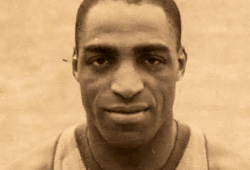
Tarzan Cooper: A legendary center for the New York Renaissance (Rens) in the 1930s and 40s
The best basketball players of the 1920s were headlined by Nat Holman, regarded as the era’s premier all-around player and a star for the Original Celtics, alongside prolific scorer Bennie Borgmann. Other dominant figures included defensive specialists Dutch Dehnert and Joe Lapchick, plus college standouts like Paul Endacott.
Key Players of the 1920s:
Nat Holman (“Mr. Basketball”): Regarded as the best all-around player, known for his elite shooting, passing, and floor leadership with the Original Celtics.
Bennie Borgmann: One of the greatest scorers of his generation,, capturing numerous scoring titles in various leagues.
Dutch Dehnert: A standout with the Original Celtics, recognized for pioneering the pivot play and exceptional defensive skills.
Joe Lapchick: Renowned as one of the best centers of the era and a key member of the dominant Celtics team.
Paul Endacott: A star at the University of Kansas, named Helms Foundation Player of the Year in 1923.
Vern Corbin: A standout college player for Cal, earning All-America honors in 1928.
These players established the foundation for professional basketball, with many playing for the touring Original Celtics, which dominated the era’s basketball landscape
A good understanding of how professional basketball teams operated and made money in the 1910 to 1930 time period can be found in a review of the N.Y. Celtics, no relationship to the Boston Celtics.
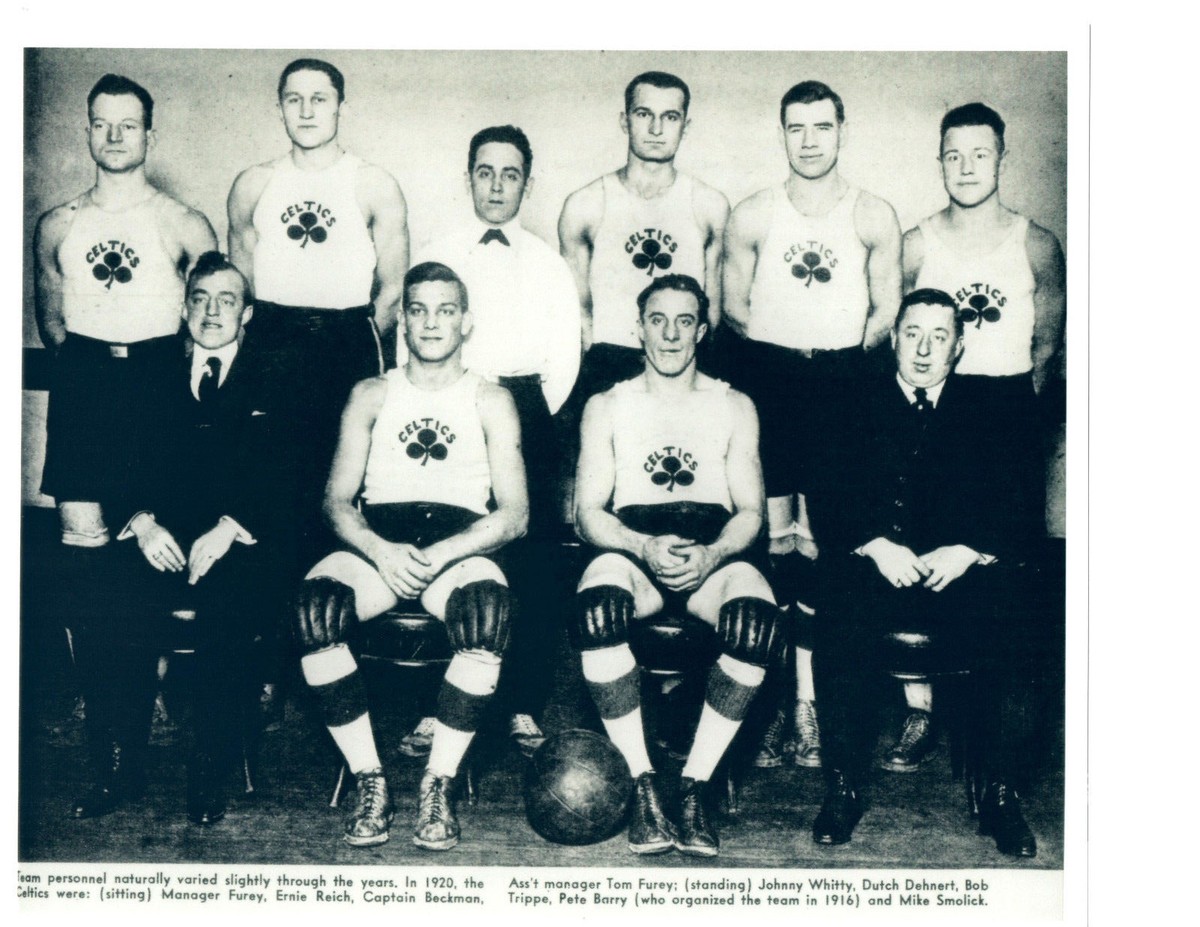
The Original N.Y Celtics in were a barnstorming professional American basketball team. At various times in their existence, the team played in the American Basketball League, the Eastern Basketball League and the Metropolitan Basketball League. ………………… The N.Y. Celtic’s roots lay in the New York Celtics team that disbanded during World War I. In 1918, James Furey assembled his own team around a nucleus of those truly “original” Celtics, adding other players mostly from the West Side of New York City, and defiantly called his new squad the Original Celtics.
Initially, they played in various struggling professional leagues, before becoming primarily a touring squad, which traveled up to 150,000 miles a year while completing a 150–200 game schedule. They won about ninety percent of their games and finished 1922–23 with the unbelievable record of 193–11–1.
The team’s first dominant players were “Dutch” Dehnert, a 6 ft 1 in (1.85 m) standing guard who some credit with introducing the modern concept of pivot play. and Nate Holman.
… … … the team took over the Atlantic City franchise when it was 4–7 and won five of six games before the Eastern League folded in January, 1923.
…………..
They also competed in the Metropolitan League but dropped out of the league during the 1st half after going 12–0.
Other outstanding individual players on these squads were “big man”, Joe Lapchick; John Beckman, George “Horse” Haggerty; John “Pete” Barry; and speedy Davey Banks.
1925–1930: ABL Dominates
American Basketball League owners proclaimed league success during the League meeting inthe summer of 1926.
But ABL directors banned the league from playing games against the N.Y. Celtics, drying up some of their most lucrative exhibition dates.
The Celtics joined the newly organized National Basketball League. The new league operated solely in and around the metropolitan New York City, but despite its geographical limitations was stocked with some of the best players in the country. After pulling off a coup by signing the Original Celtics, the NBL brashly raided ABL rosters for additional players.
————T
Top stars of this era were: Rody Cooney, Teddy Kearns and Bob Grody, George Preston Marshall, Elmer Ripley and Tillie Voss.
Notable players: Rusty Saunders, Ray Kennedy and George Glasco, Cookie Cunningham Gil Ely., George Artus, Tom Barlow, Stretch Meehan, Soup Campbell, and Chickie Passon, Benny Borgmann, Honey Russell,
The Celtics easily disposed of the weakened Cleveland team in three straight games to take the ABL championship.
The rival leagues ABL and NBL fought each other for the best players and teams
in order to stay in business.
In 1926, the American Basketball League, the ABL, exercised their dominance and took control of professional East Coast – Mid West Basketball.
In 1929 everything changed in the entire world, game attendance plummeted and, further deflated by the Great Depression, the ABL folded after the 1931 season.
New York Celtics Video/Film footage 1929
1939 – 45
Bobby McDermott: A standout guard in the NBL, he was arguably the most famous and dominant player in the first half of the 1940s, winning multiple MVP awards.
Joe Fulks: A prolific scorer for the Philadelphia Warriors, he was the top scorer in the BAA (precursor to the NBA) during the late 40s.
The best basketball players of the 1920s were headlined by Nat Holman, regarded as the era’s premier all-around player and a star for the Original Celtics, alongside prolific scorer Bennie Borgmann. Other dominant figures included defensive specialists Dutch Dehnert and Joe Lapchick, plus college standouts like Paul Endacott.
Key Players of the 1920s:
Nat Holman (“Mr. Basketball”): Regarded as the best all-around player, known for his elite shooting, passing, and floor leadership with the Original Celtics.
Bennie Borgmann: One of the greatest scorers of his generation,, capturing numerous scoring titles in various leagues.
Dutch Dehnert: A standout with the Original Celtics, recognized for pioneering the pivot play and exceptional defensive skills.
Joe Lapchick: Renowned as one of the best centers of the era and a key member of the dominant Celtics team.
Paul Endacott: A star at the University of Kansas, named Helms Foundation Player of the Year in 1923.
Vern Corbin: A standout college player for Cal, earning All-America honors in 1928.
These players established the foundation for professional basketball, with many playing for the touring Original Celtics, which dominated the era’s basketball landscape
Between 1930- 45 the depression and WW II did not help professional basketball expand. Nevertheless, The War did amazingly help the game grow globally as hundreds of thousands of internationally stationed military men played basketball in numerous countries 1941 until today.
This period saw basketball have a global popularity boom as the local populations began to enjoy watching and especially playing the game of basketball.
Until the 1930 ‘s film/video/ the game of basketball wasn’t available. Sound recordings were limited. Below is believed to be the first complete basketball game on film.
Prior to 1930, everything we know was passed on by personal voice of those that lived it, audio recordings, limited short visual video/film clips,
We also have the writings. Unfortunately, the death of the aging generation of early basketball has eliminated the word of mouth.
But by the 1940′ we start to see a decent amount of film on teaching and of the actual games
Below we get into a little thought the thirty’s … …
Around 5,000 unique individuals have played at least one game in the NBA, with recent figures suggesting the number is closer to 5,000 as of late 2024/2025, though exact counts vary slightly depending on the source and cutoff date, with some sources citing over 4,800 or even 5,000+ players. General Estimate: The consensus is roughly 5,000 players have suited up in the NBA.
Recent Data: As of late 2024, one source noted 4,898 players. Historical Perspective: Over 5,000 players have played in the NBA throughout its history, with many playing just a few games