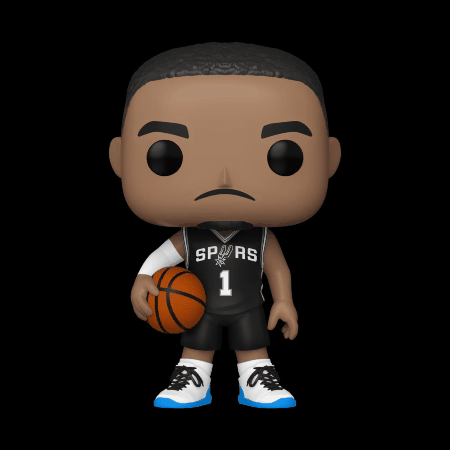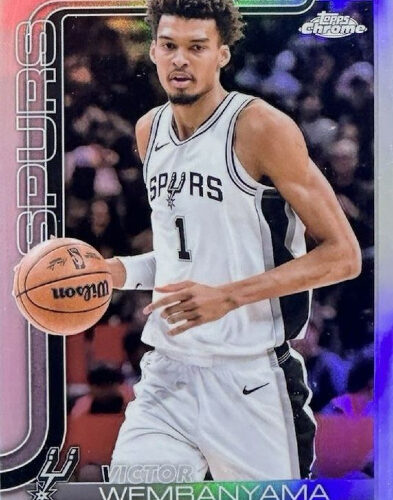
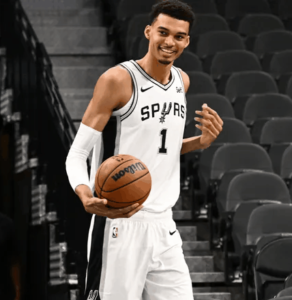
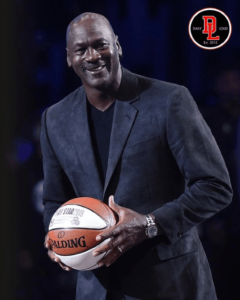
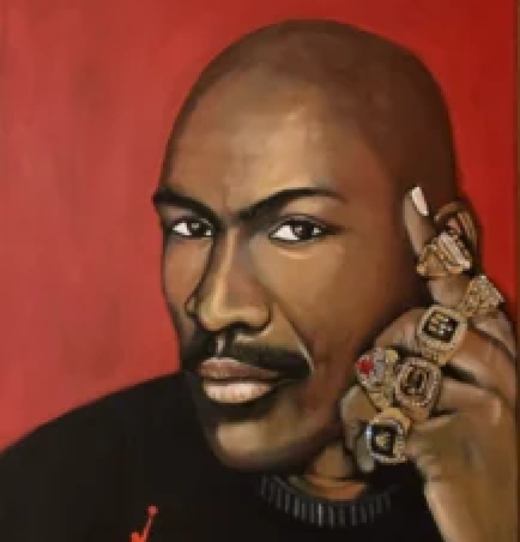
In this website’s previous section: ‘Basketball & France’, we established a link between France and Victor Wembanya to the origin of the game. Detailing a path from Melvin Ridout, Martin Feinberg, Henry ‘The Gentlemen’ Fields, to Victor’s grandfather, Michael de Fautereau, and his playing basketball days in Paris at club PUC. Then ultimately we presented Victor Wembanyama’s mother, Elodie de Fautereau, and her playing and coaching basketball in France. Elodie was Victor’s oncourt ‘basketball mom’ and his first experiences on a basketball court were with his mother nearby.
This website section: ‘Michael & Wemby’ is not a presentation about how Michael Jordan and Victor Wembanyama are similar, nor about how they share a common path. Further, we have no knowledge that they have any personal relationship whatsoever. In so very many ways, manners and physical structure they are different. They have taken very different routes to the NBA.
This is a presentation of how the early roots of Michael Jordan’s college and youth development stemmed from the very same basketball tree that is now sprouting the branches of Victor Wembanyama’s professional career in San Antonio Texas.
They are two separate branches stemming from the same basketball tree trunk, with a shared lineage and multiple links covering a century of basketball coaches.
We will demonstrate this timeline connection throughout the following presentations:
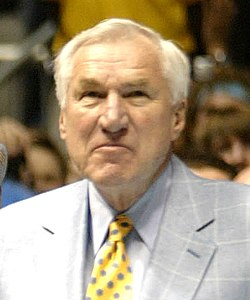
Phog Allen was a direct disciple of James Naismith. He played for Naismith at the University of Kansas. Years later, in 1952, Coach Allen’s Kansas team won a NCAA Championship and Dean Smith played on that team, and played for four years at the University of Kansas.
Dean Smith coached Michael Jordan and Larry Brown at the University of North Carolina. Larry Brown coached for the San Antonio Spurs.
It was Coach Brown that hired Greg Popovich, the five time Spurs NBA championship winning coach, as an NBA assistant.
The ties are even deeper into this tree of basketball as you find out the roots of R.C. Buford, Doug Moe, Tony Parker and many more individuals connected to this basketball history who were in the past a part of, or, those who are now members of the San Antonio Spurs organization.
In understanding this history, you will see there is a deep connection between Michael Jordan and Victor Wembanyama.
We address the early basketball path of Michael Jordan and separate some of the myth from facts about his early career.
All of this is about the ‘real’ path, of a young Michael Jordan, which will actually demonstrate his tremendous perseverance, endurance and determination to be a six time NBA champion. The journey Michael Jordan took in order to win his first trophy was not a path of roses and instant greatness, as often portrayed. Only after years of struggle, and improvement did subsequently five NBA championship trophies come under his many accomplishments.
Michael’s actual path was not a journey of instant success, and what most people think and believe it was, when today they discuss his greatness, or if he is The Greatest of All Time (G.O.A.T.), ‘they’ flower Michael Jordan’s basketball career with myth.
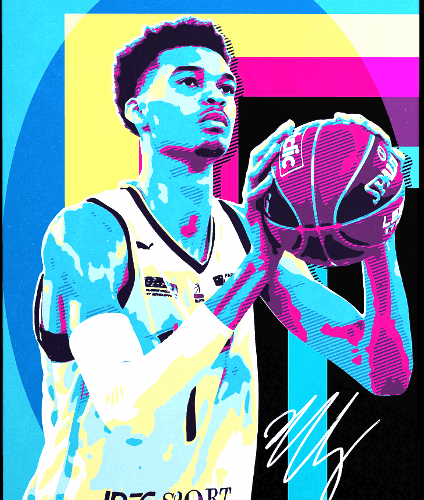
We address what all this actually means now to a 22 year old Victor Wembanyama in pursuit of his own basketball legacy in 2026 with the San Antonio Spurs. … … and what he most likely must endure to accomplish these objectives.
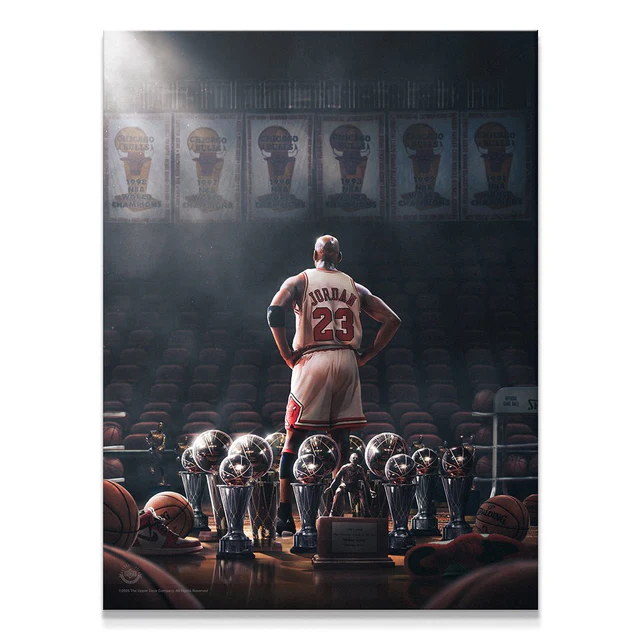
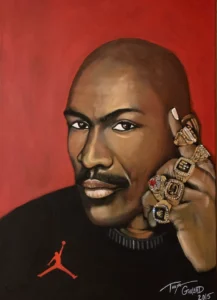
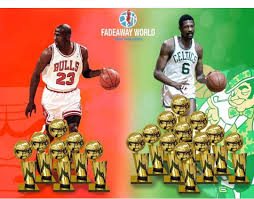
Obviously the largest current difference is Michael Jordan has six (6), yes six, NBA Championship trophies. Victor has zero. (Only a handful of players have won more titles than Michael Jordan).
A difference in basketball size, youth development, manner by which the game is currently played, current money paid to players, all the motivations which surround a current player, and much more should all be discussed as significant differences in this section.
In any case, it is the same basketball ‘TREE’ that set Michael Jordan into his career path that is now in complete control of assisting Victor Wembanyama’s career outcome.
5× NBA Most Valuable Player (1988, 1991, 1992, 1996, 1998)
14× NBA All-Star (1985–1993, 1996–1998, 2002, 2003)
3× NBA All-Star Game MVP (1988, 1996, 1998)
10× All-NBA First Team (1987–1993, 1996–1998)
All-NBA Second Team (1985)
NBA Defensive Player of the Year (1988)
9× NBA All-Defensive First Team (1988–1993, 1996–1998)
NBA Rookie of the Year (1985)
NBA All-Rookie First Team (1985)
10× NBA scoring champion (1987–1993, 1996–1998)
3× NBA steals leader (1988, 1990, 1993)
2× NBA Slam Dunk Contest champion (1987, 1988)
No. 23 retired by Chicago Bulls
No. 23 retired by Miami Heat
3× AP Athlete of the Year (1991–1993)
Sports Illustrated Sportsperson of the Year (1991)
NBA anniversary team (50th, 75th)
NCAA champion (1982)
Consensus national college player of the year (1984)
2× Sporting News National Player of the Year (1983, 1984)
2× Consensus first-team All-American (1983, 1984)
ACC Player of the Year (1984)
ACC Athlete of the Year (1984)
2× First-team All-ACC (1983, 1984)
ACC Rookie of the Year (1982)
No. 23 retired by North Carolina Tar Heels
3× USA Basketball Male Athlete of the Year (1983, 1984, 1992[c])
McDonald’s All-American (1981)
First-team Parade All-American (1981)
Presidential Medal of Freedom (2016)
Career NBA statistics
Points
32,292 (30.1 ppg)
Rebounds
6,672 (6.2 rpg)
Assists
5,633 (5.3 apg)
Stats at NBA.com
Stats at Basketball Reference
Basketball Hall of Fame
FIBA Hall of Fame
Medals
Men’s basketball
Representing the United States
Olympic Games
1984 Los Angeles
Men’s basketball
1992 Barcelona
Men’s basketball
Tournament of the Americas
1992 Portland
Men’s basketball
Pan American Games
1983 Caracas
Men’s basketball
Michael Jeffrey Jordan (born February 17, 1963), also known by his initials MJ,[8] is an American businessman and retired professional basketball player who is a minority owner of the Charlotte Hornets of the National Basketball Association (NBA). He played 15 seasons in the NBA between 1984 and 2003, winning six NBA championships with the Chicago Bulls. Widely considered one of the greatest basketball players of all time,[9][10][11] he was integral in popularizing basketball and the NBA around the world in the 1980s and 1990s.[12] He is the wealthiest athlete of all time,[13][d] and one of the world’s richest celebrities, with a $4.3 billion net worth as of 2026.[15]
Jordan played college basketball with the North Carolina Tar Heels. As a freshman, he was a member of the Tar Heels’ national championship team in 1982.[5] As a junior in 1984, he was named the national college player of the year and was selected by the Bulls with the third overall pick of the 1984 NBA draft.[5][16] With the Bulls, he emerged as a league star known for prolific scoring, defensive prowess and vehement competitiveness.[17][18] His leaping ability, demonstrated by performing slam dunks from the free-throw line in Slam Dunk Contests, earned him the nicknames “Air Jordan” and “His Airness“.[5] Jordan won his first NBA title with the Bulls in 1991 and followed that with titles in 1992 and 1993, securing a three-peat. Citing physical and mental exhaustion from basketball and superstardom, Jordan abruptly retired before the 1993–94 NBA season to play Minor League Baseball in the Chicago White Sox organization. He returned to the Bulls in 1995 and led them to three more championships in 1996, 1997, and 1998, as well as a then-record 72 regular season wins in the 1995–96 NBA season.[5] Jordan retired for the second time in 1999, then returned for two NBA seasons from 2001 to 2003 as a member of the Washington Wizards.[5][16] He was selected to play for the United States national team during his college and NBA careers, winning four gold medals—at the 1983 Pan American Games, 1984 Summer Olympics, 1992 Tournament of the Americas and 1992 Summer Olympics—while also being undefeated.[19]
Jordan’s individual accolades include six NBA Finals Most Valuable Player (MVP) awards, 10 NBA scoring titles (both all-time records), five NBA MVP awards, 10 All-NBA First Team designations, nine All-Defensive First Team honors, 14 NBA All-Star Game selections, and three NBA All-Star Game MVP awards.[16] He holds the NBA records for career regular season scoring average (30.1 points per game) and career playoff scoring average (33.4 points per game).[20] He is one of only eight players to achieve the basketball Triple Crown. In 1999, Jordan was named the 20th century’s greatest North American athlete by ESPN and was second to Babe Ruth on the Associated Press’ list of athletes of the century.[5] Jordan was twice inducted into the Naismith Memorial Basketball Hall of Fame, once in 2009 for his individual career,[21] and in 2010 as part of the 1992 United States men’s Olympic basketball team (“The Dream Team”).[22] The trophy for the NBA Most Valuable Player Award is named in his honor.
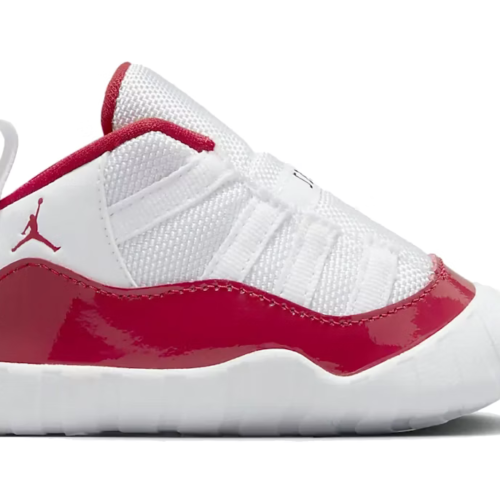
One of the most effectively marketed athletes ever, Jordan made many product endorsements.[12][23] He fueled the success of Nike’s Air Jordan sneakers, which were introduced in 1984 and remain popular.[24] Jordan starred as himself in the live-action/animation hybrid film Space Jam (1996) and was the focus of the Emmy-winning documentary series The Last Dance (2020). He became part-owner and head of basketball operations for the Charlotte Hornets (then named the Bobcats) in 2006 and bought a controlling interest in 2010, before selling his majority stake in 2023. Jordan is a co-owner of 23XI Racing in the NASCAR Cup Series. In 2014, he became the first billionaire player in NBA history.[25] In 2016, President Barack Obama awarded Jordan the Presidential Medal of Freedom.[26]
Early life
Michael Jeffrey Jordan was born on February 17, 1963, at Cumberland Hospital in the Fort Greene neighborhood of Brooklyn, New York City,[27][28] to bank employee Deloris (née Peoples) and equipment supervisor James R. Jordan Sr.[28][29] He has two older brothers, James Jr. and Larry, as well as an older sister named Deloris and a younger sister named Roslyn.[30][31] Jordan and his siblings were raised Methodist.[32]
In 1968, the family moved to Wilmington, North Carolina.[33] Jordan attended Emsley A. Laney High School, where he played basketball, baseball, and football. He tried out for the basketball varsity team during his sophomore year, but at a height of 5 feet 11 inches (1.80 m), he was deemed too short.[34][35] Motivated to prove his worth, Jordan became the star of Laney’s junior varsity team and tallied some 40-point games.[34] The following summer, he grew four inches (10 cm) and trained rigorously.[35] Upon earning a spot on the varsity roster, Jordan averaged more than 25 points per game (ppg) over his final two seasons of high school play.[36] He also adopted his signature jersey number, 23.[37] As a senior, he was selected for the 1981 McDonald’s All-American Game and scored 30 points,[38][39] after averaging 26.8 ppg,[36] 11.6 rebounds (rpg), and 10.1 assists per game (apg) for the season.[40]
Jordan was recruited by numerous college basketball programs, including Duke, North Carolina, South Carolina, Syracuse, Virginia, and Clemson.[41][42] He reportedly most strongly considered recruiting efforts from North Carolina, NC State, and Maryland before, in 1980,[42] he accepted a basketball scholarship to the University of North Carolina at Chapel Hill, where he majored in cultural geography.[43] He chose this field of study because of its relationship to meteorology, as Jordan was interested in a career as a meteorologist.[44][45]
College career
Jordan hitting the game winning shot against Georgetown in the 1982 NCAA championship game
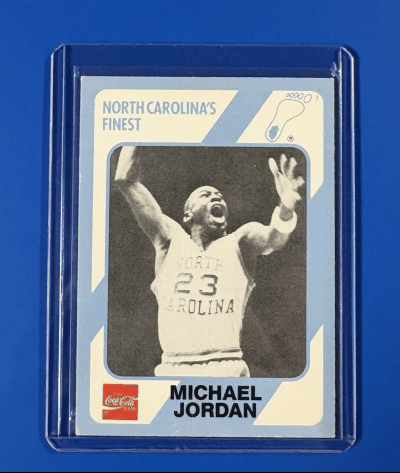
As a freshman under coach Dean Smith’s team-oriented system, Jordan was named ACC Freshman of the Year after averaging 13.4 points per game on 53.4% shooting—ranking 10th in scoring and sixth in field goal percentage in the conference.[46][47] He made the game-winning jump shot in the 1982 NCAA Championship game against Georgetown, which was led by future NBA rival Patrick Ewing.[48] Jordan later described this shot as the major turning point in his basketball career.[49][50] During his sophomore and junior seasons, Jordan consistently ranked among the ACC’s elite, finishing either 1st or 2nd in both total points and points per game, while also placing in the top 10 in field goal percentage and free throw percentage.[51][52] In his three seasons with the Tar Heels, Jordan averaged 17.7 ppg on 54.0% shooting and added 5.0 rpg and 1.8 apg.[16]
Jordan was selected by consensus to the NCAA All-American First Team in both his sophomore (1983) and junior (1984) seasons.[53][54] After winning the Naismith and the Wooden College Player of the Year awards in 1984, Jordan left North Carolina a year before his scheduled graduation to enter the 1984 NBA draft. Jordan returned to North Carolina to complete his degree in 1986,[55] when he graduated with a Bachelor of Arts degree in geography.[56][57] In 2002, Jordan was selected to the ACC 50th Anniversary men’s basketball team and named the greatest athlete in ACC history.[58][59]
Professional career
Chicago Bulls (1984–1993; 1995–1998)
Early NBA years (1984–1987)
Jordan holding his Chicago Bulls jersey at conference announcing his signing.
The Chicago Bulls selected Jordan with the third overall pick of the 1984 NBA draft after Hakeem Olajuwon (Houston Rockets) and Sam Bowie (Portland Trail Blazers). One of the primary reasons why Jordan was not drafted sooner was because the first two teams were in need of a center.[60] Trail Blazers general manager Stu Inman contended that it was not a matter of drafting a center but more a matter of taking Bowie over Jordan, in part because Portland already had Clyde Drexler, who was a guard with similar skills to Jordan.[61] Citing Bowie’s injury-laden college career, ESPN named the Blazers’ choice of Bowie as the worst draft pick in North American professional sports history.[62]
Jordan made his NBA debut at Chicago Stadium on October 26, 1984, and scored 16 points. In 2021, a ticket stub from the game sold at auction for $264,000, setting a record for a collectible ticket stub.[63] During his rookie 1984–85 season with the Bulls, Jordan averaged 28.2 ppg on 51.5% shooting.[46] He helped the Bulls improve from 27–55 to 38–44 and qualify for the postseason for the first time since the 1980–81 season.[64] Jordan quickly became a fan favorite even in opposing arenas.[65][66][67] Roy S. Johnson of The New York Times described Jordan as “the phenomenal rookie of the Bulls” in November,[67] and he appeared on the cover of Sports Illustrated with the heading “A Star Is Born” in December.[68][69] The fans voted in Jordan as an All-Star starter during his rookie season.[5] Controversy arose before the 1985 NBA All-Star Game when word surfaced that several veteran players, led by Isiah Thomas, were upset by the amount of attention Jordan was receiving.[5] This led to a so-called “freeze-out” on Jordan, where players refused to pass the ball to him.[5] The controversy left Jordan relatively unaffected when he returned to regular season play, and he would go on to be voted the NBA Rookie of the Year.[70] The Bulls lost to the Milwaukee Bucks in four games in the first round of the playoffs.[70]
An often-cited moment was on August 26, 1985,[36][71] when Jordan shook the arena during a Nike exhibition game in Trieste, Italy, by shattering the glass of the backboard with a dunk.[72][73] The moment was filmed and is often referred to as an important milestone in Jordan’s rise.[73][74] The shoes Jordan wore during the game were auctioned in August 2020 for $615,000, a record for a pair of sneakers.[75][76] Jordan’s 1985–86 season was cut short when he broke his foot in the third game of the year, causing him to miss 64 games.[77] The Bulls made the playoffs despite Jordan’s injury and a 30–52 record,[78] at the time the fifth-worst record of any team to qualify for the playoffs in NBA history.[79] Jordan recovered in time to participate in the postseason and performed well upon his return. On April 20 at the Boston Garden, in Game 2 of the First Round, a 135–131 double overtime loss to the eventual NBA champion Boston Celtics, Jordan scored a playoff career-high 63 points, breaking Elgin Baylor’s single-game playoff scoring record.[80] The Celtics team, though, swept the series in three games.[70][80][81] Jordan completely recovered in time for the 1986–87 season,[82] and had one of the most prolific scoring seasons in NBA history; he became the only player other than Wilt Chamberlain to score 3,000 points in a season, averaging a league-high 37.1 ppg on 48.2% shooting.[46][83] Jordan also demonstrated his defensive prowess, as he became the first player in NBA history to record 200 steals and 100 blocked shots in a season.[84] Despite Jordan’s success, Magic Johnson won the NBA Most Valuable Player Award.[85] The Bulls reached 40 wins,[78] and advanced to the playoffs for the third consecutive year but were again swept by the Celtics.[70]
Pistons roadblock (1987–1990)
Jordan led the league in scoring during the 1987–88 season, averaging 35.0 ppg on 53.5% shooting,[46] and won his first league MVP Award. He was named the NBA Defensive Player of the Year after averaging 1.6 blocks per game (bpg), a league-high 3.1 steals per game (spg),[86][e] and leading the Bulls defense to the fewest points per game allowed in the league.[88] The Bulls finished 50–32,[78] and made it past the first round of the playoffs for the first time in Jordan’s career, as they defeated the Cleveland Cavaliers in five games.[89] In the Eastern Conference Semifinals, the Bulls lost in five games to the more experienced Detroit Pistons,[70] who were led by Isiah Thomas and a group of physical players known as the “Bad Boys”.[90]
In the 1988–89 season, Jordan again led the league in scoring, averaging 32.5 ppg on 53.8% shooting from the field, along with 8.0 rpg and 8.0 apg.[46] During the season, Jordan expressed his frustration over the Bulls’ offense with head coach Doug Collins, who then put Jordan at point guard. In his time as a point guard, Jordan had 10 triple-doubles in 11 games, with averages of 33.6 ppg, 11.4 rpg, and 10.8 apg.[91]
The Bulls finished with a 47–35 record,[78] and advanced to the Eastern Conference Finals, defeating the Cavaliers and New York Knicks along the way.[92] The Cavaliers series included a career highlight for Jordan when he hit “The Shot” over Craig Ehlo at the buzzer in the fifth and final game of the series.[93] In the Eastern Conference Finals, the Pistons again defeated the Bulls, this time in six games,[70] by utilizing their “Jordan Rules” method of guarding Jordan, which consisted of double and triple teaming him every time he touched the ball.[5]
The Bulls entered the 1989–90 season as a team on the rise, with their core group of Jordan and young improving players like Scottie Pippen and Horace Grant and under the guidance of new coach Phil Jackson.[94] On March 28, 1990, Jordan scored a career-high 69 points in a 117–113 road win over the Cavaliers.[95] He averaged a league-leading 33.6 ppg on 52.6% shooting, to go with 6.9 rpg and 6.3 apg,[46] in leading the Bulls to a 55–27 record.[78] They again advanced to the Eastern Conference Finals after beating the Bucks and Philadelphia 76ers;[96] despite pushing the series to seven games, the Bulls lost to the Pistons for the third consecutive season.[70]
First three-peat (1991–1993)
After the Bulls’ previous losses to the Pistons, Phil Jackson, along with assistant coach Tex Winter, focused on implementing the triangle offense to counteract the Pistons’ defense and other teams that heavily targeted Jordan. This system, however, required Jordan to adjust his playing style.[97][98] In his book Eleven Rings, Jackson recalled, “I was planning to ask Michael to reduce the number of shots he took so that other members of the team could get more involved in the offense. I knew this would be a challenge for him.”[99] In The Last Dance, Jordan admitted he was initially reluctant to back the system.[98] Nevertheless, he eventually embraced the change, which led to success for the team.[100]
In the 1990–91 season, Jordan won his second MVP award after averaging 31.5 ppg on 53.9% shooting, 6.0 rpg, and 5.5 apg for the regular season.[46] The Bulls finished in first place in their division for the first time in sixteen years and set a franchise record with 61 wins in the regular season.[78] With Scottie Pippen developing into an All-Star, the Bulls had elevated their play. The Bulls defeated the New York Knicks and the Philadelphia 76ers in the opening two rounds of the playoffs. They advanced to the Eastern Conference Finals, where their rival, the Detroit Pistons, awaited them;[101] this time, the Bulls beat the Pistons in a four-game sweep.[102]
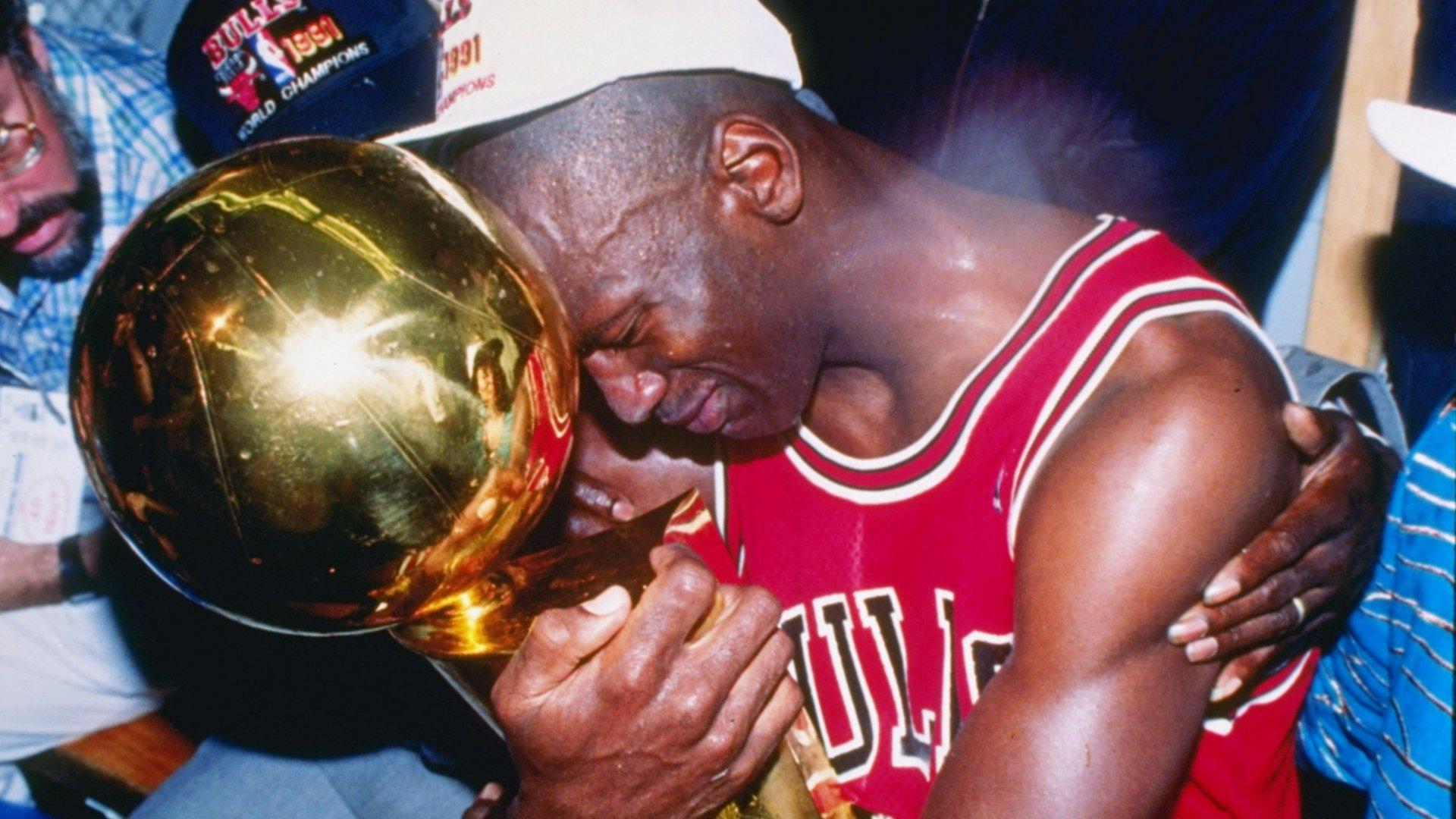
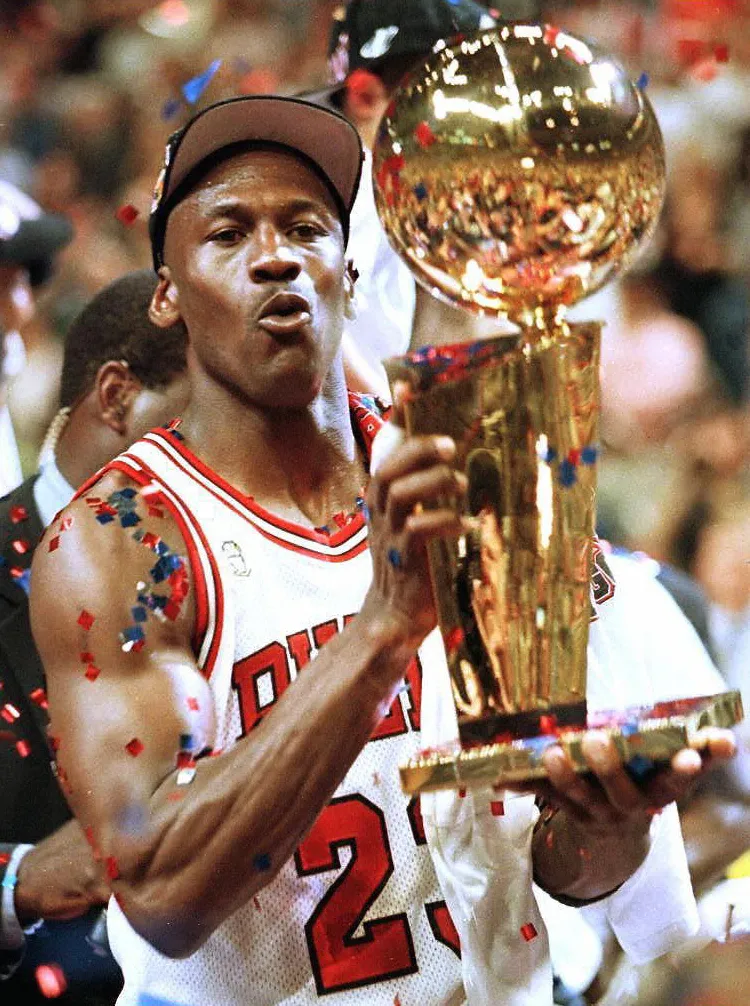
The Bulls advanced to the Finals for the first time in franchise history to face the Los Angeles Lakers. The Bulls won the series in five games and compiled a 15–2 playoff record along the way.[101] Perhaps the best-known moment of the series came in Game 2 when, attempting a dunk, Jordan avoided a potential Sam Perkins block by switching the ball from his right hand to his left in mid-air to lay the shot into the basket.[103] In his first Finals appearance, Jordan had 31.2 ppg on 56% shooting from the field, 11.4 apg, 6.6 rpg, 2.8 spg, and 1.4 bpg.[104] Jordan won his first NBA Finals MVP award[105] and cried while holding the Finals trophy.[106]
Jordan and the Bulls continued their dominance in the 1991–92 season, establishing a 67–15 record, topping their franchise record from the 1990–91 campaign.[78] Jordan won his second consecutive MVP award with averages of 30.1 ppg, 6.4 rpg, and 6.1 apg on 52% shooting.[86] After winning a physical seven-game series over the New York Knicks in the second round of the playoffs and finishing off the Cleveland Cavaliers in the Conference Finals in six games, the Bulls met Clyde Drexler and the Portland Trail Blazers in the Finals. The media, hoping to recreate a Magic–Bird rivalry, highlighted the similarities between “Air” Jordan and Clyde “The Glide” during the pre-Finals hype.[107]
In a Game 1 victory, Jordan scored a Finals-record 35 points in the first half, including a record-setting six three-point field goals.[108] After the sixth three-pointer, he jogged down the court shrugging as he looked courtside. Marv Albert, who broadcast the game, later stated that it was as if Jordan was saying: “I can’t believe I’m doing this.”[109] The Bulls went on to defeat the Blazers in six games. Jordan was named Finals MVP for the second year in a row,[105] and finished the series averaging 35.8 ppg, 4.8 rpg, and 6.5 apg, while shooting 52.6% from the floor.[110]
In the 1992–93 season, despite a 32.6 ppg, 6.7 rpg, and 5.5 apg campaign, including a second-place finish in Defensive Player of the Year voting,[86][111] Jordan’s streak of consecutive MVP seasons ended, as he lost the award to his friend Charles Barkley,[85] upsetting him.[112] Jordan and the Bulls met Barkley and his Phoenix Suns in the 1993 NBA Finals. The Bulls won their third NBA championship on a game-winning shot by John Paxson and a last-second block by Horace Grant, but Jordan was once again Chicago’s leader. He averaged a Finals-record 41.0 ppg during the six-game series,[113] and became the first player in NBA history to win three consecutive Finals MVP awards.[105] Jordan scored more than 30 points in every game of the series, including 40 or more points in four consecutive games.[114] With his third Finals triumph, Jordan capped off a seven-year run where he attained seven scoring titles and three championships, but there were signs that Jordan was tiring of his massive celebrity and all of the non-basketball hassles in his life.[115]
First retirement and stint in Minor League Baseball (1993–1995)
Michael Jordan
Jordan in training with the Scottsdale Scorpions in 1994
Birmingham Barons – No. 45, 35
Outfielder
Batted: Right
Threw: Right
Professional debut
Southern League: April 8, 1994, for the Birmingham Barons
Arizona Fall League: 1994, for the Scottsdale Scorpions
Last Southern League appearance
March 10, 1995, for the Birmingham Barons
Southern League statistics (through 1994)
Batting average
.202
Home runs
3
Runs batted in
51
Arizona Fall League statistics
Batting average
.252
Runs batted in
8
Stats at Baseball Reference
Teams
Birmingham Barons (1994–1995)
Scottsdale Scorpions (1994)
On October 6, 1993, Jordan announced his retirement, saying that he lost his desire to play basketball. He later said that the murder of his father three months earlier helped shape his decision.[116] James R. Jordan Sr. was murdered on July 23, 1993, at a highway rest area in Lumberton, North Carolina, by two teenagers, Daniel Green and Larry Martin Demery, who carjacked his Lexus.[117][118] His body, dumped in a South Carolina swamp, was not discovered until August 3.[118] Green and Demery were sentenced to life imprisonment.[119] However, in The Last Dance, Jordan stated that he retired due to physical and mental exhaustion from basketball and superstardom.[120]
Jordan was close to his father; as a child, Jordan imitated the way his father stuck out his tongue while absorbed in work. Jordan later adopted it as his own signature, often displaying it as he drove to the basket.[5] In 1996, Jordan founded a Chicago-area Boys & Girls Club and dedicated it to his father.[121][122] In his 1998 autobiography For the Love of the Game, Jordan wrote that he was preparing for retirement as early as the summer of 1992.[123] The added exhaustion due to the “Dream Team” run in the 1992 Summer Olympics solidified Jordan’s feelings about the game and his celebrity status. Jordan’s announcement sent shock waves throughout the NBA and appeared on the front pages of newspapers around the world.[124]
Jordan further surprised the sports world by signing a Minor League Baseball (MiLB) contract with the Chicago White Sox on February 7, 1994.[125] He reported to spring training in Sarasota, Florida, and was assigned to the team’s minor league system on March 31.[126] Jordan said that this decision was made to pursue the dream of his late father, who always envisioned his son as a Major League Baseball (MLB) player.[127] The White Sox were owned by Bulls owner Jerry Reinsdorf, who continued to honor Jordan’s basketball contract during the years he played baseball.[128]
In 1994, Jordan played for the Birmingham Barons, a Double-A minor league affiliate of the Chicago White Sox, batting .202 with three home runs, 51 runs batted in, 30 stolen bases, 114 strikeouts, 51 bases on balls, and 11 errors.[129][130] His strikeout total led the team and his games played tied for the team lead. His 30 stolen bases were second on the team only to Doug Brady.[131] Jordan also appeared for the Scottsdale Scorpions in the 1994 Arizona Fall League, batting .252 against the top prospects in baseball.[126] On November 1, 1994, his No. 23 was retired by the Bulls in a ceremony that included the erection of a permanent sculpture known as The Spirit outside the new United Center.[132][133][134]
Return to the NBA (1995)
The Bulls went 55–27 in 1993–94 without Jordan in the lineup[78] and lost to the New York Knicks in the second round of the playoffs.[135] In March 1995, Jordan decided to quit baseball because he feared he might become a replacement player during the Major League Baseball strike.[136] During the 1994–95 season, Jordan returned to the Bulls midway through the season. On March 18, 1995, Jordan announced his comeback to the NBA in a two-word press release: “I’m back.”[137] The next day, Jordan took to the court with the Bulls to face the Indiana Pacers in Indianapolis, scoring 19 points.[138] The game had the highest Nielsen rating of any regular season NBA game since 1975.[139] Although he could have worn his original number even though the Bulls retired it, Jordan wore No. 45, his baseball number.[138]
Despite his 18-month hiatus from the NBA, Jordan played well, making a game-winning jump shot against Atlanta in his fourth game back. He scored 55 points in his next game, against the New York Knicks at Madison Square Garden on March 28, 1995.[70] Boosted by Jordan’s comeback, the Bulls went 13–4 to make the playoffs and advanced to the Eastern Conference Semifinals against the Orlando Magic.[140] At the end of Game 1, Orlando’s Nick Anderson stripped Jordan from behind, leading to the game-winning basket for the Magic; he later commented that Jordan “didn’t look like the old Michael Jordan”,[141] and said, “No. 45 doesn’t explode like No. 23 used to”.[142]
Jordan responded by scoring 38 points in the next game, which Chicago won. Before the game, Jordan decided that he would immediately resume wearing his former No. 23. The Bulls were fined $25,000 for failing to report the impromptu number change to the NBA.[142] Jordan was fined an additional $5,000 for opting to wear white sneakers when the rest of the Bulls wore black.[143] He averaged 31 ppg in the playoffs, but Orlando won the series in six games.[144]
Second three-peat (1996–1998)
Jordan was motivated by the playoff defeat, and he trained aggressively for the 1995–96 season.[145] The Bulls were strengthened by the addition of rebound specialist Dennis Rodman, and the team dominated the league, starting the season at 41–3.[146] The Bulls finished with the best regular season record in NBA history, 72–10, a mark broken two decades later by the 2015–16 Golden State Warriors.[147] Jordan led the league in scoring with 30.4 ppg,[148] and he won the league’s regular season and All-Star Game MVP awards.[16]
Jordan in 1997
In the playoffs, the Bulls lost only three games in four series (Miami Heat 3–0, New York Knicks 4–1, and Orlando Magic 4–0), as they defeated the Seattle SuperSonics 4–2 in the NBA Finals to win their fourth championship.[146] The series was one of the tougher ones for Jordan as he had a 41.5% field goal percentage, and his scoring average dropped nearly nine points from his average during the rest of the playoffs.[149] Nevertheless, Jordan was named Finals MVP for a record fourth time;[105] he achieved only the second sweep of the MVP awards in the All-Star Game, regular season, and NBA Finals after Willis Reed in the 1969–70 season.[70] Upon winning the championship, his first since his father’s murder, Jordan reacted emotionally, clutching the game ball and crying on the locker room floor.[5][106]
In the 1996–97 season, the Bulls stood at a 69–11 record but ended the season by losing their final two games to finish the year 69–13, missing out on a second consecutive 70-win season.[150] The Bulls again advanced to the Finals, where they faced the Utah Jazz.[151] That team included Karl Malone, who had beaten Jordan for the NBA MVP award in a tight race (986–957).[152][153][154] The series against the Jazz featured two of the more memorable clutch moments of Jordan’s career. He won Game 1 for the Bulls with a buzzer-beating jump shot. In Game 5, with the series tied 2–2, Jordan played despite being feverish and dehydrated from a stomach virus or food poisoning, likely caused by a pizza ordered the night before. Jordan eventually claimed it was food poisoning in the 2020 docuseries The Last Dance.[151][155] In what is known as “The Flu Game”, Jordan scored 38 points, including the game-winning three-pointer with 25 seconds remaining.[151] The Bulls won 90–88 and went on to win the series in six games.[150] For the fifth time in as many Finals appearances, Jordan received the Finals MVP award.[105] During the 1997 NBA All-Star Game, he posted the first triple-double in All-Star Game history in a victorious effort, but the MVP award went to Glen Rice.[156]
Jordan with coach Phil Jackson in 1997
The Bulls compiled a 62–20 record in the 1997–98 season.[78] Jordan led the league with 28.7 ppg,[86] securing his fifth regular season MVP award, plus honors for All-NBA First Team, First Defensive Team, and the All-Star Game MVP.[16] The Bulls won the Eastern Conference Championship for a third straight season, including surviving a seven-game series with the Indiana Pacers in the Eastern Conference Finals; it was the first time Jordan had played in a Game 7 since the 1992 Eastern Conference Semifinals with the New York Knicks.[157][158] After winning, they moved on for a rematch with the Jazz in the Finals.[159]
The Bulls returned to the Delta Center for Game 6 on June 14, 1998, leading the series 3–2. Jordan executed a series of plays, considered to be one of the greatest clutch performances in NBA Finals history.[160] With 41.9 seconds remaining and the Bulls trailing 86–83, Phil Jackson called a timeout. When play resumed, Jordan received the inbound pass, drove to the basket, and sank a shot over several Jazz defenders, cutting Utah’s lead to 86–85.[160] The Jazz brought the ball upcourt and passed the ball to Malone, who was set up in the low post and was being guarded by Rodman. Malone jostled with Rodman and caught the pass, but Jordan cut behind him and stole the ball out of his hands.[160]
Jordan then dribbled down the court and paused, eyeing his defender, Jazz guard Bryon Russell. With 10 seconds remaining, Jordan started to dribble right, then crossed over to his left, possibly pushing off Russell, although the officials did not call a foul.[161][162][163][164] With 5.2 seconds left, Jordan made the climactic shot of his Bulls career,[165] a top-key jumper over a stumbling Russell to give Chicago an 87–86 lead. Afterwards, the Jazz’ John Stockton narrowly missed a game-winning three-pointer, and the buzzer sounded as Jordan and the Bulls won their sixth NBA championship,[166] achieving a second three-peat in the decade.[167] Once again, Jordan was voted Finals MVP for a record sixth time,[105] having led all scorers by averaging 33.5 ppg, including 45 in the deciding Game 6.[168] The 1998 Finals holds the highest television rating of any Finals series,[169] and Game 6 holds the highest television rating of any game in NBA history.[170]
Second retirement (1999–2001)
With Phil Jackson’s contract expiring, the pending departures of Scottie Pippen and Dennis Rodman looming, and being in the latter stages of an owner-induced lockout of NBA players, Jordan retired for the second time on January 13, 1999.[171][172][173] On January 19, 2000, Jordan returned to the NBA not as a player but as part owner and president of basketball operations for the Washington Wizards.[174] Jordan’s responsibilities with the Wizards were comprehensive, as he controlled all aspects of the Wizards’ basketball operations, and had the final say in all personnel matters; opinions of Jordan as a basketball executive were mixed.[175][176] He managed to purge the team of several highly paid, unpopular players (like forward Juwan Howard and point guard Rod Strickland)[177][178] but used the first pick in the 2001 NBA draft to select high school student Kwame Brown, who did not live up to expectations and was traded away after four seasons.[175][179]
Despite his January 1999 claim that he was “99.9% certain” he would never play another NBA game,[106] Jordan expressed interest in making another comeback in the summer of 2001, this time with his new team.[180][181] Inspired by the NHL comeback of his friend Mario Lemieux the previous winter,[182] Jordan spent much of the spring and summer of 2001 in training, holding several invitation-only camps for NBA players in Chicago.[183] Jordan hired his old Chicago Bulls head coach, Doug Collins, as Washington’s coach for the upcoming season, a decision that many saw as foreshadowing another Jordan return.[180][181]
Washington Wizards (2001–2003)
On September 25, 2001, Jordan announced his return to the NBA to play for the Washington Wizards, indicating his intention to donate his salary as a player to a relief effort for the victims of the September 11 attacks.[184][185] In an injury-plagued 2001–02 season, Jordan led the team in scoring (22.9 ppg), assists (5.2 apg), and steals (1.4 spg),[5] and was an MVP candidate, as he led the Wizards to a winning record and playoff contention;[186][187] Jordan would eventually finish 13th in the MVP ballot.[188] After he suffered torn cartilage in his right knee,[189] and subsequent knee soreness,[190] the Wizards missed the playoffs,[191] and Jordan’s season ended after only 60 games, the fewest he had played in a regular season since playing 17 games after returning from his first retirement during the 1994–95 season.[46] Jordan started 53 of his 60 games for the season, averaging 24.3 ppg, 5.4 apg, and 6.0 rpg, and shooting 41.9% from the field in his 53 starts. His last seven appearances were in a reserve role, in which he averaged just over 20 minutes per game.[192] The Wizards finished the season with a 37–45 record, an 18-game improvement.[191]
Playing in his 14th and final NBA All-Star Game in 2003, Jordan passed Kareem Abdul-Jabbar as the all-time leading scorer in All-Star Game history, a record since broken by Kobe Bryant and LeBron James.[193][194] That year, Jordan was the only Washington player to play in all 82 games, starting in 67 of them as he came off the bench in 15. Jordan averaged 20.0 ppg, 6.1 rpg, 3.8 assists, and 1.5 spg per game.[5] He also shot 45% from the field, and 82% from the free-throw line.[46] Although Jordan turned 40 during the season, he scored 20 or more points 42 times, 30 or more points nine times, and 40 or more points three times.[70] On February 21, 2003, Jordan became the first 40-year-old to tally 43 points in an NBA game.[195] During his stint with the Wizards, all of Jordan’s home games at the MCI Center were sold out and the Wizards were the second most-watched team in the NBA, averaging 20,172 fans a game at home and 19,311 on the road.[196] Jordan’s final two seasons did not result in a playoff appearance for the Wizards, and he was often unsatisfied with the play of those around him.[197][198] At several points, Jordan openly criticized his teammates to the media, citing their lack of focus and intensity, notably that of Kwame Brown, the number-one draft pick in the 2001 NBA draft.[197][198]
Final retirement (2003)
With the recognition that 2002–03 would be Jordan’s final season, tributes were paid to him throughout the NBA. In his final game at the United Center in Chicago, which was his old home court, Jordan received a four-minute standing ovation.[199] The Miami Heat retired the No. 23 jersey on April 11, 2003, even though Jordan never played for the team.[200] At the 2003 All-Star Game, Jordan was offered a starting spot from Tracy McGrady and Allen Iverson but refused both;[201] he accepted the spot of Vince Carter.[202] Jordan played in his final NBA game on April 16, 2003, in Philadelphia. After scoring 13 points in the game, Jordan went to the bench with 4 minutes and 13 seconds left in the third quarter and his team trailing the Philadelphia 76ers 75–56. Just after the start of the fourth quarter, the First Union Center crowd began chanting “We want Mike!” After much encouragement from coach Doug Collins, Jordan finally rose from the bench and re-entered the game, replacing Larry Hughes with 2:35 remaining. At 1:45, Jordan was intentionally fouled by the 76ers’ Eric Snow, and stepped to the line to make both free throws. After the second foul shot, the 76ers in-bounded the ball to rookie John Salmons, who in turn was intentionally fouled by Bobby Simmons one second later, stopping time so that Jordan could return to the bench. He received a three-minute standing ovation from his teammates, his opponents, the officials, and the crowd of 21,257 fans.[203]
National team career
Jordan on the U.S. Olympic team in 1992
Jordan made his debut as a college player for the U.S. national basketball team at the 1983 Pan American Games in Caracas, Venezuela. He led the team in scoring with 17.3 ppg as the U.S., coached by Jack Hartman, won the gold medal.[204][205] The following year, Jordan won another gold medal in the 1984 Summer Olympics. The 1984 U.S. team was coached by Bob Knight and featured young players such as Patrick Ewing, Sam Perkins, Chris Mullin, Steve Alford, and Wayman Tisdale. Jordan led the team in scoring, averaging 17.1 ppg for the tournament.[206]
In 1992, Jordan, now an NBA player, was a member of the “Dream Team”, which included Larry Bird and Magic Johnson. The team won gold in the 1992 Tournament of the Americas,[207] and the 1992 Summer Olympics. Jordan was the only player to start all eight games in the Olympics. He averaged 14.9 ppg on 45% shooting from the field and 68% from the free-throw line, and was second on the team in scoring.[208] He was undefeated in the four tournaments he played for the U.S. national team, and won all 30 games he took part in.[19]
Player profile
Jordan dunking the ball, 1987–88
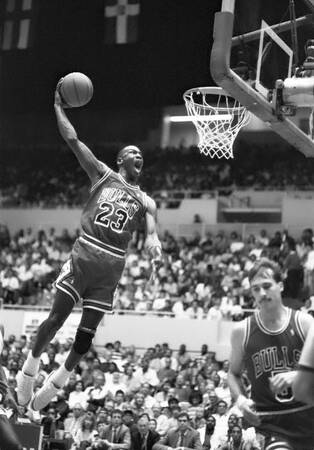
Jordan was a shooting guard who could also play as a small forward, the position he would primarily play during his second return to professional basketball with the Washington Wizards.[16] Jordan was known as a strong clutch performer. With the Bulls, he decided 25 games with field goals or free throws in the last 30 seconds, including two NBA Finals games and five other playoff contests.[209] His competitiveness was visible in his prolific trash talk and well-known work ethic.[210][211][212] Jordan often used perceived slights to fuel his performances. Sportswriter Wright Thompson described him as “a killer, in the Darwinian sense of the word, immediately sensing and attacking someone’s weakest spot”.[3] As the Bulls organization built the franchise around Jordan, management had to trade away players who were not “tough enough” to compete with him in practice. To improve his defense, Jordan spent hours studying film of opponents. On offense, he relied more on instinct and improvisation.[213] Jordan’s fierce competitiveness greatly impacted his teammates, sometimes motivating them but also leading to tension and alienation.[214][215]
Noted as a durable player, Jordan did not miss four or more games while active for a full season from 1986–87 to 2001–02, when he injured his right knee.[16][216] Of the 15 seasons Jordan was in the NBA, he played all 82 regular season games nine times.[16] Jordan has frequently cited David Thompson, Walter Davis, and Jerry West as influences.[217][218] Confirmed at the start of his career, and possibly later on, Jordan had a special “Love of the Game Clause” written into his contract, which was unusual at the time, and allowed him to play basketball against anyone at any time, anywhere.[219]
Jordan had a versatile offensive game and was capable of aggressively driving to the basket as well as drawing fouls from his opponents at a high rate. His 8,772 free throw attempts are the 11th-highest total in NBA history.[220] Early in Jordan’s career, he weighed around 200 pounds (91 kg) and was more athletic in terms of play style.[221] As his career progressed, Jordan developed the ability to post up his opponents and score with his trademark fadeaway jump shot, using his leaping ability to avoid block attempts. According to Hubie Brown, this move alone made Jordan nearly unstoppable.[222] Around this time, he bulked up to 215 pounds (98 kg) to adapt to the increased physicality of NBA defenses during the 1990s, sacrificing some athleticism for added strength in the post.[221] Despite media criticism by some as a selfish player early in his career, Jordan was willing to defer to his teammates, with a career average of 5.3 apg and a season-high of 8.0 apg.[46] For a guard, Jordan was also a good rebounder, finishing with 6.2 rpg. Defensively, he averaged 2.3 spg and 0.8 bpg.[46]
The three-point field goal was not Jordan’s strength, especially in his early years. Later on in his career, Jordan improved his three-point shooting, and finished his career with a three-point field goal percentage of 32%.[46] His best years shooting from three were the 1989–90 and 1992–93 seasons, where he shot 37% and 35% from three, respectively (Jordan did shoot higher percentages from 1994 to 1997, but in those years, the three-point line was temporarily moved inwards).[16][223]
Overall, Jordan’s effective field goal percentage was 51%, and he had six seasons with at least 50% shooting, five of which were consecutive (1988–1992). Jordan also shot 51% and 50% from the field, and 30% and 33% from three-point range, throughout his first and second retirements, respectively, finishing his Bulls career with 31.5 points per game on 50.5 FG% shooting and his overall career with 49.7 FG% shooting.[16]
In 1988, Jordan was honored with the NBA Defensive Player of the Year and Most Valuable Player awards. No NBA player had previously won both awards in their career. He also set both seasonal and career records for blocked shots by a guard,[224] and combined this with his ball-thieving ability to become a standout defensive player. Despite his defensive prowess, the 1988 season has come under scrutiny due to the large discrepancy between Jordan’s steals’ numbers at home versus on the road. Such stat inflation was common, and a 2024 study by writer Tom Haberstroh found that there were games where Jordan was often credited with steals that could not have happened. For example, in one game, he was credited with more steals than the opposing team had live-ball turnovers.[225] Jordan ranks fourth in NBA history in total steals with 2,514, trailing John Stockton, Jason Kidd and Chris Paul.[226] Jerry West often stated that he was more impressed with Jordan’s defensive contributions than his offensive ones.[227] Doc Rivers declared Jordan “the best superstar defender in the history of the game”.[228]
Jordan was known to have strong eyesight. Broadcaster Al Michaels said that Jordan was able to read baseball box scores on a 27-inch (69 cm) television clearly from about 50 feet (15 m) away.[229] During the 2001 NBA Finals, Phil Jackson compared Jordan’s dominance to Shaquille O’Neal, stating: “Michael would get fouled on every play and still have to play through it and just clear himself for shots instead and would rise to that occasion.”[230]
Legacy
Jordan’s talent was clear from his first NBA season; by November 1984, he was being compared to Julius Erving.[65][67] Larry Bird said that rookie Jordan was the best player he ever saw, and that Jordan was “one of a kind”, and comparable to Wayne Gretzky as an athlete.[231] In his first game in Madison Square Garden against the New York Knicks, Jordan received a near minute-long standing ovation.[67] After Jordan established the single game playoff record of 63 points against the Boston Celtics on April 20, 1986, Bird described him as “God disguised as Michael Jordan”.[80]
Jordan led the NBA in scoring in 10 seasons (NBA record) and tied Wilt Chamberlain’s record of seven consecutive scoring titles.[5] Jordan was a fixture of the NBA All-Defensive First Team, making the roster nine times (NBA record shared with Gary Payton, Kevin Garnett, and Kobe Bryant).[232] He also holds the top career regular season and playoff scoring averages of 30.1 and 33.4 ppg, respectively.[20][233] By 1998, the season of his Finals-winning shot against the Jazz, he was well known throughout the league as a clutch performer. In the regular season, Jordan was the Bulls’ primary threat in the final seconds of a close game and in the playoffs; he would always ask for the ball at crunch time.[234] Jordan’s total of 5,987 points in the playoffs is the second-highest among NBA career playoff scoring leaders.[235] He scored 32,292 points in the regular season,[236] placing him fifth on the NBA all-time scoring list behind LeBron James, Kareem Abdul-Jabbar, Karl Malone, and Bryant.[236]
With five regular season MVPs (tied for second place with Bill Russell—only Abdul-Jabbar has won more, with six), six Finals MVPs (NBA record), and three NBA All-Star Game MVPs, Jordan is among the most decorated players in NBA history.[16][237] He finished among the top three in regular season MVP voting 10 times.[16] Jordan was named one of the 50 Greatest Players in NBA History in 1996,[238] and selected to the NBA 75th Anniversary Team in 2021.[239] He is one of only eight players in history to achieve the basketball Triple Crown—winning an NCAA championship, an NBA championship, and an Olympic gold medal (doing so twice with the 1984 and 1992 U.S. men’s basketball teams).[240][241][242] Since 1976, the year of the ABA–NBA merger,[243] Jordan and Pippen are the only two players to win six NBA Finals playing for one team.[244] In the All-Star Game fan ballot, Jordan received the most votes nine times.[245]
“There’s Michael Jordan and then there is the rest of us.”
— Magic Johnson[5]
Harry Edwards, considered the father of the field of sociology of sport, referred to Jordan as representing the highest level of human achievement comparable to Gandhi, Einstein, or Michelangelo.[246] Many of Jordan’s contemporaries have said that he is the greatest basketball player of all time.[227] In 1999, an ESPN survey of journalists, athletes and other sports figures ranked Jordan the greatest North American athlete of the 20th century.[247] Jordan placed second to Babe Ruth in the Associated Press’ December 1999 list of 20th century athletes.[248] The Associated Press also voted Jordan the greatest basketball player of the 20th century.[249] He has also appeared on the front cover of Sports Illustrated a record 50 times.[250] In the September 1996 issue of Sport, which was the publication’s 50th-anniversary issue, Jordan was named the greatest athlete of the past 50 years.[251]
Jordan’s athletic leaping ability, highlighted in his back-to-back Slam Dunk Contest championships in 1987 and 1988, is credited by many people with having influenced a generation of young players.[252][253] Several NBA players, including James and Dwyane Wade, have stated that they considered Jordan as their role model while they were growing up.[254][255] Commentators have also dubbed a number of players “the next Michael Jordan” upon their entry to the NBA, including Penny Hardaway, Grant Hill, Allen Iverson, Bryant, Vince Carter, James, and Wade.[256][257][258] Jordan’s jersey number, 23, also became iconic;[259] numerous subsequent NBA players have worn it to pay tribute to him, including James,[260] Metta Sandiford-Artest,[261] and Anthony Davis.[262]
Although Jordan was a well-rounded player, his “Air Jordan” image is also often credited with inadvertently decreasing the jump shooting skills, defense, and fundamentals of young players,[252] a fact Jordan himself has lamented, saying: “I think it was the exposure of Michael Jordan; the marketing of Michael Jordan. Everything was marketed towards the things that people wanted to see, which was scoring and dunking. That Michael Jordan still played defense and an all-around game, but it was never really publicized.”[252] During his heyday, Jordan did much to increase the status of the game; television ratings increased only during his time in the league.[263] The popularity of the NBA in the U.S. declined after his last title.[263] As late as 2022, NBA Finals television ratings had not returned to the level reached during his last championship-winning season.[264]
In August 2009, the Naismith Memorial Basketball Hall of Fame opened a Michael Jordan exhibit.[265] When Jordan was accepted into the Hall of Fame, he selected Class of 1996 member David Thompson to present him.[266] As Jordan would explain during his induction speech in September 2009, he was not a fan of the Tar Heels when growing up in North Carolina but greatly admired Thompson, who played for the rival NC State Wolfpack. Several former Bulls teammates were in attendance at the induction, including Scottie Pippen, Dennis Rodman, Charles Oakley, Ron Harper, Steve Kerr, and Toni Kukoč,[21] as were former coaches Dean Smith and Doug Collins. His emotional reaction during his speech when Jordan began to cry was captured by Associated Press photographer Stephan Savoia and would later go viral on social media as the “Crying Jordan” meme.[267][268] In 2016, President Barack Obama honored Jordan with the Presidential Medal of Freedom.[26] In October 2021, he was named to the NBA 75th Anniversary Team.[239] In September 2022, Jordan’s jersey in which he played the opening game of the 1998 NBA Finals was sold for $10.1 million, making it the most expensive game-worn sports memorabilia in history.[269] In December 2022, the NBA unveiled a new regular season MVP trophy, named in Jordan’s honor, to be awarded beginning with the 2022–23 season, which replaced the original trophy, named in honor of former NBA commissioner Maurice Podoloff.[270][271]
Career statistics
Further information: List of career achievements by Michael Jordan § NBA career statistics, and List of career achievements by Michael Jordan § College statistics
Legend
GP
Games played
GS
Games started
MPG
Minutes per game
FG%
Field goal percentage
3P%
3-point field goal percentage
FT%
Free throw percentage
RPG
Rebounds per game
APG
Assists per game
SPG
Steals per game
BPG
Blocks per game
PPG
Points per game
Bold
Career high
†
Won an NBA championship
*
Led the league
‡
NBA record
NBA
Regular season
NBA regular season statistics
Year
Team
GP
GS
MPG
FG%
3P%
FT%
RPG
APG
SPG
BPG
PPG
1984–85
Chicago
82*
82*
38.3
.515
.173
.845
6.5
5.9
2.4
.8
28.2
1985–86
Chicago
18
7
25.1
.457
.167
.840
3.6
2.9
2.1
1.2
22.7
1986–87
Chicago
82*
82*
40.0
.482
.182
.857
5.2
4.6
2.9
1.5
37.1*
1987–88
Chicago
82
82*
40.4*
.535
.132
.841
5.5
5.9
3.2*
1.6
35.0*
1988–89
Chicago
81
81
40.2*
.538
.276
.850
8.0
8.0
2.9
.8
32.5*
1989–90
Chicago
82*
82*
39.0
.526
.376
.848
6.9
6.3
2.8*
.7
33.6*
1990–91†
Chicago
82*
82*
37.0
.539
.312
.851
6.0
5.5
2.7
1.0
31.5*
1991–92†
Chicago
80
80
38.8
.519
.270
.832
6.4
6.1
2.3
.9
30.1*
1992–93†
Chicago
78
78
39.3
.495
.352
.837
6.7
5.5
2.8*
.8
32.6*
1994–95
Chicago
17
17
39.3
.411
.500
.801
6.9
5.3
1.8
.8
26.9
1995–96†
Chicago
82
82*
37.7
.495
.427
.834
6.6
4.3
2.2
.5
30.4*
1996–97†
Chicago
82
82*
37.9
.486
.374
.833
5.9
4.3
1.7
.5
29.6*
1997–98†
Chicago
82*
82*
38.8
.465
.238
.784
5.8
3.5
1.7
.5
28.7*
2001–02
Washington
60
53
34.9
.416
.189
.790
5.7
5.2
1.4
.4
22.9
2002–03
Washington
82
67
37.0
.445
.291
.821
6.1
3.8
1.5
.5
20.0
Career[16]
1,072
1,039
38.3
.497
.327
.835
6.2
5.3
2.3
.8
30.1‡
All-Star
13
13
29.4
.472
.273
.750
4.7
4.2
2.8
.5
20.2
Playoffs
NBA playoff statistics
Year
Team
GP
GS
MPG
FG%
3P%
FT%
RPG
APG
SPG
BPG
PPG
1985
Chicago
4
4
42.8
.436
.125
.828
5.8
8.5
2.8
1.0
29.3
1986
Chicago
3
3
45.0
.505
1.000
.872
6.3
5.7
2.3
1.3
43.7‡
1987
Chicago
3
3
42.7
.417
.400
.897
7.0
6.0
2.0
2.3
35.7
1988
Chicago
10
10
42.7
.531
.333
.869
7.1
4.7
2.4
1.1
36.3
1989
Chicago
17
17
42.2
.510
.286
.799
7.0
7.6
2.5
.8
34.8
1990
Chicago
16
16
42.1
.514
.320
.836
7.2
6.8
2.8
.9
36.7
1991†
Chicago
17
17
40.5
.524
.385
.845
6.4
8.4
2.4
1.4
31.1
1992†
Chicago
22
22
41.8
.499
.386
.857
6.2
5.8
2.0
.7
34.5
1993†
Chicago
19
19
41.2
.475
.389
.805
6.7
6.0
2.1
.9
35.1
1995
Chicago
10
10
42.0
.484
.367
.810
6.5
4.5
2.3
1.4
31.5
1996†
Chicago
18
18
40.7
.459
.403
.818
4.9
4.1
1.8
.3
30.7
1997†
Chicago
19
19
42.3
.456
.194
.831
7.9
4.8
1.6
.9
31.1
1998†
Chicago
21
21
41.5
.462
.302
.812
5.1
3.5
1.5
.6
32.4
Career[16][272]
179
179
41.8
.487
.332
.828
6.4
5.7
2.1
.8
33.4‡
College
College statistics
Year
Team
GP
GS
MPG
FG%
3P%
FT%
RPG
APG
SPG
BPG
PPG
1981–82
North Carolina
34
32
31.7
.534
–
.722
4.4
1.8
1.2
.2
13.5
1982–83
North Carolina
36
36
30.9
.535
.447
.737
5.5
1.6
2.2
.8
20.0
1983–84
North Carolina
31
30
29.5
.551
–
.779
5.3
2.1
1.6
1.1
19.6
Career[54]
101
98
30.8
.540
.447
.748
5.0
1.8
1.7
.7
17.7
Awards and honors
Further information: List of career achievements by Michael Jordan
James Worthy, Jordan, and Dean Smith in 2007 at a North Carolina Tar Heels men’s basketball game honoring the 1957 and 1982 men’s basketball teams
NBA
Six-time NBA champion – 1991, 1992, 1993, 1996, 1997, 1998[5]
Ranked No. 1 by Slam magazine’s “Top 50 Players of All-Time”[300]
Ranked No. 1 by ESPN SportsCentury‘s “Top North American Athletes of the 20th Century”[247]
10-time ESPY Award winner (in various categories)[301]
1997 Marca Leyenda winner[302]
National
2016 Presidential Medal of Freedom[26]
State/local
Statue inside the United Center[303]
Section of Madison Street in Chicago renamed Michael Jordan Drive – 1994[304]
Post-retirement
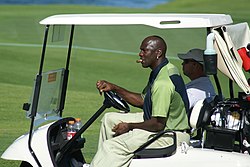
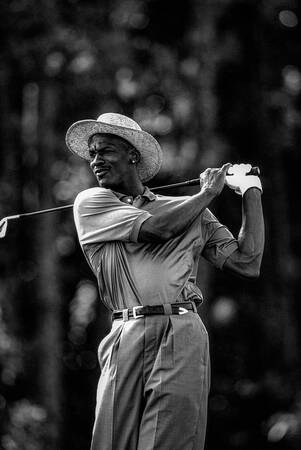
Jordan on a golf course in 2007
After his third retirement, Jordan assumed that he would be able to return to his position as Director of Basketball Operations with the Wizards.[305] Jordan’s previous tenure had produced mixed results and may have also influenced the trade of Richard “Rip” Hamilton for Jerry Stackhouse, although Jordan was not technically Director of Basketball Operations in 2002.[175] On May 7, 2003, Wizards owner Abe Pollin fired Jordan from the role.[175] Jordan later stated that he felt betrayed, and that if he had known he would be fired upon retiring, he never would have come back to play for the Wizards.[306]
Over the next few years, Jordan played golf in celebrity charity tournaments and spent time with his family in Chicago. He also promoted his Jordan Brand clothing line and rode motorcycles.[307] Since 2004, Jordan has owned Michael Jordan Motorsports, a professional closed-course motorcycle road racing team that competed with two Suzukis in the premier Superbike championship sanctioned by the American Motorcyclist Association (AMA) until the end of the 2013 season.[308][309]
Charlotte Bobcats / Hornets
On June 15, 2006, Jordan bought a minority stake in the Charlotte Bobcats (known as the Hornets since 2013), becoming the team’s second-largest shareholder behind majority owner Robert L. Johnson. As part of the deal, Jordan took full control over the basketball side of the operation, with the title Managing Member of Basketball Operations.[310][311] Despite his previous success as an endorser, Jordan made an effort not to be included in Charlotte’s marketing campaigns.[312] A decade earlier, he had made a bid to become part-owner of Charlotte’s original NBA team, the Charlotte Hornets (now the New Orleans Pelicans), but talks collapsed when owner George Shinn refused to give Jordan complete control of basketball operations.[313][314]
In February 2010, it was reported that Jordan was seeking majority ownership of the Bobcats.[315] Jordan and former Houston Rockets president George Postolos were the leading contenders for ownership of the team. On February 27, the Bobcats announced that Johnson had reached an agreement with Jordan and his group, MJ Basketball Holdings, to buy the team from Johnson pending NBA approval.[316] On March 17, the NBA Board of Governors unanimously approved Jordan’s purchase, making him the first former player to become the majority owner of an NBA team,[317] and the league’s only African-American majority owner.[318]
During the 2011 NBA lockout, The New York Times wrote that Jordan led a group of 10 to 14 hardline owners who wanted to cap the players’ share of basketball-related income at 50 percent and as low as 47. Journalists observed that, during the labor dispute in 1998, Jordan told Washington Wizards then-owner Abe Pollin: “If you can’t make a profit, you should sell your team.”[319] Jason Whitlock of FoxSports.com called Jordan “a hypocrite sellout who can easily betray the very people who made him a billionaire global icon” for wanting “current players to pay for his incompetence”.[320] He cited Jordan’s executive decisions to draft disappointing players Kwame Brown and Adam Morrison.[320]
During the 2011–12 NBA season that was shortened to 66 games by the lockout, the Bobcats posted a 7–59 record. The team closed out the season with a 23-game losing streak; their .106 winning percentage was the worst in NBA history.[321] Before the next season, Jordan said: “I’m not real happy about the record book scenario last year. It’s very, very frustrating.”[322]
During the 2019 NBA offseason, Jordan sold a minority piece of the Hornets to Gabe Plotkin and Daniel Sundheim, retaining the majority for himself,[323] as well as the role of chairman.[324] In 2023, Jordan finalized the sale of his majority stake to Plotkin and Rick Schnall, ending his 13-year tenure as majority owner, although he kept a minority stake.[325] The sale was officially completed in August 2023 for approximately $3 billion, more than 10 times the $275 million Jordan had paid for the team.[326]
23XI Racing
Jordan at Pocono Raceway in 2021
On September 21, 2020, Jordan and NASCAR driver Denny Hamlin announced they would be fielding a NASCAR Cup Series team with Bubba Wallace driving, beginning competition in the 2021 season.[327] On October 22, the team’s name was confirmed to be 23XI Racing (pronounced twenty-three eleven) and the team’s entry would bear No. 23.[328] After the team’s inaugural season, it added a second car with No. 45, driven by Kurt Busch in 2022 and Tyler Reddick in 2023.[329][330] Ty Gibbs, John Hunter Nemechek, and Daniel Hemric also drove for 23XI as substitutes during the 2022 season.[331][332][333] The team fielded a third car, No. 67, driven by Travis Pastrana in the 2023 Daytona 500.[334] Reddick won the 2024 NASCAR Cup Series regular season championship, the first for the team.[335] 23XI Racing acquired a third charter from the defunct Stewart–Haas Racing, the No. 35 driven by Riley Herbst beginning in 2025.[336] Jordan, Hamlin, and his team, along with Front Row Motorsports sued NASCAR in October 2024, over the new charter agreements;[337] the case was later settled on December 11, 2025, after 8 days in court.[338] Jordan’s car driven by Tyler Reddick would go on to win the 2026 Daytona 500, officially making Michael Jordan a Daytona 500 champion.
Personal life
Relationships
Jordan (left) receiving the Presidential Medal of Freedom from President Barack Obama at the White House
Jordan married Juanita Vanoy at A Little White Wedding Chapel in Las Vegas on September 2, 1989.[339][340] They had three children, including Jeffrey and Marcus.[341] The Jordans filed for divorce on January 4, 2002, citing irreconcilable differences, but reconciled shortly thereafter. They again filed for divorce and were granted a dissolution of marriage on December 29, 2006, commenting that the decision was made “mutually and amicably”.[342][343] It is reported that Juanita received a $168 million settlement (equivalent to $268 million in 2025), the largest celebrity divorce settlement on public record at the time.[344][345]
In 1991, Jordan purchased a lot in Highland Park, Illinois, where he planned to build a 56,000-square-foot (5,200 m2) mansion. It was completed in 1995. Jordan listed the mansion for sale in 2012.[346] He also owns homes in North Carolina and Jupiter Island, Florida.[347]
On July 21, 2006, a judge in Cook County, Illinois, determined that Jordan did not owe his alleged former lover Karla Knafel $5 million in a breach of contract claim.[348] Jordan had allegedly paid Knafel $250,000 to keep their relationship a secret.[349][350][351] Knafel claimed Jordan promised her $5 million for remaining silent and agreeing not to file a paternity suit after Knafel learned she was pregnant in 1991; a DNA test showed that Jordan was not the father of the child.[348]
Jordan proposed to his longtime girlfriend, Cuban-American model Yvette Prieto, on Christmas 2011,[352] and they were married on April 27, 2013, at Bethesda-by-the-Sea Episcopal Church.[353][354] It was announced on November 30, 2013, that the two were expecting their first child together.[355][356] On February 11, 2014, Prieto gave birth to identical twin daughters.[357] In 2019, Jordan became a grandfather when his daughter Jasmine gave birth to a son, whose father is professional basketball player Rakeem Christmas.[358]
Gambling
During the 1993 NBA playoffs, Jordan was seen gambling in Atlantic City.[359] The previous year, he admitted that he had to cover $57,000 in gambling losses,[360] and author Richard Esquinas wrote a book in 1993 claiming he had won $1.25 million from Jordan on the golf course.[361]
In 2005, Jordan discussed his gambling with Ed Bradley of 60 Minutes and admitted that he made reckless decisions:
Yeah, I’ve gotten myself into situations where I would not walk away and I’ve pushed the envelope. Is that compulsive? Yeah, it depends on how you look at it. If you’re willing to jeopardize your livelihood and your family, then yeah.
When Bradley asked him if his gambling ever got to the level where it jeopardized his livelihood or family, Jordan replied: “No.”[306] David Stern, the commissioner of the NBA, denied in 1995 and 2006 that Jordan’s 1993 retirement was a secret suspension by the league for gambling,[362][363] but the rumor spread widely.[364] In 2010, Ron Shelton, director of Jordan Rides the Bus, said that he began working on the documentary believing that the NBA had suspended him, but that research “convinced [him it] was nonsense”.[364]
Politics
In 1990, Jordan declined to endorse Democratic candidate Harvey Gantt in his race against incumbent U.S. Senator Jesse Helms, reportedly remarking, “Republicans buy sneakers, too.”[365] In The Last Dance, Jordan confirmed he made the comment on a team bus but clarified it was intended as a joke, adding that he did not view himself as a political activist.[366]
Media figure and business interests
Endorsements
Jordan wearing his signature shoe, Air Jordans, in a preseason game on October 18, 1984.
Jordan is one of the most marketed sports figures in history. He has been a major spokesman for such brands as Nike, Coca-Cola, Chevrolet, Gatorade, McDonald’s, Ball Park Franks, Rayovac, Wheaties, Hanes, and MCI.[367] Early in his career, Jordan appeared in an anti-drug advertisement sponsored by McDonald’s.[368] Jordan has appeared in over 20 commercials for Gatorade since 1991, including the “Be Like Mike” commercials in which a song was sung by children wishing to be like Jordan.[367][369] Nike created a signature shoe for Jordan, called the Air Jordan, in 1984.[370] One of his more popular commercials for the shoe involved Spike Lee playing the part of Mars Blackmon: Lee, as Blackmon, attempted to find the source of Jordan’s abilities and became convinced that “it’s gotta be the shoes”.[367] The hype and demand for the shoes brought on a spate of “shoe-jackings”, in which people were robbed of their sneakers at gunpoint. Subsequently, Nike spun off the Jordan line into its own division named the “Jordan Brand”, with athletes and celebrities as endorsers.[371][372] The brand has also sponsored college sports programs such as those of North Carolina, UCLA, California, Oklahoma, Florida, Georgetown, and Marquette.[373][374]
Jordan also has been associated with the Looney Tunes cartoons. A Nike commercial shown during 1992’s Super Bowl XXVI featured Jordan and Bugs Bunny playing basketball.[375] This commercial inspired the 1996 live action/animated film Space Jam, which starred Jordan and Bugs in a story set during the former’s first retirement from basketball.[376] They have subsequently appeared together in several commercials for MCI.[376] Jordan also made an appearance in the music video for Michael Jackson’s “Jam” (1992).[377]
Since 2008, Jordan’s yearly income from endorsements is estimated at over $40 million.[378][379] When his power at the ticket gates was at its highest point, the Bulls regularly sold out both their home and road games.[380] Due to this, Jordan set records in player salary by signing annual contracts worth in excess of US$30 million per season.[381] An academic study found that his first NBA comeback resulted in an increase in the market capitalization of his client firms of more than $1 billion.[382]
Most of Jordan’s endorsement deals, including his first deal with Nike, were engineered by his agent, David Falk.[383] Jordan has described Falk as “the best at what he does” and that “marketing-wise, he’s great. He’s the one who came up with the concept of ‘Air Jordan’.”[384]
Business ventures and wealth
In June 2010, Jordan was ranked by Forbes as the 20th-most-powerful celebrity in the world, with $55 million earned between June 2009 and June 2010. According to Forbes, Jordan Brand generates $1 billion in sales for Nike.[385] In June 2014, Jordan was named the first NBA player to become a billionaire, after he increased his stake in the Charlotte Hornets from 80% to 89.5%.[386][387] Jordan was honored with the Charlotte Business Journal’s Business Person of the Year for 2014.[388] In 2017, he became a part owner of the Miami Marlins of Major League Baseball.[389]
Forbes designated Jordan as the athlete with the highest career earnings in 2017.[390] From his Jordan Brand income and endorsements, Jordan’s 2015 income was an estimated $110 million, the most of any retired athlete.[391] As of 2026, his net worth is estimated at $4.3 billion by Forbes,[15] making him the fourth-richest African-American,[392] and one of the richest celebrities.[393] In April 2026, Sportico ranked Jordan as the highest-paid athlete in history (as of December 31, 2025). His earnings were estimated at $4.5 billion when adjusted for inflation.[394][395]
Jordan co-owns an automotive group which bears his name. The company has a Nissan dealership in Durham, North Carolina, acquired in 1990,[396] and formerly had a Lincoln–Mercury dealership from 1995 until its closure in 2009.[397][398] The company also owned a Nissan franchise in Glen Burnie, Maryland.[397] The restaurant industry is another business interest of Jordan’s. Restaurants he has owned include a steakhouse in New York City’s Grand Central Terminal;[399] that restaurant closed in 2018.[400] Jordan is the majority investor in a golf course, Grove XXIII in Hobe Sound, Florida.[401]
In September 2020, Jordan became an investor and advisor for DraftKings.[402]
Philanthropy
From 2001 to 2014, Jordan hosted an annual golf tournament, the Michael Jordan Celebrity Invitational, that raised money for various charities.[403] In 2006, Jordan and his wife Juanita pledged $5 million to Chicago’s Hales Franciscan High School.[404] The Jordan Brand has made donations to Habitat for Humanity and a Louisiana branch of the Boys & Girls Clubs of America.[405]
The Make-A-Wish Foundation named Jordan its Chief Wish Ambassador in 2008.[403] In 2013, he granted his 200th wish for the organization.[406] As of 2019, Jordan has raised more than $5 million for the Make-A-Wish Foundation.[403] In 2023, he donated $10 million to the organization for his 60th birthday.[407]
In 2015, Jordan donated a settlement of undisclosed size from a lawsuit against supermarkets that had used his name without permission to 23 different Chicago charities.[408] In 2017, Jordan gave $7 million to fund two Novant Health Michael Jordan Family Clinics in Charlotte, North Carolina, his biggest donation to that point.[409] The following year, after Hurricane Florence damaged parts of North Carolina, Jordan donated $2 million to relief efforts.[410] He gave $1 million to aid the Bahamas’ recovery following Hurricane Dorian in 2019.[411]
In 2016, amidst the public uproar about the police shootings of two African-American men, Alton Sterling and Philando Castile, and two deadly attacks against police officers in Dallas and Baton Rouge, Jordan made $1 million donations to the NAACP Legal Defense Fund and the Institute for Community-Police Relations. Jordan said the goal is to “build trust and respect between communities and law enforcement.” He also said:
I can no longer stay silent. We need to find solutions that ensure people of color receive fair and equal treatment AND that police officers – who put their lives on the line every day to protect us all – are respected and supported.[412]
On June 5, 2020, in the wake of the protests following the murder of George Floyd, Jordan and his brand announced in a joint statement that they would be donating $100 million over the next 10 years to organizations dedicated to “ensuring racial equality, social justice and greater access to education”.[413] In February 2021, Jordan funded two Novant Health Michael Jordan Family Clinics in New Hanover County, North Carolina, by giving $10 million.[414][415] In 2024, he funded the opening of another Novant Health Clinic, this time in Wilmington.[416]
Film and television
Jordan played himself in the 1996 comedy film Space Jam. The film received mixed reviews,[417] but it was a box office success, making $230 million worldwide, and earned more than $1 billion through merchandise sales.[418]
In 2000, Jordan was the subject of an IMAX documentary about his career with the Chicago Bulls, especially the 1998 NBA playoffs, titled Michael Jordan to the Max.[419] Two decades later, the same period of Jordan’s life was covered in much greater and more personal detail by the Emmy Award-winning The Last Dance, a 10-part TV documentary which debuted on ESPN in 2020. The Last Dance relied heavily on about 500 hours of candid film of Jordan’s and his teammates’ off-court activities which an NBA Entertainment crew had shot during the 1997–98 NBA season for use in a documentary. The project was delayed for many years because Jordan had not yet given his permission for the footage to be used.[420][421] Jordan was interviewed at three homes associated with the production and did not want cameras in his home or on his plane, as according to director Jason Hehir “there are certain aspects of his life that he wants to keep private”.[422] Jordan appeared in the 2022 miniseries The Captain, which follows the life and career of Derek Jeter.[423]
In May 2025, Jordan was announced as a special contributor for the revived NBA on NBC;[424] his role was later revealed to be MJ: Insights to Excellence, a segment featuring excerpts from an interview he conducted with NBC’s lead host Mike Tirico.[425][426][427]
Books
Jordan has authored several books:
Rare Air: Michael on Michael, with Mark Vancil and Walter Iooss (Harper San Francisco, 1993).[428][429]
I Can’t Accept Not Trying: Michael Jordan on the Pursuit of Excellence, with Mark Vancil and Sandro Miller (Harper San Francisco, 1994).[430]
For the Love of the Game: My Story, with Mark Vancil (Crown Publishers, 1998).[431]
Driven from Within, with Mark Vancil (Atria Books, 2005).[432]
See also
Forbes‘ list of the world’s highest-paid athletes
List of athletes who came out of retirement
List of most valuable celebrity memorabilia
List of multi-sport athletes
List of NBA teams by single season win percentage
African-American upper class
Black billionaires
Black elite
Michael Jordan’s Restaurant – Restaurant and sports bar in Chicago, Illinois, US
Video games
Jordan vs. Bird: One on One – 1988 sports video game
Michael Jordan in Flight – 1993 sports video game
Michael Jordan: Chaos in the Windy City – 1994 video game
NBA 2K11 – 2010 basketball video game
NBA 2K12 – 2011 basketball video game
Notes
Jordan’s weight fluctuated from 195 to 218 lb (88 to 99 kg) during the course of his professional career;[1][2][3] his NBA listed weight was 216 lb (98 kg).[4][5][6]
Jordan wore a nameless No. 12 jersey in a February 14, 1990, game against the Orlando Magic because his No. 23 jersey had been stolen.[7]
As part of the 1992 Olympic team
This is excluding ancient Roman charioteer Gaius Appuleius Diocles (104 – c. 146) who had a net worth of approximately $15 billion.[14]
A 2024 study by Tom Haberstroh found that Jordan was credited with several steals during the season which did not and could not have taken place. For example, during several home games, Jordan was credited with more steals than the opposing team had live-ball turnovers.
Referenc
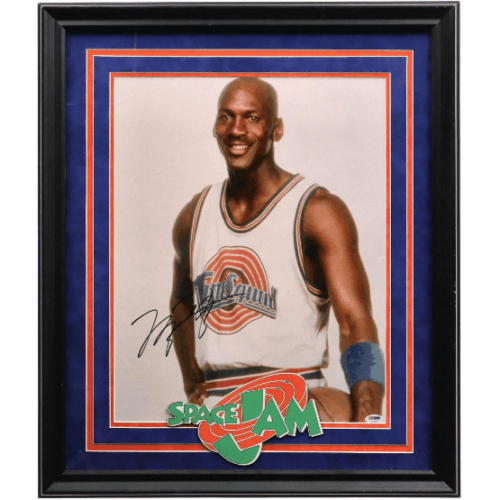
Michael Jordan
Michael Jordan
Jordan in 2014
Charlotte Hornets
Title
Minority owner
League
NBA
Personal information
Born
February 17, 1963 (age 63)
New York City, New York, U.S.
Listed height
6 ft 6 in (1.98 m)
Listed weight
216 lb (98 kg)[a]
Career information
High school
Emsley A. Laney (Wilmington, North Carolina)
College
North Carolina (1981–1984)
NBA draft
1984: 1st round, 3rd overall pick
Drafted by
Chicago Bulls
Playing career
1984–1993, 1995–1998, 2001–2003
Position
Shooting guard / small forward
Number
23, 12,[b] 45
Career history
1984–1993, 1995–1998
Chicago Bulls
2001–2003
Washington Wizards
Career highlights
6× NBA champion (1991–1993, 1996–1998)
6× NBA Finals MVP (1991–1993, 1996–1998)
5× NBA Most Valuable Player (1988, 1991, 1992, 1996, 1998)
14× NBA All-Star (1985–1993, 1996–1998, 2002, 2003)
3× NBA All-Star Game MVP (1988, 1996, 1998)
10× All-NBA First Team (1987–1993, 1996–1998)
All-NBA Second Team (1985)
NBA Defensive Player of the Year (1988)
9× NBA All-Defensive First Team (1988–1993, 1996–1998)
NBA Rookie of the Year (1985)
NBA All-Rookie First Team (1985)
10× NBA scoring champion (1987–1993, 1996–1998)
3× NBA steals leader (1988, 1990, 1993)
2× NBA Slam Dunk Contest champion (1987, 1988)
No. 23 retired by Chicago Bulls
No. 23 retired by Miami Heat
3× AP Athlete of the Year (1991–1993)
Sports Illustrated Sportsperson of the Year (1991)
NBA anniversary team (50th, 75th)
NCAA champion (1982)
Consensus national college player of the year (1984)
2× Sporting News National Player of the Year (1983, 1984)
2× Consensus first-team All-American (1983, 1984)
ACC Player of the Year (1984)
ACC Athlete of the Year (1984)
2× First-team All-ACC (1983, 1984)
ACC Rookie of the Year (1982)
No. 23 retired by North Carolina Tar Heels
3× USA Basketball Male Athlete of the Year (1983, 1984, 1992[c])
McDonald’s All-American (1981)
First-team Parade All-American (1981)
Presidential Medal of Freedom (2016)
Career NBA statistics
Points
32,292 (30.1 ppg)
Rebounds
6,672 (6.2 rpg)
Assists
5,633 (5.3 apg)
Stats at NBA.com
Stats at Basketball Reference
Basketball Hall of Fame
FIBA Hall of Fame
Medals
Men’s basketball
Representing the United States
Olympic Games
1984 Los Angeles
Men’s basketball
1992 Barcelona
Men’s basketball
Tournament of the Americas
1992 Portland
Men’s basketball
Pan American Games
1983 Caracas
Men’s basketball
Michael Jeffrey Jordan (born February 17, 1963), also known by his initials MJ,[8] is an American businessman and retired professional basketball player who is a minority owner of the Charlotte Hornets of the National Basketball Association (NBA). He played 15 seasons in the NBA between 1984 and 2003, winning six NBA championships with the Chicago Bulls. Widely considered one of the greatest basketball players of all time,[9][10][11] he was integral in popularizing basketball and the NBA around the world in the 1980s and 1990s.[12] He is the wealthiest athlete of all time,[13][d] and one of the world’s richest celebrities, with a $4.3 billion net worth as of 2026.[15]
Jordan played college basketball with the North Carolina Tar Heels. As a freshman, he was a member of the Tar Heels’ national championship team in 1982.[5] As a junior in 1984, he was named the national college player of the year and was selected by the Bulls with the third overall pick of the 1984 NBA draft.[5][16] With the Bulls, he emerged as a league star known for prolific scoring, defensive prowess and vehement competitiveness.[17][18] His leaping ability, demonstrated by performing slam dunks from the free-throw line in Slam Dunk Contests, earned him the nicknames “Air Jordan” and “His Airness“.[5] Jordan won his first NBA title with the Bulls in 1991 and followed that with titles in 1992 and 1993, securing a three-peat. Citing physical and mental exhaustion from basketball and superstardom, Jordan abruptly retired before the 1993–94 NBA season to play Minor League Baseball in the Chicago White Sox organization. He returned to the Bulls in 1995 and led them to three more championships in 1996, 1997, and 1998, as well as a then-record 72 regular season wins in the 1995–96 NBA season.[5] Jordan retired for the second time in 1999, then returned for two NBA seasons from 2001 to 2003 as a member of the Washington Wizards.[5][16] He was selected to play for the United States national team during his college and NBA careers, winning four gold medals—at the 1983 Pan American Games, 1984 Summer Olympics, 1992 Tournament of the Americas and 1992 Summer Olympics—while also being undefeated.[19]
Jordan’s individual accolades include six NBA Finals Most Valuable Player (MVP) awards, 10 NBA scoring titles (both all-time records), five NBA MVP awards, 10 All-NBA First Team designations, nine All-Defensive First Team honors, 14 NBA All-Star Game selections, and three NBA All-Star Game MVP awards.[16] He holds the NBA records for career regular season scoring average (30.1 points per game) and career playoff scoring average (33.4 points per game).[20] He is one of only eight players to achieve the basketball Triple Crown. In 1999, Jordan was named the 20th century’s greatest North American athlete by ESPN and was second to Babe Ruth on the Associated Press’ list of athletes of the century.[5] Jordan was twice inducted into the Naismith Memorial Basketball Hall of Fame, once in 2009 for his individual career,[21] and in 2010 as part of the 1992 United States men’s Olympic basketball team (“The Dream Team”).[22] The trophy for the NBA Most Valuable Player Award is named in his honor.
One of the most effectively marketed athletes ever, Jordan made many product endorsements.[12][23] He fueled the success of Nike’s Air Jordan sneakers, which were introduced in 1984 and remain popular.[24] Jordan starred as himself in the live-action/animation hybrid film Space Jam (1996) and was the focus of the Emmy-winning documentary series The Last Dance (2020). He became part-owner and head of basketball operations for the Charlotte Hornets (then named the Bobcats) in 2006 and bought a controlling interest in 2010, before selling his majority stake in 2023. Jordan is a co-owner of 23XI Racing in the NASCAR Cup Series. In 2014, he became the first billionaire player in NBA history.[25] In 2016, President Barack Obama awarded Jordan the Presidential Medal of Freedom.[26]
Early life
Michael Jeffrey Jordan was born on February 17, 1963, at Cumberland Hospital in the Fort Greene neighborhood of Brooklyn, New York City,[27][28] to bank employee Deloris (née Peoples) and equipment supervisor James R. Jordan Sr.[28][29] He has two older brothers, James Jr. and Larry, as well as an older sister named Deloris and a younger sister named Roslyn.[30][31] Jordan and his siblings were raised Methodist.[32]
In 1968, the family moved to Wilmington, North Carolina.[33] Jordan attended Emsley A. Laney High School, where he played basketball, baseball, and football. He tried out for the basketball varsity team during his sophomore year, but at a height of 5 feet 11 inches (1.80 m), he was deemed too short.[34][35] Motivated to prove his worth, Jordan became the star of Laney’s junior varsity team and tallied some 40-point games.[34] The following summer, he grew four inches (10 cm) and trained rigorously.[35] Upon earning a spot on the varsity roster, Jordan averaged more than 25 points per game (ppg) over his final two seasons of high school play.[36] He also adopted his signature jersey number, 23.[37] As a senior, he was selected for the 1981 McDonald’s All-American Game and scored 30 points,[38][39] after averaging 26.8 ppg,[36] 11.6 rebounds (rpg), and 10.1 assists per game (apg) for the season.[40]
Jordan was recruited by numerous college basketball programs, including Duke, North Carolina, South Carolina, Syracuse, Virginia, and Clemson.[41][42] He reportedly most strongly considered recruiting efforts from North Carolina, NC State, and Maryland before, in 1980,[42] he accepted a basketball scholarship to the University of North Carolina at Chapel Hill, where he majored in cultural geography.[43] He chose this field of study because of its relationship to meteorology, as Jordan was interested in a career as a meteorologist.[44][45]
College career
Jordan hitting the game winning shot against Georgetown in the 1982 NCAA championship game
As a freshman under coach Dean Smith’s team-oriented system, Jordan was named ACC Freshman of the Year after averaging 13.4 points per game on 53.4% shooting—ranking 10th in scoring and sixth in field goal percentage in the conference.[46][47] He made the game-winning jump shot in the 1982 NCAA Championship game against Georgetown, which was led by future NBA rival Patrick Ewing.[48] Jordan later described this shot as the major turning point in his basketball career.[49][50] During his sophomore and junior seasons, Jordan consistently ranked among the ACC’s elite, finishing either 1st or 2nd in both total points and points per game, while also placing in the top 10 in field goal percentage and free throw percentage.[51][52] In his three seasons with the Tar Heels, Jordan averaged 17.7 ppg on 54.0% shooting and added 5.0 rpg and 1.8 apg.[16]
Jordan was selected by consensus to the NCAA All-American First Team in both his sophomore (1983) and junior (1984) seasons.[53][54] After winning the Naismith and the Wooden College Player of the Year awards in 1984, Jordan left North Carolina a year before his scheduled graduation to enter the 1984 NBA draft. Jordan returned to North Carolina to complete his degree in 1986,[55] when he graduated with a Bachelor of Arts degree in geography.[56][57] In 2002, Jordan was selected to the ACC 50th Anniversary men’s basketball team and named the greatest athlete in ACC history.[58][59]
Professional career
Chicago Bulls (1984–1993; 1995–1998)
Early NBA years (1984–1987)
Jordan holding his Chicago Bulls jersey at conference announcing his signing.
The Chicago Bulls selected Jordan with the third overall pick of the 1984 NBA draft after Hakeem Olajuwon (Houston Rockets) and Sam Bowie (Portland Trail Blazers). One of the primary reasons why Jordan was not drafted sooner was because the first two teams were in need of a center.[60] Trail Blazers general manager Stu Inman contended that it was not a matter of drafting a center but more a matter of taking Bowie over Jordan, in part because Portland already had Clyde Drexler, who was a guard with similar skills to Jordan.[61] Citing Bowie’s injury-laden college career, ESPN named the Blazers’ choice of Bowie as the worst draft pick in North American professional sports history.[62]
Jordan made his NBA debut at Chicago Stadium on October 26, 1984, and scored 16 points. In 2021, a ticket stub from the game sold at auction for $264,000, setting a record for a collectible ticket stub.[63] During his rookie 1984–85 season with the Bulls, Jordan averaged 28.2 ppg on 51.5% shooting.[46] He helped the Bulls improve from 27–55 to 38–44 and qualify for the postseason for the first time since the 1980–81 season.[64] Jordan quickly became a fan favorite even in opposing arenas.[65][66][67] Roy S. Johnson of The New York Times described Jordan as “the phenomenal rookie of the Bulls” in November,[67] and he appeared on the cover of Sports Illustrated with the heading “A Star Is Born” in December.[68][69] The fans voted in Jordan as an All-Star starter during his rookie season.[5] Controversy arose before the 1985 NBA All-Star Game when word surfaced that several veteran players, led by Isiah Thomas, were upset by the amount of attention Jordan was receiving.[5] This led to a so-called “freeze-out” on Jordan, where players refused to pass the ball to him.[5] The controversy left Jordan relatively unaffected when he returned to regular season play, and he would go on to be voted the NBA Rookie of the Year.[70] The Bulls lost to the Milwaukee Bucks in four games in the first round of the playoffs.[70]
An often-cited moment was on August 26, 1985,[36][71] when Jordan shook the arena during a Nike exhibition game in Trieste, Italy, by shattering the glass of the backboard with a dunk.[72][73] The moment was filmed and is often referred to as an important milestone in Jordan’s rise.[73][74] The shoes Jordan wore during the game were auctioned in August 2020 for $615,000, a record for a pair of sneakers.[75][76] Jordan’s 1985–86 season was cut short when he broke his foot in the third game of the year, causing him to miss 64 games.[77] The Bulls made the playoffs despite Jordan’s injury and a 30–52 record,[78] at the time the fifth-worst record of any team to qualify for the playoffs in NBA history.[79] Jordan recovered in time to participate in the postseason and performed well upon his return. On April 20 at the Boston Garden, in Game 2 of the First Round, a 135–131 double overtime loss to the eventual NBA champion Boston Celtics, Jordan scored a playoff career-high 63 points, breaking Elgin Baylor’s single-game playoff scoring record.[80] The Celtics team, though, swept the series in three games.[70][80][81] Jordan completely recovered in time for the 1986–87 season,[82] and had one of the most prolific scoring seasons in NBA history; he became the only player other than Wilt Chamberlain to score 3,000 points in a season, averaging a league-high 37.1 ppg on 48.2% shooting.[46][83] Jordan also demonstrated his defensive prowess, as he became the first player in NBA history to record 200 steals and 100 blocked shots in a season.[84] Despite Jordan’s success, Magic Johnson won the NBA Most Valuable Player Award.[85] The Bulls reached 40 wins,[78] and advanced to the playoffs for the third consecutive year but were again swept by the Celtics.[70]
Pistons roadblock (1987–1990)
Jordan led the league in scoring during the 1987–88 season, averaging 35.0 ppg on 53.5% shooting,[46] and won his first league MVP Award. He was named the NBA Defensive Player of the Year after averaging 1.6 blocks per game (bpg), a league-high 3.1 steals per game (spg),[86][e] and leading the Bulls defense to the fewest points per game allowed in the league.[88] The Bulls finished 50–32,[78] and made it past the first round of the playoffs for the first time in Jordan’s career, as they defeated the Cleveland Cavaliers in five games.[89] In the Eastern Conference Semifinals, the Bulls lost in five games to the more experienced Detroit Pistons,[70] who were led by Isiah Thomas and a group of physical players known as the “Bad Boys”.[90]
In the 1988–89 season, Jordan again led the league in scoring, averaging 32.5 ppg on 53.8% shooting from the field, along with 8.0 rpg and 8.0 apg.[46] During the season, Jordan expressed his frustration over the Bulls’ offense with head coach Doug Collins, who then put Jordan at point guard. In his time as a point guard, Jordan had 10 triple-doubles in 11 games, with averages of 33.6 ppg, 11.4 rpg, and 10.8 apg.[91]
The Bulls finished with a 47–35 record,[78] and advanced to the Eastern Conference Finals, defeating the Cavaliers and New York Knicks along the way.[92] The Cavaliers series included a career highlight for Jordan when he hit “The Shot” over Craig Ehlo at the buzzer in the fifth and final game of the series.[93] In the Eastern Conference Finals, the Pistons again defeated the Bulls, this time in six games,[70] by utilizing their “Jordan Rules” method of guarding Jordan, which consisted of double and triple teaming him every time he touched the ball.[5]
The Bulls entered the 1989–90 season as a team on the rise, with their core group of Jordan and young improving players like Scottie Pippen and Horace Grant and under the guidance of new coach Phil Jackson.[94] On March 28, 1990, Jordan scored a career-high 69 points in a 117–113 road win over the Cavaliers.[95] He averaged a league-leading 33.6 ppg on 52.6% shooting, to go with 6.9 rpg and 6.3 apg,[46] in leading the Bulls to a 55–27 record.[78] They again advanced to the Eastern Conference Finals after beating the Bucks and Philadelphia 76ers;[96] despite pushing the series to seven games, the Bulls lost to the Pistons for the third consecutive season.[70]
First three-peat (1991–1993)
After the Bulls’ previous losses to the Pistons, Phil Jackson, along with assistant coach Tex Winter, focused on implementing the triangle offense to counteract the Pistons’ defense and other teams that heavily targeted Jordan. This system, however, required Jordan to adjust his playing style.[97][98] In his book Eleven Rings, Jackson recalled, “I was planning to ask Michael to reduce the number of shots he took so that other members of the team could get more involved in the offense. I knew this would be a challenge for him.”[99] In The Last Dance, Jordan admitted he was initially reluctant to back the system.[98] Nevertheless, he eventually embraced the change, which led to success for the team.[100]
In the 1990–91 season, Jordan won his second MVP award after averaging 31.5 ppg on 53.9% shooting, 6.0 rpg, and 5.5 apg for the regular season.[46] The Bulls finished in first place in their division for the first time in sixteen years and set a franchise record with 61 wins in the regular season.[78] With Scottie Pippen developing into an All-Star, the Bulls had elevated their play. The Bulls defeated the New York Knicks and the Philadelphia 76ers in the opening two rounds of the playoffs. They advanced to the Eastern Conference Finals, where their rival, the Detroit Pistons, awaited them;[101] this time, the Bulls beat the Pistons in a four-game sweep.[102]
The Bulls advanced to the Finals for the first time in franchise history to face the Los Angeles Lakers. The Bulls won the series in five games and compiled a 15–2 playoff record along the way.[101] Perhaps the best-known moment of the series came in Game 2 when, attempting a dunk, Jordan avoided a potential Sam Perkins block by switching the ball from his right hand to his left in mid-air to lay the shot into the basket.[103] In his first Finals appearance, Jordan had 31.2 ppg on 56% shooting from the field, 11.4 apg, 6.6 rpg, 2.8 spg, and 1.4 bpg.[104] Jordan won his first NBA Finals MVP award[105] and cried while holding the Finals trophy.[106]
Jordan and the Bulls continued their dominance in the 1991–92 season, establishing a 67–15 record, topping their franchise record from the 1990–91 campaign.[78] Jordan won his second consecutive MVP award with averages of 30.1 ppg, 6.4 rpg, and 6.1 apg on 52% shooting.[86] After winning a physical seven-game series over the New York Knicks in the second round of the playoffs and finishing off the Cleveland Cavaliers in the Conference Finals in six games, the Bulls met Clyde Drexler and the Portland Trail Blazers in the Finals. The media, hoping to recreate a Magic–Bird rivalry, highlighted the similarities between “Air” Jordan and Clyde “The Glide” during the pre-Finals hype.[107]
In a Game 1 victory, Jordan scored a Finals-record 35 points in the first half, including a record-setting six three-point field goals.[108] After the sixth three-pointer, he jogged down the court shrugging as he looked courtside. Marv Albert, who broadcast the game, later stated that it was as if Jordan was saying: “I can’t believe I’m doing this.”[109] The Bulls went on to defeat the Blazers in six games. Jordan was named Finals MVP for the second year in a row,[105] and finished the series averaging 35.8 ppg, 4.8 rpg, and 6.5 apg, while shooting 52.6% from the floor.[110]
In the 1992–93 season, despite a 32.6 ppg, 6.7 rpg, and 5.5 apg campaign, including a second-place finish in Defensive Player of the Year voting,[86][111] Jordan’s streak of consecutive MVP seasons ended, as he lost the award to his friend Charles Barkley,[85] upsetting him.[112] Jordan and the Bulls met Barkley and his Phoenix Suns in the 1993 NBA Finals. The Bulls won their third NBA championship on a game-winning shot by John Paxson and a last-second block by Horace Grant, but Jordan was once again Chicago’s leader. He averaged a Finals-record 41.0 ppg during the six-game series,[113] and became the first player in NBA history to win three consecutive Finals MVP awards.[105] Jordan scored more than 30 points in every game of the series, including 40 or more points in four consecutive games.[114] With his third Finals triumph, Jordan capped off a seven-year run where he attained seven scoring titles and three championships, but there were signs that Jordan was tiring of his massive celebrity and all of the non-basketball hassles in his life.[115]
First retirement and stint in Minor League Baseball (1993–1995)
Michael Jordan
Jordan in training with the Scottsdale Scorpions in 1994
Birmingham Barons – No. 45, 35
Outfielder
Batted: Right
Threw: Right
Professional debut
Southern League: April 8, 1994, for the Birmingham Barons
Arizona Fall League: 1994, for the Scottsdale Scorpions
Last Southern League appearance
March 10, 1995, for the Birmingham Barons
Southern League statistics (through 1994)
Batting average
.202
Home runs
3
Runs batted in
51
Arizona Fall League statistics
Batting average
.252
Runs batted in
8
Stats at Baseball Reference
Teams
Birmingham Barons (1994–1995)
Scottsdale Scorpions (1994)
On October 6, 1993, Jordan announced his retirement, saying that he lost his desire to play basketball. He later said that the murder of his father three months earlier helped shape his decision.[116] James R. Jordan Sr. was murdered on July 23, 1993, at a highway rest area in Lumberton, North Carolina, by two teenagers, Daniel Green and Larry Martin Demery, who carjacked his Lexus.[117][118] His body, dumped in a South Carolina swamp, was not discovered until August 3.[118] Green and Demery were sentenced to life imprisonment.[119] However, in The Last Dance, Jordan stated that he retired due to physical and mental exhaustion from basketball and superstardom.[120]
Jordan was close to his father; as a child, Jordan imitated the way his father stuck out his tongue while absorbed in work. Jordan later adopted it as his own signature, often displaying it as he drove to the basket.[5] In 1996, Jordan founded a Chicago-area Boys & Girls Club and dedicated it to his father.[121][122] In his 1998 autobiography For the Love of the Game, Jordan wrote that he was preparing for retirement as early as the summer of 1992.[123] The added exhaustion due to the “Dream Team” run in the 1992 Summer Olympics solidified Jordan’s feelings about the game and his celebrity status. Jordan’s announcement sent shock waves throughout the NBA and appeared on the front pages of newspapers around the world.[124]
Jordan further surprised the sports world by signing a Minor League Baseball (MiLB) contract with the Chicago White Sox on February 7, 1994.[125] He reported to spring training in Sarasota, Florida, and was assigned to the team’s minor league system on March 31.[126] Jordan said that this decision was made to pursue the dream of his late father, who always envisioned his son as a Major League Baseball (MLB) player.[127] The White Sox were owned by Bulls owner Jerry Reinsdorf, who continued to honor Jordan’s basketball contract during the years he played baseball.[128]
In 1994, Jordan played for the Birmingham Barons, a Double-A minor league affiliate of the Chicago White Sox, batting .202 with three home runs, 51 runs batted in, 30 stolen bases, 114 strikeouts, 51 bases on balls, and 11 errors.[129][130] His strikeout total led the team and his games played tied for the team lead. His 30 stolen bases were second on the team only to Doug Brady.[131] Jordan also appeared for the Scottsdale Scorpions in the 1994 Arizona Fall League, batting .252 against the top prospects in baseball.[126] On November 1, 1994, his No. 23 was retired by the Bulls in a ceremony that included the erection of a permanent sculpture known as The Spirit outside the new United Center.[132][133][134]
Return to the NBA (1995)
The Bulls went 55–27 in 1993–94 without Jordan in the lineup[78] and lost to the New York Knicks in the second round of the playoffs.[135] In March 1995, Jordan decided to quit baseball because he feared he might become a replacement player during the Major League Baseball strike.[136] During the 1994–95 season, Jordan returned to the Bulls midway through the season. On March 18, 1995, Jordan announced his comeback to the NBA in a two-word press release: “I’m back.”[137] The next day, Jordan took to the court with the Bulls to face the Indiana Pacers in Indianapolis, scoring 19 points.[138] The game had the highest Nielsen rating of any regular season NBA game since 1975.[139] Although he could have worn his original number even though the Bulls retired it, Jordan wore No. 45, his baseball number.[138]
Despite his 18-month hiatus from the NBA, Jordan played well, making a game-winning jump shot against Atlanta in his fourth game back. He scored 55 points in his next game, against the New York Knicks at Madison Square Garden on March 28, 1995.[70] Boosted by Jordan’s comeback, the Bulls went 13–4 to make the playoffs and advanced to the Eastern Conference Semifinals against the Orlando Magic.[140] At the end of Game 1, Orlando’s Nick Anderson stripped Jordan from behind, leading to the game-winning basket for the Magic; he later commented that Jordan “didn’t look like the old Michael Jordan”,[141] and said, “No. 45 doesn’t explode like No. 23 used to”.[142]
Jordan responded by scoring 38 points in the next game, which Chicago won. Before the game, Jordan decided that he would immediately resume wearing his former No. 23. The Bulls were fined $25,000 for failing to report the impromptu number change to the NBA.[142] Jordan was fined an additional $5,000 for opting to wear white sneakers when the rest of the Bulls wore black.[143] He averaged 31 ppg in the playoffs, but Orlando won the series in six games.[144]
Second three-peat (1996–1998)
Jordan was motivated by the playoff defeat, and he trained aggressively for the 1995–96 season.[145] The Bulls were strengthened by the addition of rebound specialist Dennis Rodman, and the team dominated the league, starting the season at 41–3.[146] The Bulls finished with the best regular season record in NBA history, 72–10, a mark broken two decades later by the 2015–16 Golden State Warriors.[147] Jordan led the league in scoring with 30.4 ppg,[148] and he won the league’s regular season and All-Star Game MVP awards.[16]
Jordan in 1997
In the playoffs, the Bulls lost only three games in four series (Miami Heat 3–0, New York Knicks 4–1, and Orlando Magic 4–0), as they defeated the Seattle SuperSonics 4–2 in the NBA Finals to win their fourth championship.[146] The series was one of the tougher ones for Jordan as he had a 41.5% field goal percentage, and his scoring average dropped nearly nine points from his average during the rest of the playoffs.[149] Nevertheless, Jordan was named Finals MVP for a record fourth time;[105] he achieved only the second sweep of the MVP awards in the All-Star Game, regular season, and NBA Finals after Willis Reed in the 1969–70 season.[70] Upon winning the championship, his first since his father’s murder, Jordan reacted emotionally, clutching the game ball and crying on the locker room floor.[5][106]
In the 1996–97 season, the Bulls stood at a 69–11 record but ended the season by losing their final two games to finish the year 69–13, missing out on a second consecutive 70-win season.[150] The Bulls again advanced to the Finals, where they faced the Utah Jazz.[151] That team included Karl Malone, who had beaten Jordan for the NBA MVP award in a tight race (986–957).[152][153][154] The series against the Jazz featured two of the more memorable clutch moments of Jordan’s career. He won Game 1 for the Bulls with a buzzer-beating jump shot. In Game 5, with the series tied 2–2, Jordan played despite being feverish and dehydrated from a stomach virus or food poisoning, likely caused by a pizza ordered the night before. Jordan eventually claimed it was food poisoning in the 2020 docuseries The Last Dance.[151][155] In what is known as “The Flu Game”, Jordan scored 38 points, including the game-winning three-pointer with 25 seconds remaining.[151] The Bulls won 90–88 and went on to win the series in six games.[150] For the fifth time in as many Finals appearances, Jordan received the Finals MVP award.[105] During the 1997 NBA All-Star Game, he posted the first triple-double in All-Star Game history in a victorious effort, but the MVP award went to Glen Rice.[156]
Jordan with coach Phil Jackson in 1997
The Bulls compiled a 62–20 record in the 1997–98 season.[78] Jordan led the league with 28.7 ppg,[86] securing his fifth regular season MVP award, plus honors for All-NBA First Team, First Defensive Team, and the All-Star Game MVP.[16] The Bulls won the Eastern Conference Championship for a third straight season, including surviving a seven-game series with the Indiana Pacers in the Eastern Conference Finals; it was the first time Jordan had played in a Game 7 since the 1992 Eastern Conference Semifinals with the New York Knicks.[157][158] After winning, they moved on for a rematch with the Jazz in the Finals.[159]
The Bulls returned to the Delta Center for Game 6 on June 14, 1998, leading the series 3–2. Jordan executed a series of plays, considered to be one of the greatest clutch performances in NBA Finals history.[160] With 41.9 seconds remaining and the Bulls trailing 86–83, Phil Jackson called a timeout. When play resumed, Jordan received the inbound pass, drove to the basket, and sank a shot over several Jazz defenders, cutting Utah’s lead to 86–85.[160] The Jazz brought the ball upcourt and passed the ball to Malone, who was set up in the low post and was being guarded by Rodman. Malone jostled with Rodman and caught the pass, but Jordan cut behind him and stole the ball out of his hands.[160]
Jordan then dribbled down the court and paused, eyeing his defender, Jazz guard Bryon Russell. With 10 seconds remaining, Jordan started to dribble right, then crossed over to his left, possibly pushing off Russell, although the officials did not call a foul.[161][162][163][164] With 5.2 seconds left, Jordan made the climactic shot of his Bulls career,[165] a top-key jumper over a stumbling Russell to give Chicago an 87–86 lead. Afterwards, the Jazz’ John Stockton narrowly missed a game-winning three-pointer, and the buzzer sounded as Jordan and the Bulls won their sixth NBA championship,[166] achieving a second three-peat in the decade.[167] Once again, Jordan was voted Finals MVP for a record sixth time,[105] having led all scorers by averaging 33.5 ppg, including 45 in the deciding Game 6.[168] The 1998 Finals holds the highest television rating of any Finals series,[169] and Game 6 holds the highest television rating of any game in NBA history.[170]
Second retirement (1999–2001)
With Phil Jackson’s contract expiring, the pending departures of Scottie Pippen and Dennis Rodman looming, and being in the latter stages of an owner-induced lockout of NBA players, Jordan retired for the second time on January 13, 1999.[171][172][173] On January 19, 2000, Jordan returned to the NBA not as a player but as part owner and president of basketball operations for the Washington Wizards.[174] Jordan’s responsibilities with the Wizards were comprehensive, as he controlled all aspects of the Wizards’ basketball operations, and had the final say in all personnel matters; opinions of Jordan as a basketball executive were mixed.[175][176] He managed to purge the team of several highly paid, unpopular players (like forward Juwan Howard and point guard Rod Strickland)[177][178] but used the first pick in the 2001 NBA draft to select high school student Kwame Brown, who did not live up to expectations and was traded away after four seasons.[175][179]
Despite his January 1999 claim that he was “99.9% certain” he would never play another NBA game,[106] Jordan expressed interest in making another comeback in the summer of 2001, this time with his new team.[180][181] Inspired by the NHL comeback of his friend Mario Lemieux the previous winter,[182] Jordan spent much of the spring and summer of 2001 in training, holding several invitation-only camps for NBA players in Chicago.[183] Jordan hired his old Chicago Bulls head coach, Doug Collins, as Washington’s coach for the upcoming season, a decision that many saw as foreshadowing another Jordan return.[180][181]
Washington Wizards (2001–2003)
On September 25, 2001, Jordan announced his return to the NBA to play for the Washington Wizards, indicating his intention to donate his salary as a player to a relief effort for the victims of the September 11 attacks.[184][185] In an injury-plagued 2001–02 season, Jordan led the team in scoring (22.9 ppg), assists (5.2 apg), and steals (1.4 spg),[5] and was an MVP candidate, as he led the Wizards to a winning record and playoff contention;[186][187] Jordan would eventually finish 13th in the MVP ballot.[188] After he suffered torn cartilage in his right knee,[189] and subsequent knee soreness,[190] the Wizards missed the playoffs,[191] and Jordan’s season ended after only 60 games, the fewest he had played in a regular season since playing 17 games after returning from his first retirement during the 1994–95 season.[46] Jordan started 53 of his 60 games for the season, averaging 24.3 ppg, 5.4 apg, and 6.0 rpg, and shooting 41.9% from the field in his 53 starts. His last seven appearances were in a reserve role, in which he averaged just over 20 minutes per game.[192] The Wizards finished the season with a 37–45 record, an 18-game improvement.[191]
Playing in his 14th and final NBA All-Star Game in 2003, Jordan passed Kareem Abdul-Jabbar as the all-time leading scorer in All-Star Game history, a record since broken by Kobe Bryant and LeBron James.[193][194] That year, Jordan was the only Washington player to play in all 82 games, starting in 67 of them as he came off the bench in 15. Jordan averaged 20.0 ppg, 6.1 rpg, 3.8 assists, and 1.5 spg per game.[5] He also shot 45% from the field, and 82% from the free-throw line.[46] Although Jordan turned 40 during the season, he scored 20 or more points 42 times, 30 or more points nine times, and 40 or more points three times.[70] On February 21, 2003, Jordan became the first 40-year-old to tally 43 points in an NBA game.[195] During his stint with the Wizards, all of Jordan’s home games at the MCI Center were sold out and the Wizards were the second most-watched team in the NBA, averaging 20,172 fans a game at home and 19,311 on the road.[196] Jordan’s final two seasons did not result in a playoff appearance for the Wizards, and he was often unsatisfied with the play of those around him.[197][198] At several points, Jordan openly criticized his teammates to the media, citing their lack of focus and intensity, notably that of Kwame Brown, the number-one draft pick in the 2001 NBA draft.[197][198]
Final retirement (2003)
With the recognition that 2002–03 would be Jordan’s final season, tributes were paid to him throughout the NBA. In his final game at the United Center in Chicago, which was his old home court, Jordan received a four-minute standing ovation.[199] The Miami Heat retired the No. 23 jersey on April 11, 2003, even though Jordan never played for the team.[200] At the 2003 All-Star Game, Jordan was offered a starting spot from Tracy McGrady and Allen Iverson but refused both;[201] he accepted the spot of Vince Carter.[202] Jordan played in his final NBA game on April 16, 2003, in Philadelphia. After scoring 13 points in the game, Jordan went to the bench with 4 minutes and 13 seconds left in the third quarter and his team trailing the Philadelphia 76ers 75–56. Just after the start of the fourth quarter, the First Union Center crowd began chanting “We want Mike!” After much encouragement from coach Doug Collins, Jordan finally rose from the bench and re-entered the game, replacing Larry Hughes with 2:35 remaining. At 1:45, Jordan was intentionally fouled by the 76ers’ Eric Snow, and stepped to the line to make both free throws. After the second foul shot, the 76ers in-bounded the ball to rookie John Salmons, who in turn was intentionally fouled by Bobby Simmons one second later, stopping time so that Jordan could return to the bench. He received a three-minute standing ovation from his teammates, his opponents, the officials, and the crowd of 21,257 fans.[203]
National team career
Jordan on the U.S. Olympic team in 1992
Jordan made his debut as a college player for the U.S. national basketball team at the 1983 Pan American Games in Caracas, Venezuela. He led the team in scoring with 17.3 ppg as the U.S., coached by Jack Hartman, won the gold medal.[204][205] The following year, Jordan won another gold medal in the 1984 Summer Olympics. The 1984 U.S. team was coached by Bob Knight and featured young players such as Patrick Ewing, Sam Perkins, Chris Mullin, Steve Alford, and Wayman Tisdale. Jordan led the team in scoring, averaging 17.1 ppg for the tournament.[206]
In 1992, Jordan, now an NBA player, was a member of the “Dream Team”, which included Larry Bird and Magic Johnson. The team won gold in the 1992 Tournament of the Americas,[207] and the 1992 Summer Olympics. Jordan was the only player to start all eight games in the Olympics. He averaged 14.9 ppg on 45% shooting from the field and 68% from the free-throw line, and was second on the team in scoring.[208] He was undefeated in the four tournaments he played for the U.S. national team, and won all 30 games he took part in.[19]
Player profile
Jordan dunking the ball, 1987–88
Jordan was a shooting guard who could also play as a small forward, the position he would primarily play during his second return to professional basketball with the Washington Wizards.[16] Jordan was known as a strong clutch performer. With the Bulls, he decided 25 games with field goals or free throws in the last 30 seconds, including two NBA Finals games and five other playoff contests.[209] His competitiveness was visible in his prolific trash talk and well-known work ethic.[210][211][212] Jordan often used perceived slights to fuel his performances. Sportswriter Wright Thompson described him as “a killer, in the Darwinian sense of the word, immediately sensing and attacking someone’s weakest spot”.[3] As the Bulls organization built the franchise around Jordan, management had to trade away players who were not “tough enough” to compete with him in practice. To improve his defense, Jordan spent hours studying film of opponents. On offense, he relied more on instinct and improvisation.[213] Jordan’s fierce competitiveness greatly impacted his teammates, sometimes motivating them but also leading to tension and alienation.[214][215]
Noted as a durable player, Jordan did not miss four or more games while active for a full season from 1986–87 to 2001–02, when he injured his right knee.[16][216] Of the 15 seasons Jordan was in the NBA, he played all 82 regular season games nine times.[16] Jordan has frequently cited David Thompson, Walter Davis, and Jerry West as influences.[217][218] Confirmed at the start of his career, and possibly later on, Jordan had a special “Love of the Game Clause” written into his contract, which was unusual at the time, and allowed him to play basketball against anyone at any time, anywhere.[219]
Jordan had a versatile offensive game and was capable of aggressively driving to the basket as well as drawing fouls from his opponents at a high rate. His 8,772 free throw attempts are the 11th-highest total in NBA history.[220] Early in Jordan’s career, he weighed around 200 pounds (91 kg) and was more athletic in terms of play style.[221] As his career progressed, Jordan developed the ability to post up his opponents and score with his trademark fadeaway jump shot, using his leaping ability to avoid block attempts. According to Hubie Brown, this move alone made Jordan nearly unstoppable.[222] Around this time, he bulked up to 215 pounds (98 kg) to adapt to the increased physicality of NBA defenses during the 1990s, sacrificing some athleticism for added strength in the post.[221] Despite media criticism by some as a selfish player early in his career, Jordan was willing to defer to his teammates, with a career average of 5.3 apg and a season-high of 8.0 apg.[46] For a guard, Jordan was also a good rebounder, finishing with 6.2 rpg. Defensively, he averaged 2.3 spg and 0.8 bpg.[46]
The three-point field goal was not Jordan’s strength, especially in his early years. Later on in his career, Jordan improved his three-point shooting, and finished his career with a three-point field goal percentage of 32%.[46] His best years shooting from three were the 1989–90 and 1992–93 seasons, where he shot 37% and 35% from three, respectively (Jordan did shoot higher percentages from 1994 to 1997, but in those years, the three-point line was temporarily moved inwards).[16][223]
Overall, Jordan’s effective field goal percentage was 51%, and he had six seasons with at least 50% shooting, five of which were consecutive (1988–1992). Jordan also shot 51% and 50% from the field, and 30% and 33% from three-point range, throughout his first and second retirements, respectively, finishing his Bulls career with 31.5 points per game on 50.5 FG% shooting and his overall career with 49.7 FG% shooting.[16]
In 1988, Jordan was honored with the NBA Defensive Player of the Year and Most Valuable Player awards. No NBA player had previously won both awards in their career. He also set both seasonal and career records for blocked shots by a guard,[224] and combined this with his ball-thieving ability to become a standout defensive player. Despite his defensive prowess, the 1988 season has come under scrutiny due to the large discrepancy between Jordan’s steals’ numbers at home versus on the road. Such stat inflation was common, and a 2024 study by writer Tom Haberstroh found that there were games where Jordan was often credited with steals that could not have happened. For example, in one game, he was credited with more steals than the opposing team had live-ball turnovers.[225] Jordan ranks fourth in NBA history in total steals with 2,514, trailing John Stockton, Jason Kidd and Chris Paul.[226] Jerry West often stated that he was more impressed with Jordan’s defensive contributions than his offensive ones.[227] Doc Rivers declared Jordan “the best superstar defender in the history of the game”.[228]
Jordan was known to have strong eyesight. Broadcaster Al Michaels said that Jordan was able to read baseball box scores on a 27-inch (69 cm) television clearly from about 50 feet (15 m) away.[229] During the 2001 NBA Finals, Phil Jackson compared Jordan’s dominance to Shaquille O’Neal, stating: “Michael would get fouled on every play and still have to play through it and just clear himself for shots instead and would rise to that occasion.”[230]
Legacy
Jordan’s talent was clear from his first NBA season; by November 1984, he was being compared to Julius Erving.[65][67] Larry Bird said that rookie Jordan was the best player he ever saw, and that Jordan was “one of a kind”, and comparable to Wayne Gretzky as an athlete.[231] In his first game in Madison Square Garden against the New York Knicks, Jordan received a near minute-long standing ovation.[67] After Jordan established the single game playoff record of 63 points against the Boston Celtics on April 20, 1986, Bird described him as “God disguised as Michael Jordan”.[80]
Jordan led the NBA in scoring in 10 seasons (NBA record) and tied Wilt Chamberlain’s record of seven consecutive scoring titles.[5] Jordan was a fixture of the NBA All-Defensive First Team, making the roster nine times (NBA record shared with Gary Payton, Kevin Garnett, and Kobe Bryant).[232] He also holds the top career regular season and playoff scoring averages of 30.1 and 33.4 ppg, respectively.[20][233] By 1998, the season of his Finals-winning shot against the Jazz, he was well known throughout the league as a clutch performer. In the regular season, Jordan was the Bulls’ primary threat in the final seconds of a close game and in the playoffs; he would always ask for the ball at crunch time.[234] Jordan’s total of 5,987 points in the playoffs is the second-highest among NBA career playoff scoring leaders.[235] He scored 32,292 points in the regular season,[236] placing him fifth on the NBA all-time scoring list behind LeBron James, Kareem Abdul-Jabbar, Karl Malone, and Bryant.[236]
With five regular season MVPs (tied for second place with Bill Russell—only Abdul-Jabbar has won more, with six), six Finals MVPs (NBA record), and three NBA All-Star Game MVPs, Jordan is among the most decorated players in NBA history.[16][237] He finished among the top three in regular season MVP voting 10 times.[16] Jordan was named one of the 50 Greatest Players in NBA History in 1996,[238] and selected to the NBA 75th Anniversary Team in 2021.[239] He is one of only eight players in history to achieve the basketball Triple Crown—winning an NCAA championship, an NBA championship, and an Olympic gold medal (doing so twice with the 1984 and 1992 U.S. men’s basketball teams).[240][241][242] Since 1976, the year of the ABA–NBA merger,[243] Jordan and Pippen are the only two players to win six NBA Finals playing for one team.[244] In the All-Star Game fan ballot, Jordan received the most votes nine times.[245]
“There’s Michael Jordan and then there is the rest of us.”
— Magic Johnson[5]
Harry Edwards, considered the father of the field of sociology of sport, referred to Jordan as representing the highest level of human achievement comparable to Gandhi, Einstein, or Michelangelo.[246] Many of Jordan’s contemporaries have said that he is the greatest basketball player of all time.[227] In 1999, an ESPN survey of journalists, athletes and other sports figures ranked Jordan the greatest North American athlete of the 20th century.[247] Jordan placed second to Babe Ruth in the Associated Press’ December 1999 list of 20th century athletes.[248] The Associated Press also voted Jordan the greatest basketball player of the 20th century.[249] He has also appeared on the front cover of Sports Illustrated a record 50 times.[250] In the September 1996 issue of Sport, which was the publication’s 50th-anniversary issue, Jordan was named the greatest athlete of the past 50 years.[251]
Jordan’s athletic leaping ability, highlighted in his back-to-back Slam Dunk Contest championships in 1987 and 1988, is credited by many people with having influenced a generation of young players.[252][253] Several NBA players, including James and Dwyane Wade, have stated that they considered Jordan as their role model while they were growing up.[254][255] Commentators have also dubbed a number of players “the next Michael Jordan” upon their entry to the NBA, including Penny Hardaway, Grant Hill, Allen Iverson, Bryant, Vince Carter, James, and Wade.[256][257][258] Jordan’s jersey number, 23, also became iconic;[259] numerous subsequent NBA players have worn it to pay tribute to him, including James,[260] Metta Sandiford-Artest,[261] and Anthony Davis.[262]
Although Jordan was a well-rounded player, his “Air Jordan” image is also often credited with inadvertently decreasing the jump shooting skills, defense, and fundamentals of young players,[252] a fact Jordan himself has lamented, saying: “I think it was the exposure of Michael Jordan; the marketing of Michael Jordan. Everything was marketed towards the things that people wanted to see, which was scoring and dunking. That Michael Jordan still played defense and an all-around game, but it was never really publicized.”[252] During his heyday, Jordan did much to increase the status of the game; television ratings increased only during his time in the league.[263] The popularity of the NBA in the U.S. declined after his last title.[263] As late as 2022, NBA Finals television ratings had not returned to the level reached during his last championship-winning season.[264]
In August 2009, the Naismith Memorial Basketball Hall of Fame opened a Michael Jordan exhibit.[265] When Jordan was accepted into the Hall of Fame, he selected Class of 1996 member David Thompson to present him.[266] As Jordan would explain during his induction speech in September 2009, he was not a fan of the Tar Heels when growing up in North Carolina but greatly admired Thompson, who played for the rival NC State Wolfpack. Several former Bulls teammates were in attendance at the induction, including Scottie Pippen, Dennis Rodman, Charles Oakley, Ron Harper, Steve Kerr, and Toni Kukoč,[21] as were former coaches Dean Smith and Doug Collins. His emotional reaction during his speech when Jordan began to cry was captured by Associated Press photographer Stephan Savoia and would later go viral on social media as the “Crying Jordan” meme.[267][268] In 2016, President Barack Obama honored Jordan with the Presidential Medal of Freedom.[26] In October 2021, he was named to the NBA 75th Anniversary Team.[239] In September 2022, Jordan’s jersey in which he played the opening game of the 1998 NBA Finals was sold for $10.1 million, making it the most expensive game-worn sports memorabilia in history.[269] In December 2022, the NBA unveiled a new regular season MVP trophy, named in Jordan’s honor, to be awarded beginning with the 2022–23 season, which replaced the original trophy, named in honor of former NBA commissioner Maurice Podoloff.[270][271]
Career statistics
Further information: List of career achievements by Michael Jordan § NBA career statistics, and List of career achievements by Michael Jordan § College statistics
Legend
GP
Games played
GS
Games started
MPG
Minutes per game
FG%
Field goal percentage
3P%
3-point field goal percentage
FT%
Free throw percentage
RPG
Rebounds per game
APG
Assists per game
SPG
Steals per game
BPG
Blocks per game
PPG
Points per game
Bold
Career high
†
Won an NBA championship
*
Led the league
‡
NBA record
NBA
Regular season
NBA regular season statistics
Year
Team
GP
GS
MPG
FG%
3P%
FT%
RPG
APG
SPG
BPG
PPG
1984–85
Chicago
82*
82*
38.3
.515
.173
.845
6.5
5.9
2.4
.8
28.2
1985–86
Chicago
18
7
25.1
.457
.167
.840
3.6
2.9
2.1
1.2
22.7
1986–87
Chicago
82*
82*
40.0
.482
.182
.857
5.2
4.6
2.9
1.5
37.1*
1987–88
Chicago
82
82*
40.4*
.535
.132
.841
5.5
5.9
3.2*
1.6
35.0*
1988–89
Chicago
81
81
40.2*
.538
.276
.850
8.0
8.0
2.9
.8
32.5*
1989–90
Chicago
82*
82*
39.0
.526
.376
.848
6.9
6.3
2.8*
.7
33.6*
1990–91†
Chicago
82*
82*
37.0
.539
.312
.851
6.0
5.5
2.7
1.0
31.5*
1991–92†
Chicago
80
80
38.8
.519
.270
.832
6.4
6.1
2.3
.9
30.1*
1992–93†
Chicago
78
78
39.3
.495
.352
.837
6.7
5.5
2.8*
.8
32.6*
1994–95
Chicago
17
17
39.3
.411
.500
.801
6.9
5.3
1.8
.8
26.9
1995–96†
Chicago
82
82*
37.7
.495
.427
.834
6.6
4.3
2.2
.5
30.4*
1996–97†
Chicago
82
82*
37.9
.486
.374
.833
5.9
4.3
1.7
.5
29.6*
1997–98†
Chicago
82*
82*
38.8
.465
.238
.784
5.8
3.5
1.7
.5
28.7*
2001–02
Washington
60
53
34.9
.416
.189
.790
5.7
5.2
1.4
.4
22.9
2002–03
Washington
82
67
37.0
.445
.291
.821
6.1
3.8
1.5
.5
20.0
Career[16]
1,072
1,039
38.3
.497
.327
.835
6.2
5.3
2.3
.8
30.1‡
All-Star
13
13
29.4
.472
.273
.750
4.7
4.2
2.8
.5
20.2
Playoffs
NBA playoff statistics
Year
Team
GP
GS
MPG
FG%
3P%
FT%
RPG
APG
SPG
BPG
PPG
1985
Chicago
4
4
42.8
.436
.125
.828
5.8
8.5
2.8
1.0
29.3
1986
Chicago
3
3
45.0
.505
1.000
.872
6.3
5.7
2.3
1.3
43.7‡
1987
Chicago
3
3
42.7
.417
.400
.897
7.0
6.0
2.0
2.3
35.7
1988
Chicago
10
10
42.7
.531
.333
.869
7.1
4.7
2.4
1.1
36.3
1989
Chicago
17
17
42.2
.510
.286
.799
7.0
7.6
2.5
.8
34.8
1990
Chicago
16
16
42.1
.514
.320
.836
7.2
6.8
2.8
.9
36.7
1991†
Chicago
17
17
40.5
.524
.385
.845
6.4
8.4
2.4
1.4
31.1
1992†
Chicago
22
22
41.8
.499
.386
.857
6.2
5.8
2.0
.7
34.5
1993†
Chicago
19
19
41.2
.475
.389
.805
6.7
6.0
2.1
.9
35.1
1995
Chicago
10
10
42.0
.484
.367
.810
6.5
4.5
2.3
1.4
31.5
1996†
Chicago
18
18
40.7
.459
.403
.818
4.9
4.1
1.8
.3
30.7
1997†
Chicago
19
19
42.3
.456
.194
.831
7.9
4.8
1.6
.9
31.1
1998†
Chicago
21
21
41.5
.462
.302
.812
5.1
3.5
1.5
.6
32.4
Career[16][272]
179
179
41.8
.487
.332
.828
6.4
5.7
2.1
.8
33.4‡
College
College statistics
Year
Team
GP
GS
MPG
FG%
3P%
FT%
RPG
APG
SPG
BPG
PPG
1981–82
North Carolina
34
32
31.7
.534
–
.722
4.4
1.8
1.2
.2
13.5
1982–83
North Carolina
36
36
30.9
.535
.447
.737
5.5
1.6
2.2
.8
20.0
1983–84
North Carolina
31
30
29.5
.551
–
.779
5.3
2.1
1.6
1.1
19.6
Career[54]
101
98
30.8
.540
.447
.748
5.0
1.8
1.7
.7
17.7
Awards and honors
Further information: List of career achievements by Michael Jordan
James Worthy, Jordan, and Dean Smith in 2007 at a North Carolina Tar Heels men’s basketball game honoring the 1957 and 1982 men’s basketball teams
NBA
Six-time NBA champion – 1991, 1992, 1993, 1996, 1997, 1998[5]
Ranked No. 1 by Slam magazine’s “Top 50 Players of All-Time”[300]
Ranked No. 1 by ESPN SportsCentury‘s “Top North American Athletes of the 20th Century”[247]
10-time ESPY Award winner (in various categories)[301]
1997 Marca Leyenda winner[302]
National
2016 Presidential Medal of Freedom[26]
State/local
Statue inside the United Center[303]
Section of Madison Street in Chicago renamed Michael Jordan Drive – 1994[304]
Post-retirement
Jordan on a golf course in 2007
After his third retirement, Jordan assumed that he would be able to return to his position as Director of Basketball Operations with the Wizards.[305] Jordan’s previous tenure had produced mixed results and may have also influenced the trade of Richard “Rip” Hamilton for Jerry Stackhouse, although Jordan was not technically Director of Basketball Operations in 2002.[175] On May 7, 2003, Wizards owner Abe Pollin fired Jordan from the role.[175] Jordan later stated that he felt betrayed, and that if he had known he would be fired upon retiring, he never would have come back to play for the Wizards.[306]
Over the next few years, Jordan played golf in celebrity charity tournaments and spent time with his family in Chicago. He also promoted his Jordan Brand clothing line and rode motorcycles.[307] Since 2004, Jordan has owned Michael Jordan Motorsports, a professional closed-course motorcycle road racing team that competed with two Suzukis in the premier Superbike championship sanctioned by the American Motorcyclist Association (AMA) until the end of the 2013 season.[308][309]
Charlotte Bobcats / Hornets
On June 15, 2006, Jordan bought a minority stake in the Charlotte Bobcats (known as the Hornets since 2013), becoming the team’s second-largest shareholder behind majority owner Robert L. Johnson. As part of the deal, Jordan took full control over the basketball side of the operation, with the title Managing Member of Basketball Operations.[310][311] Despite his previous success as an endorser, Jordan made an effort not to be included in Charlotte’s marketing campaigns.[312] A decade earlier, he had made a bid to become part-owner of Charlotte’s original NBA team, the Charlotte Hornets (now the New Orleans Pelicans), but talks collapsed when owner George Shinn refused to give Jordan complete control of basketball operations.[313][314]
In February 2010, it was reported that Jordan was seeking majority ownership of the Bobcats.[315] Jordan and former Houston Rockets president George Postolos were the leading contenders for ownership of the team. On February 27, the Bobcats announced that Johnson had reached an agreement with Jordan and his group, MJ Basketball Holdings, to buy the team from Johnson pending NBA approval.[316] On March 17, the NBA Board of Governors unanimously approved Jordan’s purchase, making him the first former player to become the majority owner of an NBA team,[317] and the league’s only African-American majority owner.[318]
During the 2011 NBA lockout, The New York Times wrote that Jordan led a group of 10 to 14 hardline owners who wanted to cap the players’ share of basketball-related income at 50 percent and as low as 47. Journalists observed that, during the labor dispute in 1998, Jordan told Washington Wizards then-owner Abe Pollin: “If you can’t make a profit, you should sell your team.”[319] Jason Whitlock of FoxSports.com called Jordan “a hypocrite sellout who can easily betray the very people who made him a billionaire global icon” for wanting “current players to pay for his incompetence”.[320] He cited Jordan’s executive decisions to draft disappointing players Kwame Brown and Adam Morrison.[320]
During the 2011–12 NBA season that was shortened to 66 games by the lockout, the Bobcats posted a 7–59 record. The team closed out the season with a 23-game losing streak; their .106 winning percentage was the worst in NBA history.[321] Before the next season, Jordan said: “I’m not real happy about the record book scenario last year. It’s very, very frustrating.”[322]
During the 2019 NBA offseason, Jordan sold a minority piece of the Hornets to Gabe Plotkin and Daniel Sundheim, retaining the majority for himself,[323] as well as the role of chairman.[324] In 2023, Jordan finalized the sale of his majority stake to Plotkin and Rick Schnall, ending his 13-year tenure as majority owner, although he kept a minority stake.[325] The sale was officially completed in August 2023 for approximately $3 billion, more than 10 times the $275 million Jordan had paid for the team.[326]
23XI Racing
Jordan at Pocono Raceway in 2021
On September 21, 2020, Jordan and NASCAR driver Denny Hamlin announced they would be fielding a NASCAR Cup Series team with Bubba Wallace driving, beginning competition in the 2021 season.[327] On October 22, the team’s name was confirmed to be 23XI Racing (pronounced twenty-three eleven) and the team’s entry would bear No. 23.[328] After the team’s inaugural season, it added a second car with No. 45, driven by Kurt Busch in 2022 and Tyler Reddick in 2023.[329][330] Ty Gibbs, John Hunter Nemechek, and Daniel Hemric also drove for 23XI as substitutes during the 2022 season.[331][332][333] The team fielded a third car, No. 67, driven by Travis Pastrana in the 2023 Daytona 500.[334] Reddick won the 2024 NASCAR Cup Series regular season championship, the first for the team.[335] 23XI Racing acquired a third charter from the defunct Stewart–Haas Racing, the No. 35 driven by Riley Herbst beginning in 2025.[336] Jordan, Hamlin, and his team, along with Front Row Motorsports sued NASCAR in October 2024, over the new charter agreements;[337] the case was later settled on December 11, 2025, after 8 days in court.[338] Jordan’s car driven by Tyler Reddick would go on to win the 2026 Daytona 500, officially making Michael Jordan a Daytona 500 champion.
Personal life
Relationships
Jordan (left) receiving the Presidential Medal of Freedom from President Barack Obama at the White House
Jordan married Juanita Vanoy at A Little White Wedding Chapel in Las Vegas on September 2, 1989.[339][340] They had three children, including Jeffrey and Marcus.[341] The Jordans filed for divorce on January 4, 2002, citing irreconcilable differences, but reconciled shortly thereafter. They again filed for divorce and were granted a dissolution of marriage on December 29, 2006, commenting that the decision was made “mutually and amicably”.[342][343] It is reported that Juanita received a $168 million settlement (equivalent to $268 million in 2025), the largest celebrity divorce settlement on public record at the time.[344][345]
In 1991, Jordan purchased a lot in Highland Park, Illinois, where he planned to build a 56,000-square-foot (5,200 m2) mansion. It was completed in 1995. Jordan listed the mansion for sale in 2012.[346] He also owns homes in North Carolina and Jupiter Island, Florida.[347]
On July 21, 2006, a judge in Cook County, Illinois, determined that Jordan did not owe his alleged former lover Karla Knafel $5 million in a breach of contract claim.[348] Jordan had allegedly paid Knafel $250,000 to keep their relationship a secret.[349][350][351] Knafel claimed Jordan promised her $5 million for remaining silent and agreeing not to file a paternity suit after Knafel learned she was pregnant in 1991; a DNA test showed that Jordan was not the father of the child.[348]
Jordan proposed to his longtime girlfriend, Cuban-American model Yvette Prieto, on Christmas 2011,[352] and they were married on April 27, 2013, at Bethesda-by-the-Sea Episcopal Church.[353][354] It was announced on November 30, 2013, that the two were expecting their first child together.[355][356] On February 11, 2014, Prieto gave birth to identical twin daughters.[357] In 2019, Jordan became a grandfather when his daughter Jasmine gave birth to a son, whose father is professional basketball player Rakeem Christmas.[358]
Gambling
During the 1993 NBA playoffs, Jordan was seen gambling in Atlantic City.[359] The previous year, he admitted that he had to cover $57,000 in gambling losses,[360] and author Richard Esquinas wrote a book in 1993 claiming he had won $1.25 million from Jordan on the golf course.[361]
In 2005, Jordan discussed his gambling with Ed Bradley of 60 Minutes and admitted that he made reckless decisions:
Yeah, I’ve gotten myself into situations where I would not walk away and I’ve pushed the envelope. Is that compulsive? Yeah, it depends on how you look at it. If you’re willing to jeopardize your livelihood and your family, then yeah.
When Bradley asked him if his gambling ever got to the level where it jeopardized his livelihood or family, Jordan replied: “No.”[306] David Stern, the commissioner of the NBA, denied in 1995 and 2006 that Jordan’s 1993 retirement was a secret suspension by the league for gambling,[362][363] but the rumor spread widely.[364] In 2010, Ron Shelton, director of Jordan Rides the Bus, said that he began working on the documentary believing that the NBA had suspended him, but that research “convinced [him it] was nonsense”.[364]
Politics
In 1990, Jordan declined to endorse Democratic candidate Harvey Gantt in his race against incumbent U.S. Senator Jesse Helms, reportedly remarking, “Republicans buy sneakers, too.”[365] In The Last Dance, Jordan confirmed he made the comment on a team bus but clarified it was intended as a joke, adding that he did not view himself as a political activist.[366]
Media figure and business interests
Endorsements
Jordan wearing his signature shoe, Air Jordans, in a preseason game on October 18, 1984.
Jordan is one of the most marketed sports figures in history. He has been a major spokesman for such brands as Nike, Coca-Cola, Chevrolet, Gatorade, McDonald’s, Ball Park Franks, Rayovac, Wheaties, Hanes, and MCI.[367] Early in his career, Jordan appeared in an anti-drug advertisement sponsored by McDonald’s.[368] Jordan has appeared in over 20 commercials for Gatorade since 1991, including the “Be Like Mike” commercials in which a song was sung by children wishing to be like Jordan.[367][369] Nike created a signature shoe for Jordan, called the Air Jordan, in 1984.[370] One of his more popular commercials for the shoe involved Spike Lee playing the part of Mars Blackmon: Lee, as Blackmon, attempted to find the source of Jordan’s abilities and became convinced that “it’s gotta be the shoes”.[367] The hype and demand for the shoes brought on a spate of “shoe-jackings”, in which people were robbed of their sneakers at gunpoint. Subsequently, Nike spun off the Jordan line into its own division named the “Jordan Brand”, with athletes and celebrities as endorsers.[371][372] The brand has also sponsored college sports programs such as those of North Carolina, UCLA, California, Oklahoma, Florida, Georgetown, and Marquette.[373][374]
Jordan also has been associated with the Looney Tunes cartoons. A Nike commercial shown during 1992’s Super Bowl XXVI featured Jordan and Bugs Bunny playing basketball.[375] This commercial inspired the 1996 live action/animated film Space Jam, which starred Jordan and Bugs in a story set during the former’s first retirement from basketball.[376] They have subsequently appeared together in several commercials for MCI.[376] Jordan also made an appearance in the music video for Michael Jackson’s “Jam” (1992).[377]
Since 2008, Jordan’s yearly income from endorsements is estimated at over $40 million.[378][379] When his power at the ticket gates was at its highest point, the Bulls regularly sold out both their home and road games.[380] Due to this, Jordan set records in player salary by signing annual contracts worth in excess of US$30 million per season.[381] An academic study found that his first NBA comeback resulted in an increase in the market capitalization of his client firms of more than $1 billion.[382]
Most of Jordan’s endorsement deals, including his first deal with Nike, were engineered by his agent, David Falk.[383] Jordan has described Falk as “the best at what he does” and that “marketing-wise, he’s great. He’s the one who came up with the concept of ‘Air Jordan’.”[384]
Business ventures and wealth
In June 2010, Jordan was ranked by Forbes as the 20th-most-powerful celebrity in the world, with $55 million earned between June 2009 and June 2010. According to Forbes, Jordan Brand generates $1 billion in sales for Nike.[385] In June 2014, Jordan was named the first NBA player to become a billionaire, after he increased his stake in the Charlotte Hornets from 80% to 89.5%.[386][387] Jordan was honored with the Charlotte Business Journal’s Business Person of the Year for 2014.[388] In 2017, he became a part owner of the Miami Marlins of Major League Baseball.[389]
Forbes designated Jordan as the athlete with the highest career earnings in 2017.[390] From his Jordan Brand income and endorsements, Jordan’s 2015 income was an estimated $110 million, the most of any retired athlete.[391] As of 2026, his net worth is estimated at $4.3 billion by Forbes,[15] making him the fourth-richest African-American,[392] and one of the richest celebrities.[393] In April 2026, Sportico ranked Jordan as the highest-paid athlete in history (as of December 31, 2025). His earnings were estimated at $4.5 billion when adjusted for inflation.[394][395]
Jordan co-owns an automotive group which bears his name. The company has a Nissan dealership in Durham, North Carolina, acquired in 1990,[396] and formerly had a Lincoln–Mercury dealership from 1995 until its closure in 2009.[397][398] The company also owned a Nissan franchise in Glen Burnie, Maryland.[397] The restaurant industry is another business interest of Jordan’s. Restaurants he has owned include a steakhouse in New York City’s Grand Central Terminal;[399] that restaurant closed in 2018.[400] Jordan is the majority investor in a golf course, Grove XXIII in Hobe Sound, Florida.[401]
In September 2020, Jordan became an investor and advisor for DraftKings.[402]
Philanthropy
From 2001 to 2014, Jordan hosted an annual golf tournament, the Michael Jordan Celebrity Invitational, that raised money for various charities.[403] In 2006, Jordan and his wife Juanita pledged $5 million to Chicago’s Hales Franciscan High School.[404] The Jordan Brand has made donations to Habitat for Humanity and a Louisiana branch of the Boys & Girls Clubs of America.[405]
The Make-A-Wish Foundation named Jordan its Chief Wish Ambassador in 2008.[403] In 2013, he granted his 200th wish for the organization.[406] As of 2019, Jordan has raised more than $5 million for the Make-A-Wish Foundation.[403] In 2023, he donated $10 million to the organization for his 60th birthday.[407]
In 2015, Jordan donated a settlement of undisclosed size from a lawsuit against supermarkets that had used his name without permission to 23 different Chicago charities.[408] In 2017, Jordan gave $7 million to fund two Novant Health Michael Jordan Family Clinics in Charlotte, North Carolina, his biggest donation to that point.[409] The following year, after Hurricane Florence damaged parts of North Carolina, Jordan donated $2 million to relief efforts.[410] He gave $1 million to aid the Bahamas’ recovery following Hurricane Dorian in 2019.[411]
In 2016, amidst the public uproar about the police shootings of two African-American men, Alton Sterling and Philando Castile, and two deadly attacks against police officers in Dallas and Baton Rouge, Jordan made $1 million donations to the NAACP Legal Defense Fund and the Institute for Community-Police Relations. Jordan said the goal is to “build trust and respect between communities and law enforcement.” He also said:
I can no longer stay silent. We need to find solutions that ensure people of color receive fair and equal treatment AND that police officers – who put their lives on the line every day to protect us all – are respected and supported.[412]
On June 5, 2020, in the wake of the protests following the murder of George Floyd, Jordan and his brand announced in a joint statement that they would be donating $100 million over the next 10 years to organizations dedicated to “ensuring racial equality, social justice and greater access to education”.[413] In February 2021, Jordan funded two Novant Health Michael Jordan Family Clinics in New Hanover County, North Carolina, by giving $10 million.[414][415] In 2024, he funded the opening of another Novant Health Clinic, this time in Wilmington.[416]
Film and television
Jordan played himself in the 1996 comedy film Space Jam. The film received mixed reviews,[417] but it was a box office success, making $230 million worldwide, and earned more than $1 billion through merchandise sales.[418]
In 2000, Jordan was the subject of an IMAX documentary about his career with the Chicago Bulls, especially the 1998 NBA playoffs, titled Michael Jordan to the Max.[419] Two decades later, the same period of Jordan’s life was covered in much greater and more personal detail by the Emmy Award-winning The Last Dance, a 10-part TV documentary which debuted on ESPN in 2020. The Last Dance relied heavily on about 500 hours of candid film of Jordan’s and his teammates’ off-court activities which an NBA Entertainment crew had shot during the 1997–98 NBA season for use in a documentary. The project was delayed for many years because Jordan had not yet given his permission for the footage to be used.[420][421] Jordan was interviewed at three homes associated with the production and did not want cameras in his home or on his plane, as according to director Jason Hehir “there are certain aspects of his life that he wants to keep private”.[422] Jordan appeared in the 2022 miniseries The Captain, which follows the life and career of Derek Jeter.[423]
In May 2025, Jordan was announced as a special contributor for the revived NBA on NBC;[424] his role was later revealed to be MJ: Insights to Excellence, a segment featuring excerpts from an interview he conducted with NBC’s lead host Mike Tirico.[425][426][427]
Books
Jordan has authored several books:
Rare Air: Michael on Michael, with Mark Vancil and Walter Iooss (Harper San Francisco, 1993).[428][429]
I Can’t Accept Not Trying: Michael Jordan on the Pursuit of Excellence, with Mark Vancil and Sandro Miller (Harper San Francisco, 1994).[430]
For the Love of the Game: My Story, with Mark Vancil (Crown Publishers, 1998).[431]
Driven from Within, with Mark Vancil (Atria Books, 2005).[432]
See also
Forbes‘ list of the world’s highest-paid athletes
List of athletes who came out of retirement
List of most valuable celebrity memorabilia
List of multi-sport athletes
List of NBA teams by single season win percentage
African-American upper class
Black billionaires
Black elite
Michael Jordan’s Restaurant – Restaurant and sports bar in Chicago, Illinois, US
Video games
Jordan vs. Bird: One on One – 1988 sports video game
Michael Jordan in Flight – 1993 sports video game
Michael Jordan: Chaos in the Windy City – 1994 video game
NBA 2K11 – 2010 basketball video game
NBA 2K12 – 2011 basketball video game
Notes
Jordan’s weight fluctuated from 195 to 218 lb (88 to 99 kg) during the course of his professional career;[1][2][3] his NBA listed weight was 216 lb (98 kg).[4][5][6]
Jordan wore a nameless No. 12 jersey in a February 14, 1990, game against the Orlando Magic because his No. 23 jersey had been stolen.[7]
As part of the 1992 Olympic team
This is excluding ancient Roman charioteer Gaius Appuleius Diocles (104 – c. 146) who had a net worth of approximately $15 billion.[14]
A 2024 study by Tom Haberstroh found that Jordan was credited with several steals during the season which did not and could not have taken place. For example, during several home games, Jordan was credited with more steals than the opposing team had live-ball turnovers.
Referenc
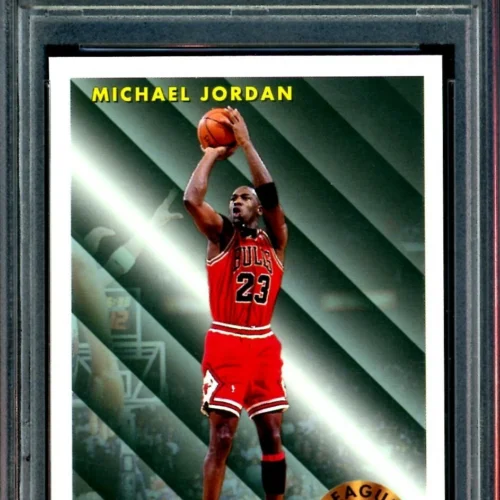
Michael & The Cricket
A Digital Narrative on The Game of Basketball
Wemby's Connections To Michael
SHARING THE SAME BASKETBALL TREE
Wemby Chases His Dreams & His Own Basketball Legacy … … …
In this website’s previous section: ‘Basketball & France’, we established a link between France and Victor Wembanya to the origin of the game. Detailing a path from Melvin Ridout, Martin Feinberg, Henry ‘The Gentlemen’ Fields, to Victor’s grandfather, Michael de Fautereau, and his playing basketball days in Paris at club PUC. Then ultimately we presented Victor Wembanyama’s mother, Elodie de Fautereau, and her playing and coaching basketball in France. Elodie was Victor’s oncourt ‘basketball mom’ and his first experiences on a basketball court were with his mother nearby.
This website section: ‘Michael & Wemby’ is not a presentation about how Michael Jordan and Victor Wembanyama are similar, nor about how they share a common path. Further, we have no knowledge that they have any personal relationship whatsoever. In so very many ways, manners and physical structure they are different. They have taken very different routes to the NBA.
This is a presentation of how the early roots of Michael Jordan’s college and youth development stemmed from the very same basketball tree that is now sprouting the branches of Victor Wembanyama’s professional career in San Antonio Texas.
They are two separate branches stemming from the same basketball tree trunk, with a shared lineage and multiple links covering a century of basketball coaches.
We will demonstrate this timeline connection throughout the following presentations:
Phog Allen was a direct disciple of James Naismith. He played for Naismith at the University of Kansas. Years later, in 1952, Coach Allen’s Kansas team won a NCAA Championship and Dean Smith played on that team, and played for four years at the University of Kansas.
Dean Smith coached Michael Jordan and Larry Brown at the University of North Carolina. Larry Brown coached for the San Antonio Spurs.
It was Coach Brown that hired Greg Popovich, the five time Spurs NBA championship winning coach, as an NBA assistant.
The ties are even deeper into this tree of basketball as you find out the roots of R.C. Buford, Doug Moe, Tony Parker and many more individuals connected to this basketball history who were in the past a part of, or, those who are now members of the San Antonio Spurs organization.
In understanding this history, you will see there is a deep connection between Michael Jordan and Victor Wembanyama.
We address the early basketball path of Michael Jordan and separate some of the myth from facts about his early career.
All of this is about the ‘real’ path, of a young Michael Jordan, which will actually demonstrate his tremendous perseverance, endurance and determination to be a six time NBA champion. The journey Michael Jordan took in order to win his first trophy was not a path of roses and instant greatness, as often portrayed. Only after years of struggle, and improvement did subsequently five NBA championship trophies come under his many accomplishments.
Michael’s actual path was not a journey of instant success, and what most people think and believe it was, when today they discuss his greatness, or if he is The Greatest of All Time (G.O.A.T.), ‘they’ flower Michael Jordan’s basketball career with myth.
We address what all this actually means now to a 22 year old Victor Wembanyama in pursuit of his own basketball legacy in 2026 with the San Antonio Spurs. … … and what he most likely must endure to accomplish these objectives.
Obviously the largest current difference is Michael Jordan has six (6), yes six, NBA Championship trophies. Victor has zero. (Only a handful of players have won more titles than Michael Jordan).
A difference in basketball size, youth development, manner by which the game is currently played, current money paid to players, all the motivations which surround a current player, and much more should all be discussed as significant differences in this section.
In any case, it is the same basketball ‘TREE’ that set Michael Jordan into his career path that is now in complete control of assisting Victor Wembanyama’s career outcome.
Michael Jordan was NOT the best player on that 1982 UNC team, Sam Perkins and James Worthy were the team stars. Michael was the third option on the famous play which resulted in ‘THE SHOT’.
The play was designed to get the ball into the hands of James Worthy in the post, or to Sam Perkins for one of his great left-handed baby hook shots across the middle in the lane.
Matt caught the pass twice on the elbow from the on the point guard Jimmy. He did not execute the play, not pivoting and turning to face the basket, or even looking into the post, he quickly tossed the ball immediately back to Jimmy. He had just bricked a free-throw and was extremely nervous. Matt was a very good free throw shooter. However the passes between Jimmy and Matt were moving the defense over to the right side of the court, away from Michael’s weak side.
Careful not to turn it over at the wrong time, they did not toss it into the post. The team kept composure but seemed afraid to make a play. Time was running out.
Patrick Ewing was the determining factor in Michael’s famous shot. He had blocked everything near the rim the entire game. (Watch the first minutes of the game). Coach Smith and everyone watching the game knew Ewing was ready to take away any inside shot. Coach Smith knew Michael would most likely be open on the opposite side wing, if the ball was passed into the post. This was a well known universally taught zone offensive rule. ‘Opposite Wing Zone ‘O’ Outlet’, is always option one, from the post. Standard procedure. Dean knew the ‘Golden Zone Offensive Rules’ since childhood. He wasn’t designing a play on the bench to break the rule and get the ball into the hands of a Freshman to take a final shot for an NCAA Championship, as myth would later portray. The myth was later created to elaborate heights in the Bulls Championship years.
Nevertheless, Coach Smith knew Michael had a good chance of ending up with the ball in his hands, and Coach Smith had absolute faith that his ‘cocky’ and often over confident Michael Jordan would make a 15 footer from the wing 70% of the time. As usual, Coach Smith had covered his bases long before the moment required.
With Ewing in the middle of the Georgetown zone defense the plan was set to go directly at him with Sam or James and challenge him. Take it at him and into his body. Perhaps draw a foul, if the shot misses. This was the huddle plan and instructions.
After the huddle timeout broke, while players returned to the floor, Dean tapped Michael on the butt and said,”‘if your open, make the shot’. Eddy Fogler was the only person to hear Coach Smith’s last instructions.
The myth of exaggerated greatness began to grow as the ball swished through the net.
The famous mythical MJ ‘shot’ did not determine the outcome of the game. Time remained on the clock after Jordan made ‘the shot’.
Georgetown still had a chance to win the game. Timeout was called to set up the Hoyas winning play, UNC went into a man-to-man defense. And then, in a complete unexplainable, unpredictable, and chaotic play of basketball, there was a game determining panic turn of events.
Hoyas guard, Fred Brown, turned without looking and passed the ball to James Worthy, who had made a big, terrible, stupid mistake in a gamble to over defend the passing lane in order to steal the ball. James was standing in the dead zone, 45 feet from the basket with time running out on the clock. Not the location you want your 6’10 All-American standing with Patrick Ewing under the basket during the final determining play of the game. The game was over as James Worthy dribbled out the clock in open court, getting fouled and ending the game with free throws. James, who was always very bright and clever as a basketball player, must have thought to himself, I never made a bigger basketball mistake that turned out to be such a great play.
Although Michael played his part and made ‘the shot’, he was trained to take that shot in the Dean Smith system. It wasn’t the mythical greatness of MJ that determined the 1982 championship.
Contrary to the later created myth, it wasn’t a last second shot, and it wasn’t a play designed to have the ‘G.O.A.T’ score a buzzer ending shot.
Michael mentioned the shot in his Hall of Fame speech. (See video below). It did provide a spark to Michael’s career and confidence … … it motivated him to get better. He always worked hard to improve, he worked even harder after ‘the shot’, and Michael’s faith in Dean’s system became unshakable.
However, Michael Jordan never returned two an NCAA Final Four. He became an All-American college player in the next two seasons before turning pro. But, at that time, he had not the ability to propel a team to a college championship. That took a special mixture to accomplish.
It was a standing joke around the organization at basketball camp the summer of 1982, that it was God’s predetermined destination that resulted in the outcome of that bizarre chaotic final minutes of the 1982 Championship game. A manifestation sent from the ‘Carilina Blue Sky’ straight from the Almighty himself right onto that basketball court.
But, as they say, “A Win Is A Win, Is A Win”! Take ’em All! Dean Smith and the University of North Caroline won their first Championship. 1982 wasn’t Coach Smith’s last NCAA Championship. Michael Jordan did not win another Championship until 1992!
Despite some early low points, Smith was supported by the University administration and EVENTUALLY, after decades of success, Smith became beloved by most of the fan base, even some of the same fan base who hung him in effigy eventually embraced Coach Smith.
Despite prestigious team achievements over a period of many years, the University of North Carolina fan base was never completely satisfied with Coach Smith until the NCAA Championship in 1982.
The insatiable self righteous Tarheel fan base tagged Coach Smith with the label: ‘He Can’t Win The Big One’!
Despite always being in the mix for an NCAA Championship, it just wasn’t enough for the Tarheel illumni and fans. The Charlie Scott ordeal also left a bad taste in a community which was slow to encrust segregation justice.
Coach Smith ran a ‘clean program’ and he was always able to maintain the University’s administration support, and there were plenty of supporting wealthy booster who understood how lucky the school was in having Smith run the program in the manner in which he did and compete with the best teams in college. Most top college programs were breaking lots of NCAA rules to maintain success, Dean wasn’t a cheater.
Smith’s first major successes came in the late 1960s, when his teams won consecutive regular-season and ACC tournament championships, and went to three straight Final Fours, going all the way to the national championship game in 1968. But ACC championships and Final Four appearances were not enough for the Carolina Blue fan base. They wanted a sky blue heaven and a championship banner in the arena. This relentless demand created a cloud over his head, which Coach Smith mostly ignored. He knew he was running a basketball program built for the benefit of everyone.
Out of all the great accomplishments of Michael Jordan, the greatest unspoken accomplishment was indeed his ‘SHOT’ and the 1982 U.N.C. basketball TEAM winning an NCAA Championship. This was Coach Smith’s first championship, which put an end to the reluctant constant criticism of Coach Dean Smith.
They Hung Dean Smith in effigy ….
January 7, 1965, UNC basketball coach Dean Smith was hung in effig by students outside Woollen Gym after a 107-85 loss to Wake Forest.
The protest occurred during his fourth season following a four-game losing streak. Player Billy Cunningham pulled down the dummy, while Smith, unfazed, later recalled the incident with humor.
Details regarding the 1965 incident:
Context: The team had lost four consecutive games, culminating in a 22-point defeat to Wake Forest.
The Scene: Around 100 students gathered at the gym when the team bus returned, with a dummy hanging from a tree, which Smith recognized by its “big nose”.
While Assistant Coach Ken Rosemond noted the incident, Smith instructed players to stay on the bus to avoid confrontation.
Billy Cunningham, a player on the team, went out and tore the effigy down.
It remains a notable moment in UNC history, representing the high-pressure, early-tenure struggles of the future Hall of Fame coach.
Smith, who was not actually fired, went on to lead the team to a win over Duke shortly after and never had another losing season in his career.
Despite this early low point, Smith was supported by the university administration and eventually became beloved by the same fan base, with the current arena bearing his name. Coach Smith opposed the naming of the arena.
The good news was that the uppity snobby, raised nose, self indulgent UNC fan base stopped trying to hang real live (black) people at about the same time as this event. The Carolina fan base hasn’t changed much over the years. They have just gotten richer and more protective of their own clicks.
Of course, the entire bushel of apples is seldom rotten, you can always find good apples. The Carolina fan base has many great people.
In 1983, I witnessed six college age guys call a black guy out of a campus house and rough him up because he was dating a white woman. Jimmy, a U.N.C. starting point guard, had to explain the situation to me, I was in disbelief as to the reason for the attack. We did stand up and move forward, giving a little presence warning. Things subsided shortly thereafter.
The true racism of the geographical area was demonstrated when Coach Smith had the first lack player on the team.
Charlie Scott was a two-time All-American and became the first great African-American player in ACC history.
Charlie was the first Black scholarship athlete to play for Dean Smith and the University of North Carolina (UNC) men’s basketball team, joining in 1967 and debuting on the varsity team in December of that year. He was a trailblazer in the Atlantic Coast Conference (ACC), leading the Tar Heels to two Final Four appearance.
Beyond recruiting Scott, Smith was a vocal proponent of civil rights in Chapel Hill, including efforts to desegregate local businesses. Local, as meaning, Chapel Hill!
The Spurs Legacy of Larry Brown:
The San Antonio Spurs rize to the top & His Assistant Coach Greg Popovich
Coach Larry Brown and the San Antonio Spurs
Larry Brown played for Coach Dean Smith at the University of North Carolina for three years in 1961-63. He played one year for Frank McGuire, Dean’s predecessor.
Larry was a lifetime coach who started his coaching career in the ABA, after a short ABA playing career. He had his best friend Doug Mo by his side for years as a college player at U.N.C. and then a professional player in the ABA. Doug Mo was Larry Brown’s assistant coach as he started his coaching career.
Doug Mo played for Dean Smith and coached the San Antonio Spurs for four years from 1976-80.
Larry Brown served as the San Antonio Spurs head coach from 1988 to 1992, compiling a 153-131 record over four seasons. He revitalized the franchise, leading them to back-to-back 50-win seasons and two division titles. Despite early success and nurturing David Robinson’s rookie season, Brown was fired in January 1992 following a 21-17 start to his fourth season.
Brown hired Greeg Popovich as his assistant coach in his first year. Popovich was a Spurs assistant for four years
Brown was a basketball program turnaround expert. If you wanted to get thing corrected on the basketball win – loss record, you hired Larry Brown. This was his reputation.
After a 21-61 debut season (1988-89), Brown turned the San Antonio Spurs team around to 56-26 (1989-90) and 55-27 (1990-91) records.
Playoff Performance: Led the Spurs to two consecutive division titles and playoff appearances in 1990 and 1991, although they never advanced past the second round.
Development of The Admiral:
Brown was fired in January 1992 amidst front-office friction, something Brown was also well known for as a coach. Brown often did not agree that office workers and owners knew more about coaching than he knew and would often would not relent his coaching methods to fit their demands. The San Antonio team ‘organization’ cited the need for a different direction despite his previous successes.
Legacy: Brown’s tenure was noted for stabilizing a struggling franchise and setting the stage for future success, as well as being part of the history that led to the eventual hiring of Gregg Popovich
Larry Started The Spurs Championship Journey
Greg Popovich With Larry Brown on The University of Kansas Basketball Team Bench
Pop’s Players Love Him – But The Fandom Relationship With Popovich Was Difficult
… … … it took Championships before embrassing Pop
Gregg Popovich’s Division III Succes Leads him To Dean Smith and Larry Brown’s Coaching Staff
During the 1985-86 season, Popovich’s seventh at the helm at Division III Palmona-Pitzer, those many years of hard and diligent work came together in a championship. The Palmona Sagehens won their league, the Southern California Intercollegiate Athletic Conference, outright for the first time in 68 years. That earned them a spot in the NCAA Tournament, where they were blown out 89-59 by Nebraska Wesleyan in a game that Popovich told reporters “didn’t think that this would happen in my worst nightmare.”
The Change …
After that run, the gears that led Popovich to basketball immortality were put into motion.
With the encouragement of Pomona athletic director Curt Tong, a former Division III coach himself, Popovich took a sabbatical. Rather than going abroad somewhere or taking time away from the game to avoid burnout, Popovich got a basketball education in which he was able to view the game through a lens that was previously unavailable to him.
While still a player in the early and mid-1970s, Popovich developed a relationship with legendary coach Larry Brown, who was twice a part of staffs that cut Popovich – first for the U.S. men’s national team for the 1972 Summer Olympics and then again in 1975 while Brown was the head coach of the Denver Nuggets, then of the ABA.
The two stayed in touch and following the 1985-86 season, Popovich went to learn under Coach Larry Brown.
Greg Popovich spent October and November of the 1986-87 season at North Carolina, Brown’s alma mater, under the supervision of Dean Smith before going through the rest of the season with Brown and Kansas, serving a key role on the Jayhawks’ bench and coaching a group of players, most notably Danny Manning, that would lead the program to the NCAA championship the following season.
Popovich’s sabbatical time with Dean Smith in North Carolina gave him direct coaching knowledge on the UNC program that developed Michael Jordean in his College career.
It was Popovich’s recent coaching and organizational activities of the San Antonio Spurs in 2022 and 2023 that made Victor Wembanyama the first round selection of the team.
This Popovich – Larry Brown -Dean Smith background is the round-robin physical connection and coaching tree that exist between Michael Jordan and Victor Wembanyama
Despite being respected by his players and the Spurs organization, Greg Popovich had to win two NBA titles before the general sentiment about his coaching would become positive. We will not even consider his relationship withe ‘The Press’ in this section. Except to say, ummm.
In Dec. 1996, then-San Antonio Spurs general manager Gregg Popovich made what would become one of the shrewdest moves in NBA history, firing coach Bob Hill after a dreadful 3-15 start to the season and inserting himself into the position.
You probably know what came next.
The Spurs became one of the longest-running and unlikeliest dynasties in NBA history, winning five championships over a 15-year stretch while experiencing significant roster churn and employing wildly different playing styles from their first title to their last. And at the head of it all was Popovich, the wise and wry basketball genius who cemented his place as one of the greatest coaches in NBA history.
Watch Video Below Titled: ‘Nobody, Snake, to the G.O.A.T’ of coaches.
While at a cabin in the summer of 1988, news broke that Brown, months after leading Kansas to the national title, had been named the Spurs’ head coach. One of his assistants, Lee Wimberly, suggested Popovich call him to see if he’d bring him along to San Antonio. Popovich had his doubts.
What followed, is now history, with Popovich spending four seasons with Brown in San Antonio, leaving to work as an assistant under Don Nelson for two years with the Golden State Warriors and returning to the Spurs to become their president of basketball operations and general manager in 1994. Then taking over the Head Coaching position, resulted in lots of NBA Championship Trophies.
In 1979 – after six years as an assistant coach at his alma mater, Air Force – a 30-year-old Popovich was named the head coach at Pomona-Pitzer, a hiring that was back page news in in a small handful of California newspapers.
After Popovich’s sabbatical his heart led him back to Pomona-Pitzer.
“I’ve been spoiled at North Carolina and Kansas,” he said to the Los Angeles Times in 1987. “When I get back to Pomona, I’m going to have to be careful not to be someone else other than me. I know I’ll be more efficient and I’ll have a computer bank of knowledge that should help my teaching techniques. I’d be a fool to say it isn’t a thrill to watch and help players of Division I caliber develop into great players. But I think at this point, the small-college level is the place to be if you want to coach and not have droves of people who want a piece of you. That’s more consistent with my personality.”
In his brief time away, though, circumstances had changed. Shortly after Popovich got back to Pomona-Pitzer, Voelkel died and school leadership that succeeded him wasn’t as invested in his program’s success. By the end of the 1987-88 season, he began thinking of life away from the community he loved.
While at a cabin in the summer of 1988, news broke that Brown, months after leading Kansas to the national title, had been named the Spurs’ head coach. One of his assistants, Lee Wimberly, suggested Popovich call him to see if he’d bring him along to San Antonio. Popovich had his doubts.
What followed, as they say, is history, with Popovich spending four seasons with Brown in San Antonio, leaving to work as an assistant under Don Nelson for two years with the Golden State Warriors and returning to the Spurs to become their president of basketball operations and general manager in 1994.
IF YOU CAN’T CRY ABOUT LOSSING … …
… … WINNING A CHAMPIONSHIP IS LESS LIKELY TO OCCUR
His Name Is Michael Jeffery Jordan
THE MYTH OF THE GOAT (G.O.A.T.):
… BEST BORN CHAMPION TO HAVE LIVED / OR / MOST NBA CHAMPIONSHIP TITLES
Michael Jordan and Bill Russel are the two BEST “WINNERS” to ever play the game of basketball. This is a personal opinion, not a fact.
G.O.A.T. WINNERS.
Even Michael Jordan has said, ‘calling him the greatest of all time (G.O.A.T.), is not possible. One can not accurately compare players of different eras.
Here Is a List of NBA players with 6 or more Titles:
Bill Russell (11): 1957, 1959–1966, 1968–1969
Sam Jones (10): 1959–1966, 1968–1969
K.C. Jones (8): 1959–1966
Satch Sanders (8): 1961–1966, 1968–1969
John Havlicek (8): 1963–1966, 1968–1969, 1974, 1976
Are the above players the Greatest of All Time (G.O.A.T.) ?
It took Michael Jordan many years to learn how to combine his great individual skills with a team championship formula. Michael Jordan was 28 years old when he won his first NBA title. He did not win an NBA Championship title until his seventh NBA season.
It was the coaching of Phil Jacson that altered how Michael approached playing the game to win championships.
The first thing Michael Jordan states in his Hall of Fame speech is: ” I didn’t do this alone. Scotty Pippen was there with me for all six titles”.
In my opinion, for a period of about two years, in the after retirement championship run, Scotty Pippen was better than Michael Jordan, as an overall player. Scotty Pipen was a great NBA basketball player.
THE MYTH OF BEING CUT FROM HIS HIGH SCHOOL TEAM.
Below is a video of the coach, Fred Lynch, who is associated with this myth that “CUT”” Michael Jordan in High School..
Hear it from the man himself … He calls it: “Hollywood Fiction”
The Michael Jeffery Jordan Path Was Not Easy
I met Michael when we were young basketball players attending the Dean Smith Basketball School at the University of North Carolina in the 1979 … … . Dean Smith appropriately always called it the Bill Guthridge Basketball School, an inside acknowledgement about who really ran the show. It was also never called a basketball camp by coach, it was called a basketball ‘SCHOOL’! As part of the ‘school‘ show for ten years, I became good friends with Coach Bill Guthridge. Beloved and missed he remains to me.
I think, it was the 79-80 basketball year. In any case, Michael was a rising high school star, and I was just an aspiring college player … … , we both attended the basketball camp – I mean school .
I briefly met Michael’s Father and his sister in that summer of that year as well, I think. Michael’s Dad had watched me play on a Friday morning of camp. While watching Michael in the same gym. There was always multiple games going on simultaneously. SIMULTANEOUSLY the Dean Smith Way … … . Mr. James Jordan, later spoke to me back at the dorms. After watching me for only a few minutes, he liked my game, and he told me so. The point is, perhaps, the sons eyes often come from the father’s eyes. This was the only time Coach Smith put Michael and I in the gym together during the entire week of camp. Dean always had his reasons … … …
For two summers, Michael and I stayed in the same large dorm on the University of North Carolina campus at the Bill Guthridge Basketball School, with 500 other basketball crazy camper kids. We moved in the same paths to and from the cafeteria, down to the pool, and into the basement for ping-pong and piano playing. I had been attending the Dean Smith – Bill Guthridge Basketball School since the age of 14. I worked the camp my first three years of college and returned once or twice in later years, then the 90’s for a final hooray. You just could beat the Dean Smith pay structure of weekly and yearly bonus increases. It was like getting paid to go on vacation. In any case, now, all of those Carolina Basketball School days blend together as a marvelous episode of my basketball life.
I remember that I first encountered Michel Jeffery Jordan on a Sunday in Carmichael Auditorium, playing pick up basketball games. The same day Roy Williams claims to have watched a 17 year old basketball player and immediately proclaimed, he knew at that moment,”he was watching the greatest basketball player of all time. Roy doesn’t lie, never! But Roy tells a lot of fish catching stories on the golf course, and he always tells the same story, but after some time, Coach Roy enlarges the size of the catch, and the size of the fish. But the stories are always factual in basic actuality.
I was there too that day with Coach Roy. I remember proclaiming spending time in the open play gym with the most entertaining, humorous, mischievous coaches of all time, Roy Williams. Yes he was quite the entertainer. It was always enjoyable being around Roy, especially on camp Sundays when the duties were light and time was free. This was, of course, long before Roy became grand and famous. He then became very very serious as a successful college basketball coach.
I have different details in my fish story of that day. I played with Michael on the court that day, and in the year later. However, I also played with and knew a few guys who were hanging around campus who were much better at playing hoops than Michael, at that time.
I had spent those muggy North Carolina afternoons playing pick-up games with Walter Davis, James Worthy, Sam Perkins, Al Wood, and Phil Ford, just to name a few guys who spent those days on the court in Chapel Hill. All of these guys were older, and better than Michael Jordan at that time. Walter was a NBA MVP!
Coach Smith always had a game plan in putting his teams together. The coach was a savant of basketball and a genius with a photographic memory. He would memorize five hundred camper names in a week, and call them by name when handing out ‘Basketball School’ completion certificates on Fridays. And, Coach Smith, required you to learn the name of every kid in your assigned coaching gym before Friday at camps end. He had a plan for everything long before most anyone ever knew a plan was needed. He was not forgetful.
Coach Smith called ‘MJ” Michael, not Mike, as Coach most often used your formal birth name when addressing you. Everybody followed coaches lead, we called him Michael. I always called him Michael.
We did indeed marvel at the ‘potential’ ability of young Michael those summer days. We also knew, Michael was going to test Coach’s unwritten rule about not starting freshman basketball players. Sam and James had pushed, around campus, betting odds were taken on whether MJ was going to break the coach’s freshman rules. Michael was going to take over Al’s small forward spot for the upcoming season, this team would have four returning starters from an NCAA finals team that lost to Indiana. Most of us did agree that Michael was going to be the first to break those rules. But UNC was at the top of the ladder in those days, it wasn’t a small ball time. Patients were always required in the Tarheel program.
That first encounter was all occurring the year before Michael was driving around Chapel Hill in his black Monte Carlo preparing for his freshman season at UNC . In that summer, the 1981-82 pre-season, we both were hanging around for three weeks that summer. We were both now playing college basketball on opposite sides of the country. Mike hadn’t hit the famous Georgetown Jumper’, yet. On any given night, you could watch Mike and Buzz cruising the streets of Chapel Hill without anyone in town knowing who he was or why he was listening to such music. It was the last time Micheal Jordan every did anything without being recognized.
During that summer, Michael and I spoke a few times, and we had friendly encounters, but we were not friends, just friendly … … … .. well, we were not made of the same cloth. … … … … after much thought, we were made from the same cloth, just different tables.
Chapter 3 UNC Ideas : … … umm … attack or defend … … losing in SLC to UNC , my NCAA dream crashed by Dean and Bill, … … … the deep end, and Coach Guthridge’s European phone call to me while swimming in the deep end of the swamp…. … … .somebody’s gotta play with the alligators … … Bill knew all about my alligator adventures .. … the UNC Irish eyes were crying on the Notre Dame basketball court , that day … a tear in Coach Dean’s eye? … … where ya going now with $3k from camp salary, … … … forbidden Basketball Card Trading during UNC basketball School … . How about nothing?
Michael Jeffery Jordan During Our Youth.
The Day Michael Jeffery Jordan Changed Basketball In France
THE CROWNING MOMENT IN FRANCE’S BASKETBALL HISTORY
Surprisingly, both the Italian and Spanish champions, traditional European powerhouses Benetton and FC Barcelona, lost their preliminary stage games and were forced to battle for 5th place. The Chicago Bulls instead led by Michael Jordan, and without Scottie Pippen managed to win their semifinal game against the hosts PSG Racing coached by Božidar Maljković, by 89–82. In the final game Chicago Bulls faced European champions Olympiacos Piraeus. The Greek side coached by legendary Serbian coach Dušan Ivković proved stronger than PSG Racing, but the Bulls pulled the best of their abilities and cruised to an easy 104–78 win.[3]
The tournament was noted for having more than 1,000 journalists from 54 countries covering it, more than the previous NBA finals.[4] It was mentioned in an early episode of the documentary miniseries, The Last Dance.
DECEMBER 11 ,2025 Thursday
By: Christopher Lee (Pin Name)
a.k.a.: Mr. Fat Hat / Picasso / Kristoph Lee
Qualification History: It was Chip that initiated it all and he connected me to the Bulls.
Few if any know about Chip. Almost nobody knows anything about me and my participation. In Coach Phil Jackson’s long NBA coaching career of championship basketball at Chicago and Los Angeles, there is a man who can be observed sitting next to coach Phil Jackson in every game. That’s Chip Shaefer.
Chip was a friend, he had supervised me daily through rehabilitation and back from a double Achilles tear injury. We spent many days together during my Sophomore year in college. When most everyone had written me off to the wind, and said my playing career was finished, it was Chip, who was at that time, a college student trainer at Utah, leading me step-by-step daily, through many months of pain and disappointment and back to the court. After a long year, I was starting on a basketball team that won a few NCAA tournament games my Junior year. That wasn’t likely without Chip. I continued playing internationally until the age of thirty.
Years later, Chip Shaefer could be found sitting next to Phil on the bench in the Bulls organization, he was much more than a trainer to the Chicago Bulls dynasty.
Again, Chip and I crossed paths many years after those college days. After I had been forced to stop playing basketball in Europe due to injury and I was unsuccessfully trying my hand at coaching, bouncing around back and forth from the States, Brazil, and to Europe. I found myself grounded back home in Indiana. I was stationary in that location out of unexpected serious health concern for my daughter – which is in itself a long story. Chip had heard some of the real story from Gary Vitti. and I let him know I was doing some writing for FIBA magazine and arranged to met Chip in Indianapolis to find out about extending it to the hottest team on earth, the Chicago bullls..
I was digging into the Flying Dutchman of the Indiana Pacers, Rick Smits, preparing an article for FIBA — which, by the way, is how, when and where I started selling basketball cards, through FIBA basketball magazine, taking out paid advertisements and selling cards to kids in Europe. So Chip and I arranged to meet on Christmas at the hotel in Indy. Satisfying the forever curious Chip – always the polymath – I tossed him a file on my notes during our encounter. Not thinking much about it.
During a secluded depressive filled Christmas lunch in a room with a non-conversational Michael and most of the tired weary Bulls team, I quickly realized the entire Bulls team was simply unapproachable. The Beatles phenomenon had taken over the team. I wasn’t gonna get much in that closed circle. There was no source to procure any articles with this group.
A few hours later, Chip came walking down the empty streets of Indianapolis, asking me if I had any more info on The Dunkin’ Dutchman.
Chip said he shoved my writing onto Coach Phil’s desk at the hotel and he wanted to read more. I guessed, to my surprise, Phil liked what he was reading and he asked for more reports. Chip escorted me to the only open copy location in downtown and I zipped off a few more pages of my prep notes.. We chatted a little after the Pacers game and suggested we stay in touch.
A few days later, after a telephone-fax call, we didn’t have text, yet, back in those years, Chip arranged for me to attend practices and watch a Bulls basketball game. I wrote about my observations. Then, I forwarded my writing to Chip. After that, he continued asking me to come up to Chicago every few weeks. I would drive up to Chicago and watch morning practice and then attend the games at night. He arranged open access to practice and Chicago games. Phil and I had a few short verbal discussions after practice or the games. But I barely spoke to the player of the team. I remember these talks with Phil to be quite esoteric, Zen like verbal exchanges, ten minute deep thought mind warping exchanges … … usually not about basketball. Sometimes in the back halls of the Chicago arena post game, often sharing a cigarette break. I wasn’t paid much, I had enough money for gas money and a hotel. But I knew it was an experience of a lifetime watching this team. It was priceless.
It was fascinating to watch Michael – or MJ, as he had by then known to be called by most all, some friends addressed him as Mike, I had always called him Michael – work out with the Chicago Bulls in the morning of game days, then watch the games at night. I was around the team enough to hear what was being spoken by the players, but I tried to stay out of the fray and not interfere, nor participate, as I was interested in the observation of the basketball process. Chip was always happy to speak and answer any questions I might have had during my visits.
During that period, I was, however, able to get two autographed Michael Jordan Fleer 1986 Rookie cards signature authenticated by Michael Jordan, himself. I did not have Michael Jordan sign the cards. But I wanted to know if they were authentic after paying good money to a mutual friend who claimed he got them signed during a card game, Prior to this request, I had heard through the grape vine … … . Well, … … I heard the rumors from those games and Michael confirmed he had signed the two cards, stating it was most likely during one of the many card games.
This is how and when my 1986 Fleer Michael Jordan Rookie cards became signed and authenticated. However, there is more intrigue within the story.
On one of my trips, I brought the cards with me, knowing if the team won, Chip would get me into the locker-room post game. I came prepared. As a spoof, I ask Michael to autograph a tiny pair of Nike baby shoes. He laughed, and scribbled something on the small side of the shoe. Then, made his usual facetious response. Then, I showed him the cards and he confirmed those were his signatures. If I recall correctly, that was the 1991-92 season. The start of the third championship year. I gave the baby shoes to a high school friend with a four year old daughter dealing with serious health concerns. She had an entire family of absolute crazy Chicago Bulls and Chicago Bears fanatical nuts. They didn’t believe the shoes were an authentic autograph, but the young girl didn’t care. She was so happy to have a pair of Nike baby shoes signed by Michael Jordan … … … although the shoes were too tiny for her feet, she walked around carrying them for days. She was the queen of the family.
I never ask Michael for a single thing in my endeavors hanging in the old Chicago stadium during games and practice facilities up north. I even brought the team a few gifts. One such renderings were hand made Amish crafted wood memorabilia displays of unique photos and cards. Michael wasn’t interested, but other teammates liked the gifts. I wasn’t interested in eating any of the lucrative ‘pie’ from the global financial bonanza surrounding the entire Chicago Bulls situation. Basketball was my thing, and my sole needed that during this period of my life.
Everybody wanted everything from Michael, and I saw the toil up close and personal. Micheal really did not ever seem to have a minute to spare, I wasn’t there to take on him. I visited the Jordan restaurant downtown between practices and games, and sometimes I would run over to Michael’s newly purchased sky scraper building and drop off recorded cassette tapes of my thoughts and observations. I think Juanita listen to some of the info with strange suspicions. I would visit the basketball courts in the ghetto next to the stadium. I just did my thing and watched, then, I wrote reports on my thoughts from observation. Like a Professor, Coach Phil Jackson read the reports, that was enough for me. Well worth the five minutes of verbal time he often provided me after games.
During my last visit to the Bulls, the game had changed venues to the new stadium. An era had ended with the destruction of the old stadium. That is the occasion I bought four old bricks of the torn down stadium from a desperate street vendor. Much later, I tried to get UNC basketball office to forward one of the bricks to the Jordan family. I suggested that someone in the Jordan family would place the brick in the fresh cement of a newly built walkway at one of the many mansions. Everybody seemed oblivious to ‘Real Sports Memorabilia’ and responded as if I was crazy. I don’t know what happen to the brick I left at the UNC basketball office years after the Jordan Bulls team disseminated. I put one of the bricks in my walkway cement at Lake Wolcott. Foresight isn’t always seen by all with eyes.
Michael did, on one occasion, ask me what I wanted from him. I had absolutely no response.
This happened after I snuck a few of the neighborhood young park rats into the stadium hours before the game. As I knew, he would be alone on the court hours before game time, unprepared to fight them off. I never found a basketball stadium or a court I couldn’t find entrance into. The kids went crazy watching MJ take jumpers in an empty gym hours before the game. Those were some happy kids, some with missing teeth and one without shoes. After a time, he did enjoy speaking with the kids before security stepped in to clear the ecstatic kids out the door. Michael then asked me to follow him down to the locker room tunnel. We were alone in the empty stadium, as it was hours before game time. I got him good with the kids, so I followed with a smile. We stood relaxed face-to-face with one foot propped up behind us on the wall for support. We mentioned the latest UNC rumors and then Michael ask me, “What do you want”? I had no response. I just shook my shoulders.
He had nothing to give me that I wanted at that given time. My needs were in my house with my family. Fame and fortune would not change those requirements, or suffice my fill my needs. He did not have anything that I could use at that time. I had no request, nothing except what I was already experiencing, watching him practice and play basketball games up close and personal. My soul needed that experience.
So, my trips took a hiatus when MJ went to hit baseballs. I did take one trip to watch Scotty take over the basketball world as the best player on the globe, and I made a last HAJJ after the MJ return from “retirement’ celebration.
THE PRESSURE OF WINNING
Michael Jordan’s persona underwent a significant transformation as he transitioned from a relatively anonymous college student at the University of North Carolina to a global icon with the Chicago Bulls. This evolution is marked by changes in his public name, his accessibility, and the mounting pressure of his superstardom.
The “Michael” Era at UNC
During his time at North Carolina, Jordan was primarily known as “Michael,” largely
because Coach Dean Smith insisted on using players’ formal birth names when addressing them.
At this stage, he was seen as a player with immense “potential,” though teammates like James Worthy and Sam Perkins were considered better than him at the time. A defining characteristic of his college persona was his relative anonymity. In the summer of 1981, Jordan could still cruise the streets of Chapel Hill in his black Monte Carlo without being recognized. This period represented the last time he could move freely in public without the interference of fame
The Transition to “MJ” and Global Icon
By the time he was established with the Chicago Bulls, his persona had shifted into the world-famous “MJ” or “Air Jordan” there were many key aspects of this evolution. Jordan became secluded, often preferring to stay hidden in a hotel room rather than facing a mobbing adoring public.
Unapproachability: By the 1990s, the “Beatles phenomenon” had taken over the Bulls, making Jordan and the team almost entirely unapproachable to outsiders. He was often described as “non-conversational,” “tired,” and “weary” due to the constant demands of his fame.
• The Burden of Stardom: Unlike his college days, “everybody wanted everything from Michael” during his professional career. This constant pressure created a persona that was often on the defensive; Jordan’s immediate question was often, “What do you want?”
Guarded Nature: He lived within a “closed circle” where he rarely had a minute to spare.
This level of fame eventually led to “physical and mental exhaustion,” contributing to his first retirement in 1993.
THE CONCLUSION:
What will be the result of the Victor Wembanyama legacy. Sorry, this we can not disclose. You have to buy the book. No, just joking, seriously. Nobody knows.
However, we will leave you with this thought. The Michael Jordan Legacy demonstrates that you cannot achieve an NBA Championship by yourself, no matter how good you are as an individual player. He was good.
And, we believe this applies to the same fact of how tall you are, and how skilled of a tall player you might be. Victor Wembanyama is tall and skilled. He may be the tallest most skilled player to have ever played the game. However, he can’t win an NBA Championship by himself. It’s never been accomplished by a single player.
It takes a team to win an NBA Championship. Through the decades, we have witnessed dozens of great individuals who were of tremendous basketball skill that did not have a single championship trophy.
Winning NBA Championships is like a rope made up of many individual inter-twinded strands of ropes, all twisted together and making a single stronger, thicker, and more durable rope that doesn’t break under the pressure.
This is the secret magic of the game of basketball that only the masters of the game have created.
One must not be blinded by myths and endure much to win. It took Michael Jordan many years, until the age of 28, after spending a decade of being taught by masters of the game, to win an NBA title. Victor Wembanyama is 22 years of age, at this time.
Our advice to Victor Wembanyama is: “DO NOT BELIEVE THE MYTH(S)”!
BREAKING NEWS: THE THREE FAMOUS BASKETBALL COMMENTATORS: Curly – Larry & MOE, along with Ernie will NOW be hanging with the crickets.
Straight from the studios of E.S.P (extra super perceptions), the dynamic group will provide their deep introspective on the active San Antonio Spurs basketball games, while adding commentary based on a voluminous education.
THE CRICKETS ARE ECSTATIC TO HAVE THESE PROFESSIONAL ACTORS AS NEW MEMBERS OF THE CRICKET GROUP.
The Crickets are in Paris having a good time listening to ‘FRENCH JAZZ’ music &… “avoir une conversation” … … JOIN THEM!
‘Michael & The Cricket
This digital presentation is an accumulation of stories about basketball players, coaches, teams, games, practices, international travel, grand pianos in hotel lobbies, and living life while playing the game for an education and for money. Narrated by a former professional basketball player.
This digital narrative explores the spiritual and historical genesis of basketball, framing the game’s 1891 invention by Dr. James Naismith as a providential event that ignited a global “it factor” among young athletes. The text blends early sports history reviewing those who played pivotal roles in transforming basketball from a newly invented indoor activity into a professionalized, global sport with structured coaching and evolving rules.
Ultimately, the website serves as an educational and philosophical foundation dedicated to basketball phenoms, arguing that the sport’s enduring appeal lies in a unique, magnetic character trait found in those who compete at the highest levels.